Overt Acts and Predicate Acts, Explained
After months of anticipation, Donald Trump and 18 people who thought it was a good idea to trust Donald Trump have been indicted by a grand jury in Fulton County, Georgia. Fulton County District Attorney Fani Willis — notoriously fearless, particularly of cameras — is prosecuting them on a 41-count trek through Georgia criminal law. But one law leads every story and falls from every lip — RICO. Yes, Ms. Willis has charged the defendants with conspiracy to violate Georgia's Racketeer Influenced and Corrupt Organizations law, commonly known as RICO, modeled on the infamous federal statute.
Georgia RICO’s statute contains a core prohibition:
It shall be unlawful for any person employed by or associated with any enterprise to conduct or participate in, directly or indirectly, such enterprise through a pattern of racketeering activity.
The indictment charges the defendants with violation of the conspiracy component of the statute:
It shall be unlawful for any person to conspire or endeavor to violate any of the provisions of subsection (a) or (b) of this Code section. A person violates this subsection when:
He or she together with one or more persons conspires to violate any of the provisions of subsection (a) or (b) of this Code section and any one or more of such persons commits any overt act to effect the object of the conspiracy;
After the preliminary charging language, the indictment launches into a 52-page, 161-act list of acts committed by the defendants:
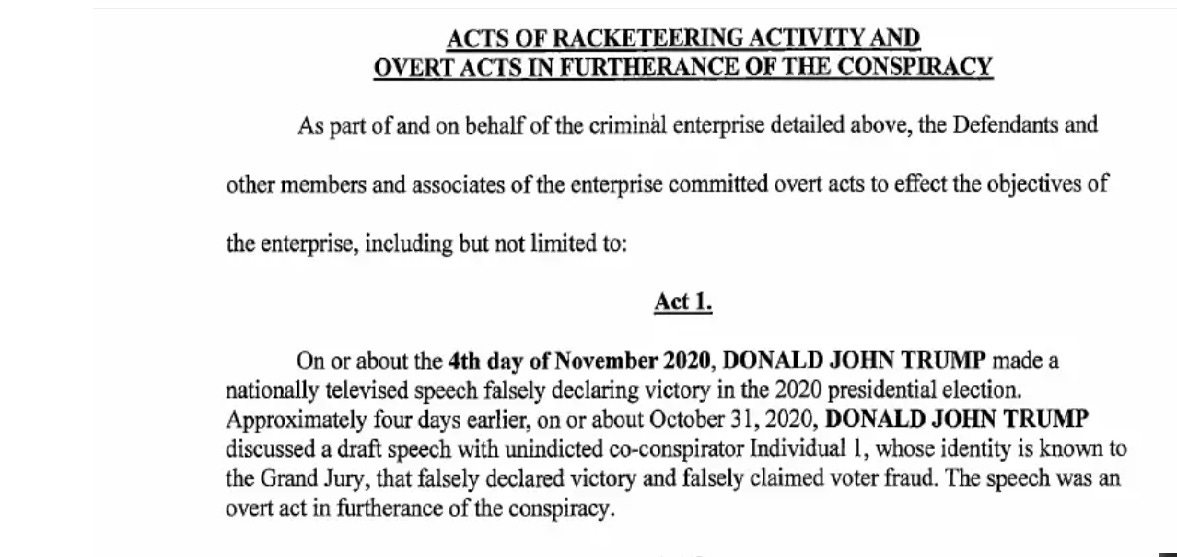
This has led to much comment and confusion. Some of it is contrived and in bad faith, some of it reflects honest concern or confusion. The thrust of it is this: wait, some of the acts on that list aren’t crimes, are they? And aren’t some of them speech protected by the First Amendment? Here’s a not-good-faith example:
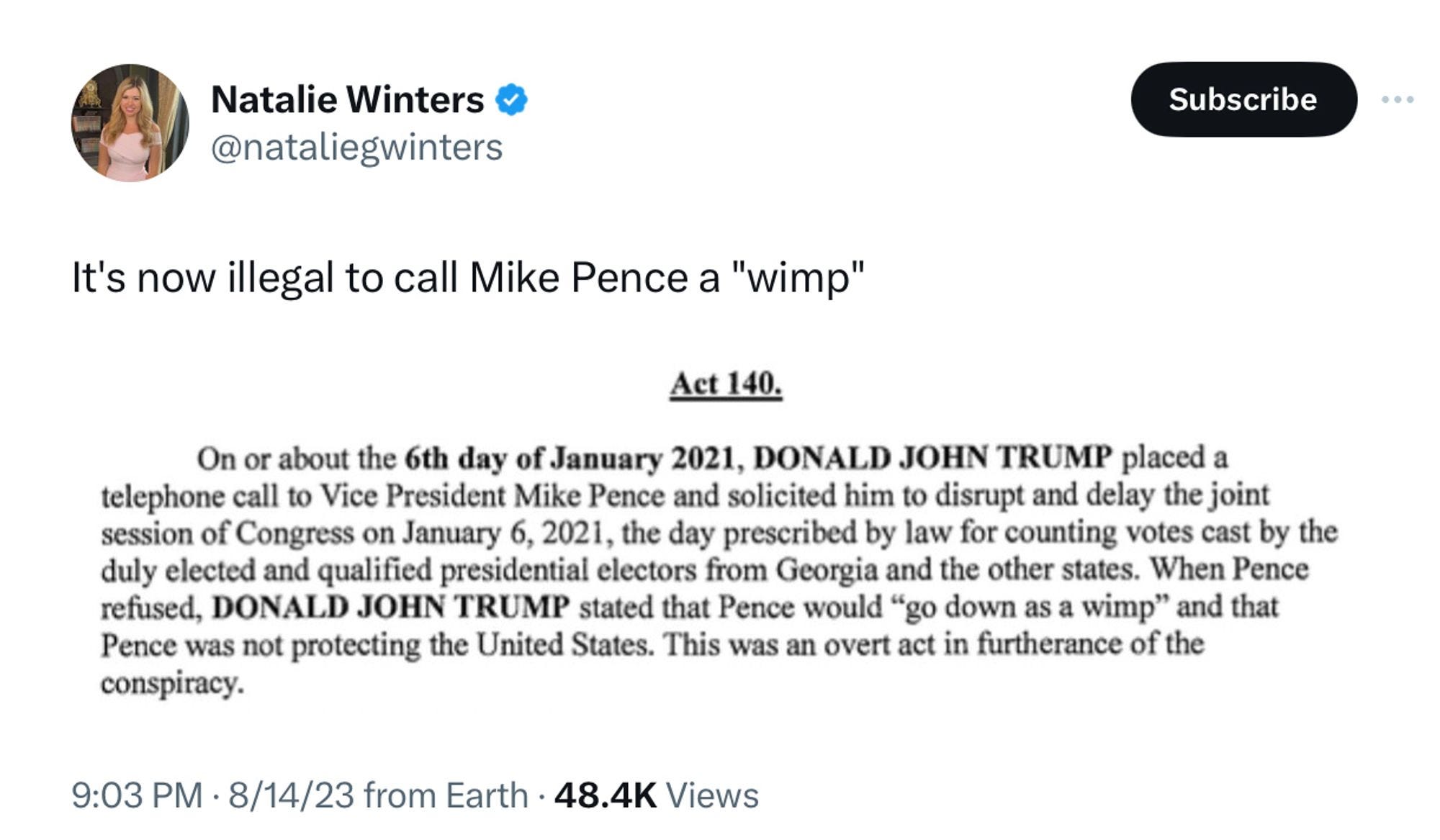
Political theater and propaganda aside, there are some reasonable questions here: how can a tweet (like act 101) or statements at a press conference (Act 3) be a crime?
The answer is that they’re not crimes — or, at least, that’s not what the indictment claims. They’re overt acts.
Overt Acts: Originally A Bulwark Against Tyranny, Now Mostly For Exposition
So what is an overt act?
A criminal conspiracy is an agreement by two or more people to do an illegal thing. An overt act is some step, however small, intended to promote that illegal goal. Many
...This excerpt is provided for preview purposes. Full article content is available on the original publication.