How Jeff Bezos and Amazon became instruments of authoritarianism
Last Friday, Amazon’s anodyne corporate campus in Santa Monica, California was overrun with protestors. Hundreds gathered on the corner of Olympic and 26th, some waving signs with messages like ‘AMAZON POWERS ICE’. Cheers from the crowd erupted at one point as a contingent of high schoolers showed up and marched down the sidewalk en masse. The demonstration was part of the ‘ICE Out’ day of action arranged in solidarity with Minneapolis; the site had been chosen, organizers said, because of the tech giant’s role in ICE’s operations. Amazon signed a $25 million contract with ICE last year to operate its cloud services and databases.
“Our goal today was to draw the connection between ICE’s cruelty and the digital infrastructure that Amazon provides to give them the ability to target and capture migrants,” Carter Moon, one of the event’s organizers, told me.
“Big tech has not caught enough heat for this,” said Olga Lexell, a screenwriter and former tech worker. “It’s people like Elon Musk, Jeff Bezos, Sam Altman, Mark Zuckerberg—the tech CEOs who are using their tools to facilitate these deportations. They can actually do more now than anyone in our government probably can.”
Lexell said that when she was on the metro on way to the protest with other demonstrators, she overheard a pair of Amazon workers worriedly discussing the backlash. They had evidently not been aware Amazon was a partner with ICE at all. This was part of the reason Lexell says she joined the protest, to try to get Amazon employees like them to learn about their company’s associations with ICE and the Trump administration—and, ideally, to walk out.
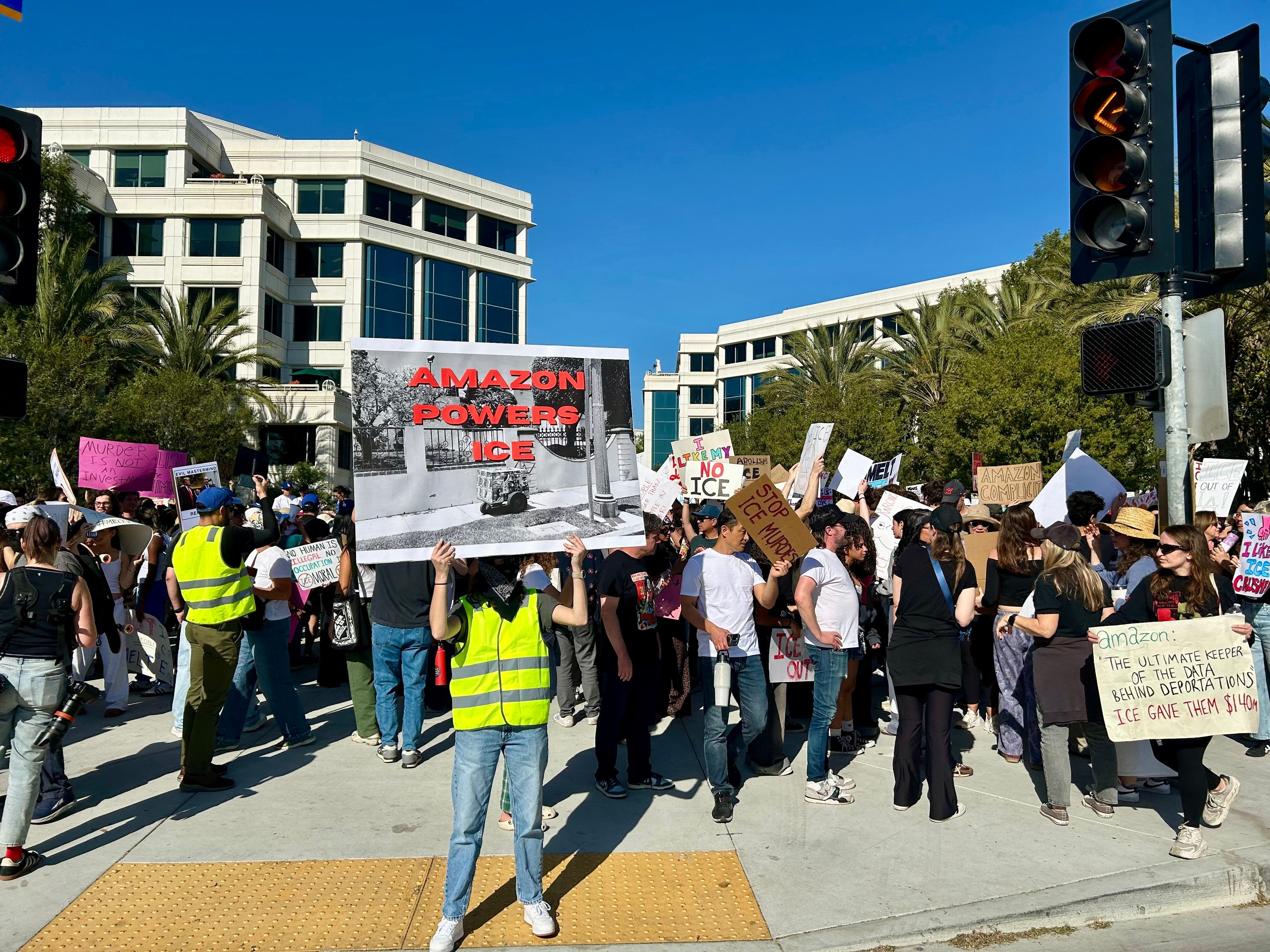
So far, none had, as far as anyone could tell. It can be difficult to absorb, perhaps, both for consumers and employees, the full extent to which Amazon and its leadership have become instrumental to effectuating the state’s authoritarian projects. Perhaps events of the following days made it a little bit clearer.
The week after the ICE Out Amazon protest, Jeff Bezos, who in 2013 bought the Washington Post, laid off 30% of its staff. He eliminated the newspaper’s books and sports sections, gutted critical tech, climate, and international coverage, fired decorated war correspondents while they were still in a combat zone in Ukraine, and “reset” the paper to focus on national security and American politics, according to NPR. IE, subject matter areas that
...This excerpt is provided for preview purposes. Full article content is available on the original publication.