Two Steppes forward, one step back: parsing our Indo-European past
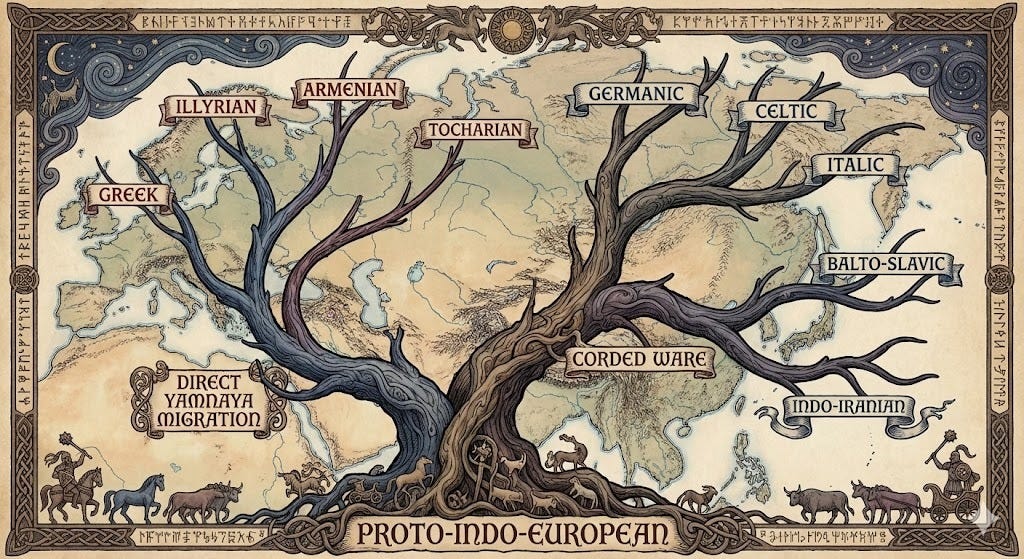
In 1985, I flipped open a dictionary in my elementary school library, and became completely distracted by a map in the front matter illustrating the distribution of modern Indo-European languages. I was nine years old and this was the first time I saw the term “Indo-European.” Both the term and the map perplexed me. Included were the two languages I knew: English and Bengali, the northwesternmost and easternmost of the Indo-European languages, respectively. What could possibly connect them across that vast geographical span? I certainly had never noted any similarities…until I paused to take a closer look. That weekend, library card in hand, I trudged off to the public library, thumbed through the card catalog until I found the entry for “Indo-European,” inspected it and followed it to the linguistics section. I was already a habitué of the adults’ section, but so far, had solely explored the science stacks. That day, I pulled down a tome whose details I scarcely recall, unfamiliar matters of philology mixed with prehistoric speculation. What I do remember to this day is that inside that doorstopper was a wealth of maps, language-family trees and long lists of word-comparisons laid out in tables (what I know now to be swadesh lists). Seeing the similarities in the core words across Indo-European languages explicitly outlined, the scales fell from my eyes. Below are some typical cognates in English, Bengali and Proto-Indo-European (PIE):
Mother, mā and *méh₂tēr
Father, pitā and *ph₂tḗr
Name, nām and *h₁nómn̥
New, notun and *néwos
Nose, nāk and *néh₂s
Door, dorja and *dʰwer-
Mind, mon and *men-
Mouse, mushik and *muh₂s
Serpent, sap and *serp-
Deity, debôtā and deywós
Once you have seen, you cannot unsee.
More than 40% of humans alive today speak an Indo-European language as their mother tongue, some 3.4 billion people (and well north of 50% if you count second-language learners). The top ten are:
Spanish ~484 million
English ~390 million
Hindi ~345 million
Portuguese ~250 million
Bengali ~242 million
Russian ~145 million
Punjabi ~120 million
Marathi ~83 million
Urdu ~78 million
German ~76 million
It is notable that, for raw numbers, being
...This excerpt is provided for preview purposes. Full article content is available on the original publication.