Record Low Crime Rates Are Real, Not Just Reporting Bias Or Improved Medical Care
Last year, the US may have recorded the lowest murder rate in its 250 year history. Other crimes have poorer historical data, but are at least at ~50 year lows.
This post will do two things:
Establish that our best data show crime rates are historically low
Argue that this is a real effect, not just reporting bias (people report fewer crimes to police) or an artifact of better medical care (victims are more likely to survive, so murders get downgraded to assaults)
Here’s US murder rate, 1776 - present:
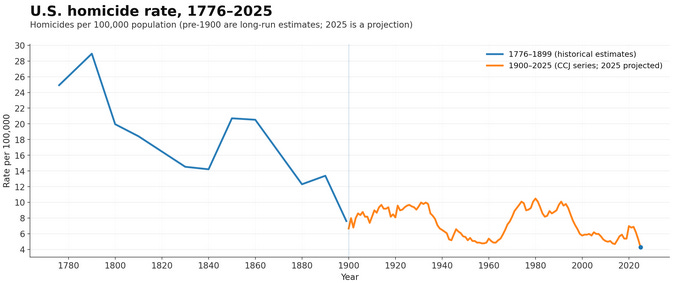
The pre-1900 estimates come from Tcherni-Buzzeo (2018); their ultimate source seems to be work by sociologist Claude Fisher which I can’t access. The 1900 - present data come from historian Randolph Roth’s American Homicide and the FBI’s Uniform Crime Reporting, both by way of the Council on Criminal Justice.
There’s less historical data for property crimes, and the nature of property has changed throughout history in ways that make numbers incommensurable (is it bad if we have a higher grand theft auto rate today than in 1840?) I was only able to get good data since 1960, but here it is:
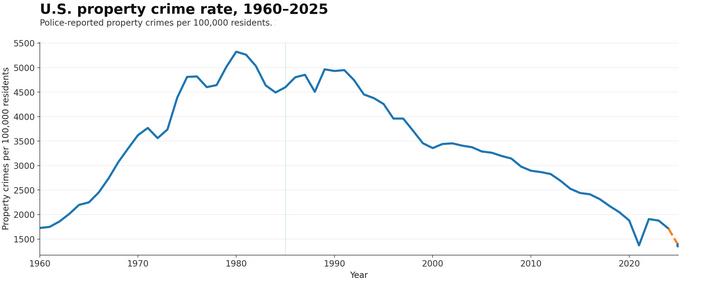
The 1960-2023 data come from FBI Data Explorer via Vital City; the 2024 and 2025 data come directly from the FBI website, with 2025 annualized via incomplete Jan - Oct data. This one may or may not be an all-time low, but it’s pretty good.
These data are counterintuitive. Are they wrong?
Could This Be An Artifact Of Reporting Bias?
People could be so inured to crime that they stop reporting it to the police. Or the police could be so overwhelmed that they stop accepting the reports. Since most crime statistics are based on police reports, this would look like crime going down. There’s some evidence of this happening in specific situations, like shoplifting in San Francisco. Could it be the whole effect?
No, for three reasons.
The National Crime Victimization Survey is a government-run survey of a 240,000 person nationally representative sample. They find random people and ask whether they were the victims of crimes in the past year. This obviously doesn’t work for murder, but they keep statistics on rape, assault, larceny, and burglary. Their numbers mostly mirror those reported by police and used in the usual statistics about crime rates. But here there’s no extra step of needing to trust the
...This excerpt is provided for preview purposes. Full article content is available on the original publication.