Kushner’s Moscow mission wasn’t just corrupt. It was unconstitutional.
Deep Dives
Explore related topics with these Wikipedia articles, rewritten for enjoyable reading:
-
Foreign Emoluments Clause
17 min read
The article's central legal argument rests on this constitutional provision. Understanding its 18th-century origins, the Founders' concerns about foreign corruption, and how courts have interpreted it provides essential context for evaluating whether Kushner's foreign investments constitute violations.
-
Public Investment Fund
2 min read
The Saudi sovereign wealth fund is the source of Kushner's $2 billion investment and the entity whose agricultural subsidiaries benefit from the peace plan's Black Sea provisions. Understanding PIF's scale, governance structure under Mohammed bin Salman, and global investment strategy illuminates the potential conflicts of interest.
-
Logan Act
13 min read
The article mentions this 1799 law prohibiting private citizens from conducting foreign diplomacy. Its fascinating history—including why no one has ever been successfully prosecuted under it—provides context for the legal distinction between authorized and unauthorized foreign negotiations.
Jared Kushner, President Trump’s son-in-law, has been traveling the world to participate in high-stakes foreign policy negotiations on behalf of the president. On Tuesday, Kushner traveled to Moscow and sat across the table from Russian President Vladimir Putin to discuss a peace deal to end the war in Ukraine. The entire United States delegation consisted only of Kushner and Special Envoy Steve Witkoff. Kushner and Witkoff were joined at the table by an interpreter.
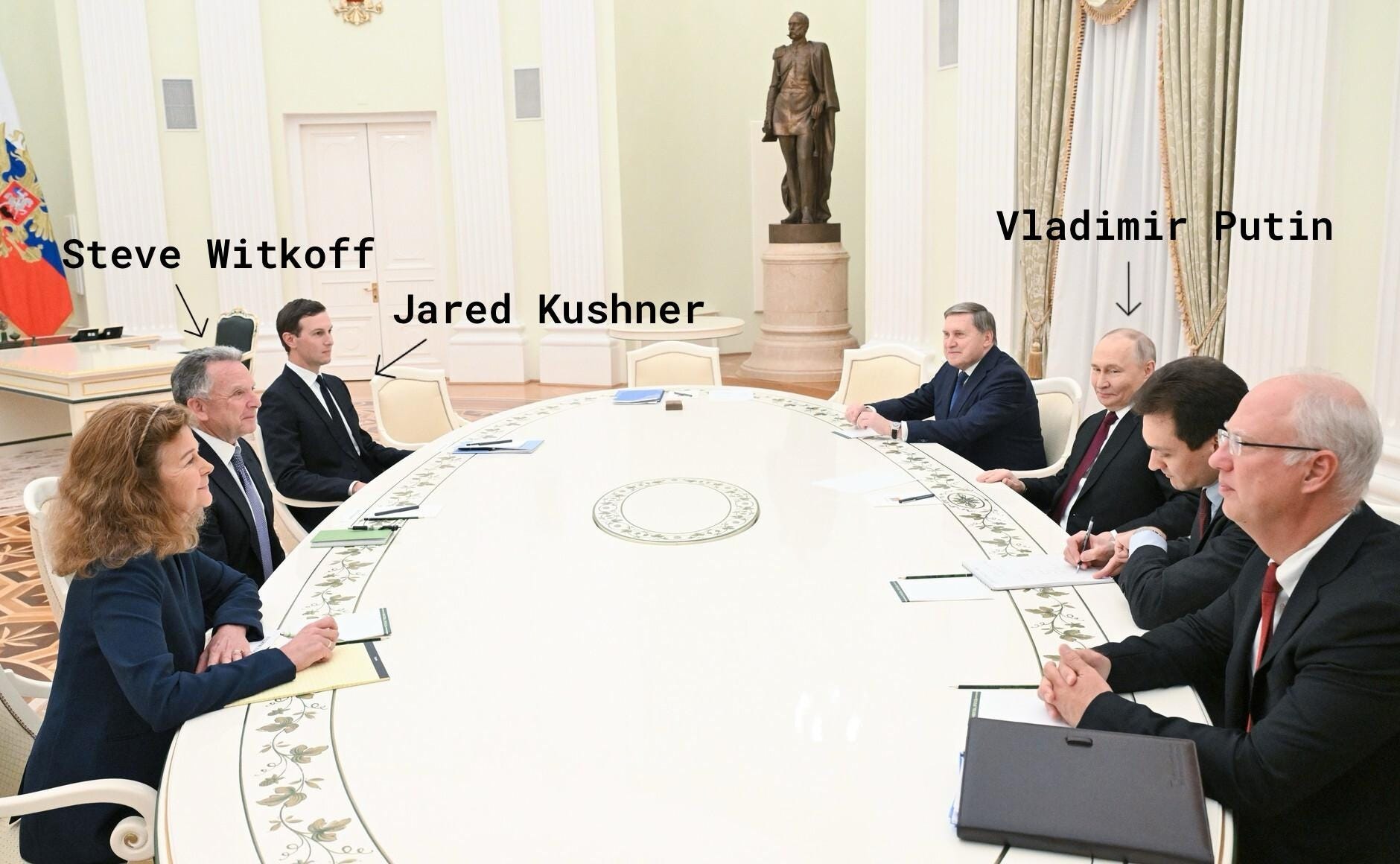
Kushner’s participation in the Moscow meeting — and the similar role he played in the Gaza negotiations — likely violates the law.
Representing the Trump administration in high-level foreign policy negotiations makes Kushner, at a minimum, a Special Government Employee (SGE). Under the law, an SGE is someone “who is retained, designated, appointed, or employed to perform, with or without compensation, for not to exceed one hundred and thirty days during any period of three hundred and sixty-five consecutive days, temporary duties either on a full-time or intermittent basis.”
Trump has not named Kushner an SGE. But a seminal 1977 opinion by the Department of Justice’s Office of Legal Counsel (OLC) found “an identifiable act of appointment may not be absolutely essential for an individual to be regarded as an officer or employee in a particular case where the parties omitted it for the purpose of avoiding the application of the conflict-of-interest laws.” In that opinion, the OLC considered the status of an individual who had not been named to any role by the president but “assumed considerable responsibility for coordinating the Administration’s activities in [a] particular area.” The OLC concluded that since the individual was “quite clearly engaging in a governmental function” and is “working under the direction or supervision of the President,” he should be considered an SGE.
Here, Kushner is engaged in activities that can only be conducted by government officials. The Logan Act bars private citizens from engaging in negotiations with foreign governments without authorization. Kushner is acting in an authorized capacity, under Trump’s direction, and that creates a host of legal issues.
As a de facto SGE with substantial authority, the Foreign Emoluments Clause of the Constitution prohibits Kushner from accepting “any present, Emolument, Office, or Title, of any kind whatever, from any
...This excerpt is provided for preview purposes. Full article content is available on the original publication.