Time for a "Land Acknowledgement"!
Deep Dives
Explore related topics with these Wikipedia articles, rewritten for enjoyable reading:
-
Cochise
12 min read
The article centers on Cochise's guerrilla war against the U.S. Army as an example of a 'land acknowledgement done right.' Most readers know the name but not the specific 1861-1872 conflict, his tactical innovations, or the remarkable 1872 peace that established a reservation on ancestral lands.
-
Sister Souljah moment
13 min read
Yglesias explicitly invokes this political concept as the mechanism for how liberals should respond to land acknowledgments. Understanding Bill Clinton's 1992 calculated criticism and its lasting influence on Democratic Party strategy provides essential context for the political argument being made.
-
Land acknowledgement
11 min read
The entire article is a debate about land acknowledgments - their purpose, politics, and meaning. A Wikipedia deep-dive would explain the practice's origins in Australia and Canada, its spread to American institutions, and the ongoing controversy about whether they're meaningful gestures or empty performativity.
The SubStack Attempt to Avoid the ClickBait-Rage Trap Is Failing: The argument against the idea that SubStack needed to develop a social-media #discoverability layer in order to reach appropriate audience scale was that to drink from that cup was to drink from a poisoned chalice that would lead to the death of reason and discussion…
This morning Matt Yglesias provides a powerful data point strengthening that argument.
He finds the best use of his time to be to issue a SubStack note stating that “The United States of America is not ‘occupied Turtle Island’”, and goes on to say that the “movement to delegitimize the United States of America… needs to be contested by American liberals…”
How are American liberals to contest it?
They are, he says, to do it by invoking a so-called “Sister Souljah” moment, and ostentatiously refusing to do “land acknowledgements”.
Me?
I think we should do land acknowledgements right.
For example:
In 1861 U.S. soldiers wrongfully accused Cochise, Chief of the Chiricahua Apache, of abducting a boy. Botched negotiations led to hostage-taking, executions, and an eleven-year mobile guerrilla war across southeastern Arizona and southwestern New Mexico, with Cochise and Mangas Colorados leading the maneuvering and fighting with small, fast bands, deep local knowledge, and selective violence: ambushes of patrols and stage routes, rapid dispersal after strikes, and control of water and passes. The aim was not to hold towns but to impose constant cost on military columns and settlers, deny safe movement, and preserve autonomous living space.
In 1872, U.S. General Oliver Otis Howard gave up the U.S. Army’s campaign, and established the Chiricahua Reservation: a reservation in the tribe’s place, not a distant relocation, recognizing Cochise’s authority and military strength.
In honor and admiration of their fight and their success—of those who, when relationships between colonial settlers and previous inhabitants degenerated into the unfortunate human social practice of war, were highly effective and punched well above their numerical weight in the use of deadly violence against U.S. military personnel and civilian colonizers in ways their understanding of that human social practice allowed—we have since the mid-1980s had: the AH-64 Apache, the U.S. Army’s primary attack helicopter, built around survivability and precision fires, pairing a nose‑mounted sensor suite with armored, redundant systems and powerful engines for low‑level combat in bad weather and at night:
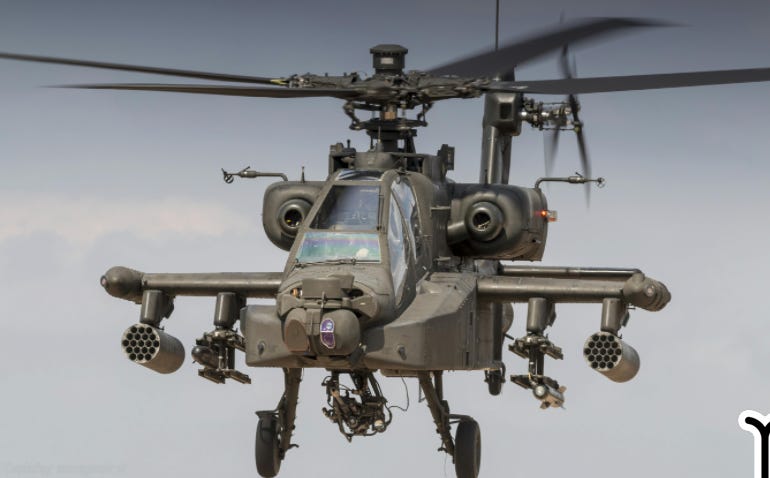
We have named this helicopter thus to call to the forefront of
...This excerpt is provided for preview purposes. Full article content is available on the original publication.