[#307-Appendix] Calculating "Order-to-Delivery" metric in E-commerce
Welcome to “Supply Chain in Numbers”. This newsletter tracks significant numbers from the supply chain world. Primarily, this newsletter publishes five prominent numbers every Monday. In this “Appendix” post (published on Thursday), one of the numbers from the week is used to illustrate more interesting points.
In last week’s Supply Chain in Numbers, I covered this number regarding US consumer expectations on faster delivery:
31% of shoppers expect same day delivery
Nearly one in three U.S. consumers now expect same-day delivery, according to Ryder’s 2025 E-commerce Consumer Study. The finding highlights how quickly shopper expectations are shifting and how much pressure this puts on supply chains already balancing speed, cost, and sustainability. The study, which surveyed 1,000 U.S. online shoppers, found that 31% now consider same-day delivery standard, up sharply from prior years when two-day shipping was the gold standard. At the same time, 63% expect delivery in two days or less, showing how fast fulfillment is becoming a baseline requirement. [Supply Chain 24x7]
The findings of this survey are hardly surprising at a macro level, but ‘same day’ delivery should be taken with a grain of salt. An online shopper can be someone ordering ‘dog food from the nearby store for pickup’ (picking up in 2 hours), ‘running shoes’ (okay to get it next 2 to 3 days), or ‘electronic synthesizer with custom case’ (I know this takes 6 to 8 days). I can go on and on. You get that point. More on this some other day.
It is common for a supply chain manager to get questions from Senior Leadership related to this topic. I want to focus this post on how to get insights on answering these questions. To make it a little more fun (hopefully), I will structure each insight as a GenAI prompt.
We will start with the most basic question: “What is our average order-to-delivery days”. As much as I want to say that it is a simple difference between order date and delivery date, there are nuances.
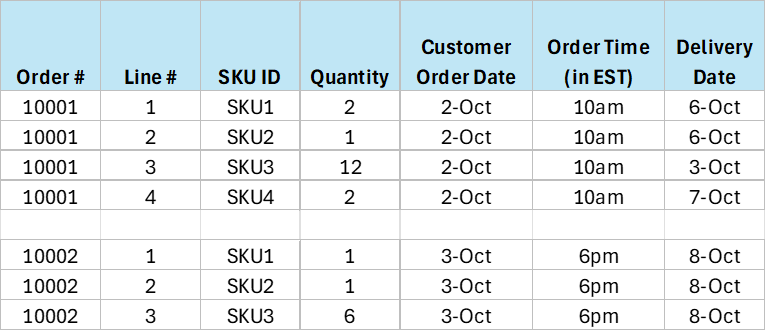
To illustrate, here is a sample order dataset with two orders. Each has multiple orderliness, and they have different delivery dates.
Calculate “Customer OTD days”. It is defined as number of calendar days between “Delivery Date” and “Customer Order Date”. Add the column.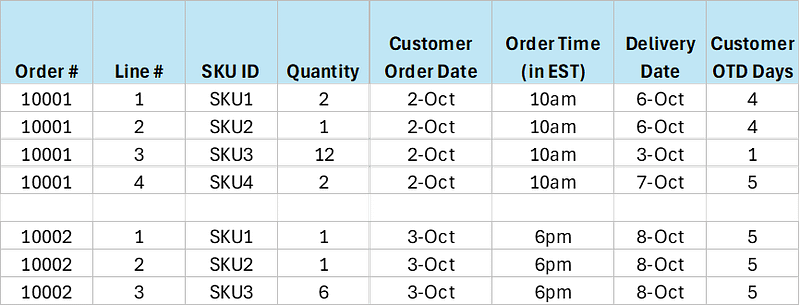
Any supply chain person is going to fume at this table. Because it
...This excerpt is provided for preview purposes. Full article content is available on the original publication.