How Trump’s trillion-dollar war machine enriches the 1%
Deep Dives
Explore related topics with these Wikipedia articles, rewritten for enjoyable reading:
-
Share repurchase
14 min read
The article's central argument hinges on how defense contractors use taxpayer funds for stock buybacks. Understanding the mechanics, history, and controversy around share repurchases would illuminate why the author considers this a wealth transfer mechanism and why buybacks became prevalent after regulatory changes in 1982.
-
Military–industrial complex
12 min read
Eisenhower's famous 1961 warning about the military-industrial complex provides essential historical context for understanding the defense contractor consolidation and political dynamics described in this article. The Wikipedia entry covers the concept's origins, evolution, and ongoing debates about its influence on US policy.
-
United States federal budget
13 min read
Understanding how the federal budget process works—including the relationship between authorization bills like the NDAA and actual appropriations—helps readers grasp the procedural complexity behind the trillion-dollar figures discussed and how military spending competes with social programs.
Congress will decide in the coming weeks whether to approve a $1 trillion military budget for 2026.
The House-passed National Defense Authorization Act (NDAA) proposes $893 billion in military spending, while the Senate version proposes $926 billion. Whichever total prevails, the White House plans to add another $119 billion from the One Big Beautiful Bill Act. All told, next year’s pending military budget stands between $1.012 trillion and $1.045 trillion.
Money is policy. Should Congress approve such a historic sum, it would not only enable many of Trump’s dangerous and unjust policies — including military occupations of US cities, the resumption of nuclear weapons testing, and rushing toward wars in Mexico, Nigeria, and Venezuela — it would also trigger a historic redistribution of wealth from the public to private arms companies and their shareholders.
A looming half-trillion-dollar privatization of wealth
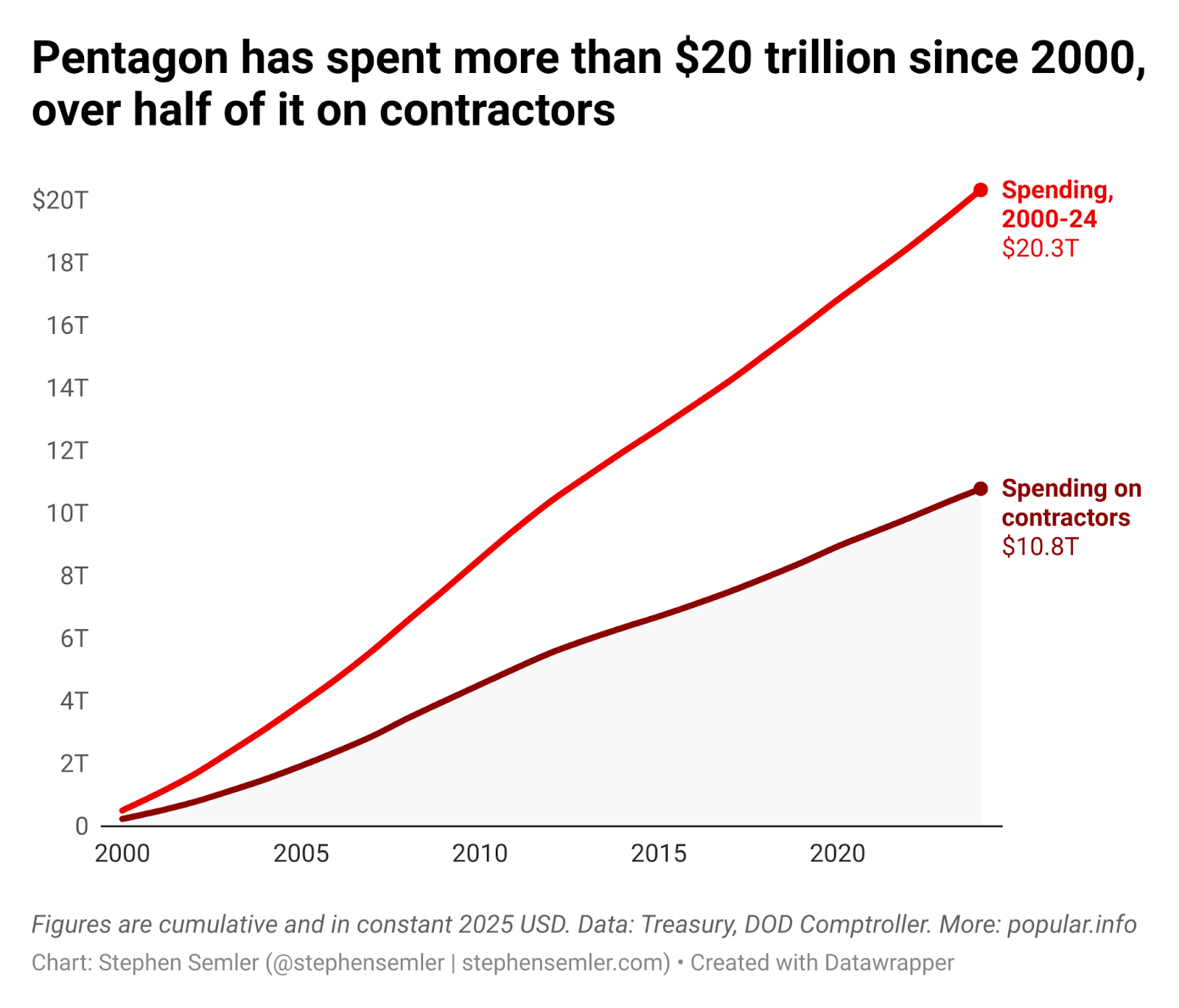
More than half of next year’s trillion-dollar Pentagon budget would likely go to private companies. A recent study from Brown University’s Costs of War project found that over half of Pentagon spending from 2020 to 2024 went to for-profit contractors. For Popular Information, I expanded the report’s sample size by another 20 years (I should know how to do this, as I co-authored the Brown study.1) Since 2000, 53% of Pentagon spending has gone to contracts.2 By that figure, the 2026 military budget would likely privatize well over $500 billion in public funds.
Four military contractors, ten years, $103 billion in taxpayer-funded buybacks and dividends
More than a quarter of next year’s Pentagon contract dollars will likely go to just four companies: Lockheed Martin, Raytheon (now RTX), General Dynamics, and Northrop Grumman.3
A review of each contracting giant’s 10-K filings over the last decade reveals what should be a scandal: Taxpayers are subsidizing arms company shareholders. Based on their share of revenue from sales to the US government, Lockheed Martin, Raytheon (RTX), General Dynamics, and Northrop Grumman used public funds to cover $103 billion in buybacks and dividends over the last decade. US taxpayers covered two out of every three dollars these companies spent enriching their shareholders.4 This is a conservative estimate.5
Two main factors make these billions in shareholder subsidies possible. First, the extent to which these firms rely on public funds. Here’s how much of their 2015–2024 revenue came from US government contracts:
Lockheed Martin: 72%
Raytheon
This excerpt is provided for preview purposes. Full article content is available on the original publication.