Where is knowledge stored in the brain?

Last time, in The Neocortex Builds a Model of the World, I wrote about how the brain builds a representation, or model, of every thing we know—including objects, words, ideas, etc. I've also written about the columnar structure of the neocortex with its hundreds of thousands of tiny columns that each utilize a similar learning algorithm to build its knowledge.
All of this is based off of Jeff Hawkin's "Thousand Brains" theory of intelligence. At this point, you might be left wondering why this theory refers to a thousand brains and not just one. So here's my final piece on our series on intelligence.
A thousand models
The Thousand Brains theory states that the brain stores information as models. However, there isn't just one model for everything you know. It turns out that almost every cortical column builds its own model of complete objects or ideas. Given that there are a few hundred thousand columns in the neocortex, that means there are thousands of models for every thing you hold in your brain.
That isn't to say that each model is perfectly complete. Each of our cortical columns are connected to different parts of our bodies from our fingertips to our eyes to our feet. That means that each column has an incomplete picture of the nature of an object or idea based on its connections.
In one of his talks, Jeff uses the example of a coffee cup. Say you placed three fingers on a coffee cup and didn't move them. A single point on a coffee cup could be interpreted as a ball, soda can, or mug given their similar features. However, one column feels a rim and can thus rule out the ball as the object. Another column feels the handle and can thus rule out the ball and the soda can. These columns talk to each other, vote on which object it is, and conclude that the object you are touching is a coffee cup.
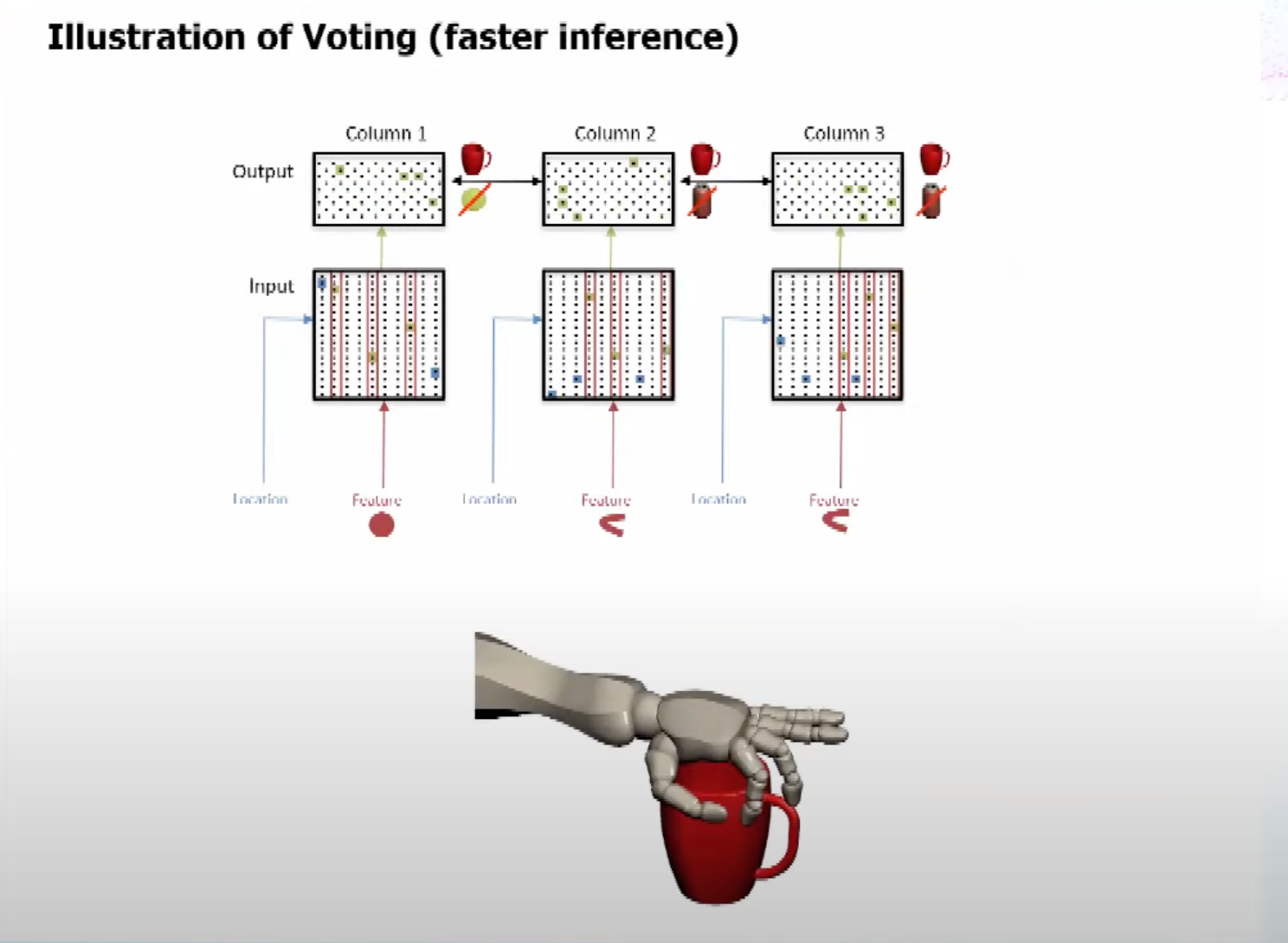
Jeff claims that this is similar to how the retina in your eye works: each patch of retina is connected to its own column and together they vote to recognize objects in your visual field and construct a coherent image.
This is an incredibly simplistic example, but I hope the point gets across: your brain is a like a democracy: each column votes
...This excerpt is provided for preview purposes. Full article content is available on the original publication.