(Largely) HOISTED FROM THE ARCHIVES: “West”, “North Atlantic”, or “Dover Circle”?
Deep Dives
Explore related topics with these Wikipedia articles, rewritten for enjoyable reading:
-
Epic of Gilgamesh
20 min read
The article explicitly references Gilgamesh and the Uruk civilization as the supposed origin point of 'Western civilization' in the torch-relay narrative DeLong critiques. Understanding this ancient Mesopotamian epic provides crucial context for evaluating claims about civilizational continuity.
-
Judith N. Shklar
11 min read
DeLong quotes extensively from Shklar's 'A Life of Learning' about post-WWII Harvard and the rise of 'Western Civilization' courses. Her political philosophy and refugee experience directly inform why she found these conversations 'unreal.'
-
Ian Morris (historian)
12 min read
The article centers on Morris's maps and thesis about shifting 'core areas' of Western and Eastern civilization from his book 'Why the West Rules—for Now.' Understanding his methodology and arguments is essential to following DeLong's critique of civilizational categories.
Hoisted so I can find this easily in the future: From January 2023. With a little bit of reëditing:
“West” or “Dover Circle”? A student asked me why, in my lectures earlier this week, I kept on referring to the “North Atlantic” rather than the “Western” economies. Why did I use the first to refer to those that have become vastly richer than the world average over the past 200 years? Even as of the early 1800s, “North Atlantic” made more sense than did “West”. By 1960, “North Atlantic” itself became less apposite. Would “Global North” be a good replacement? And in the 2000s things have changed still further: I have swung around to think that a more useful and informative label would be “Dover Circle-Plus”: those economies and societies that are, that have received very large settler inflows from, or that have strained every nerve to emulate the particular economic structures and patterns and practices that developed in the years after 1500 in a 300-mile radius circle centered on the port of Dover at the southeast corner of England:
When asked why I kept on referring to the “North Atlantic” rather than the “Western” economies, I responded: I was not aware that I had settled on “North Atlantic”— I had thought that I found myself bouncing around when I am not focusing on what descriptor to use.
I do, however, try to avoid “West”. Part it is that “West” is out-of-date. “West” comes from a time and a place now long ago: a time and a place when it was assumed that pretty much everything of interest was in Eurasia, and that the most important thing was the contrast between the western edge of Eurasia and everything else that was east—that was the “Orient”, from the Latin word for the direction from which the sun rose.
But even then, “West” as in “Western edge of Eurasia” did not really cut it.
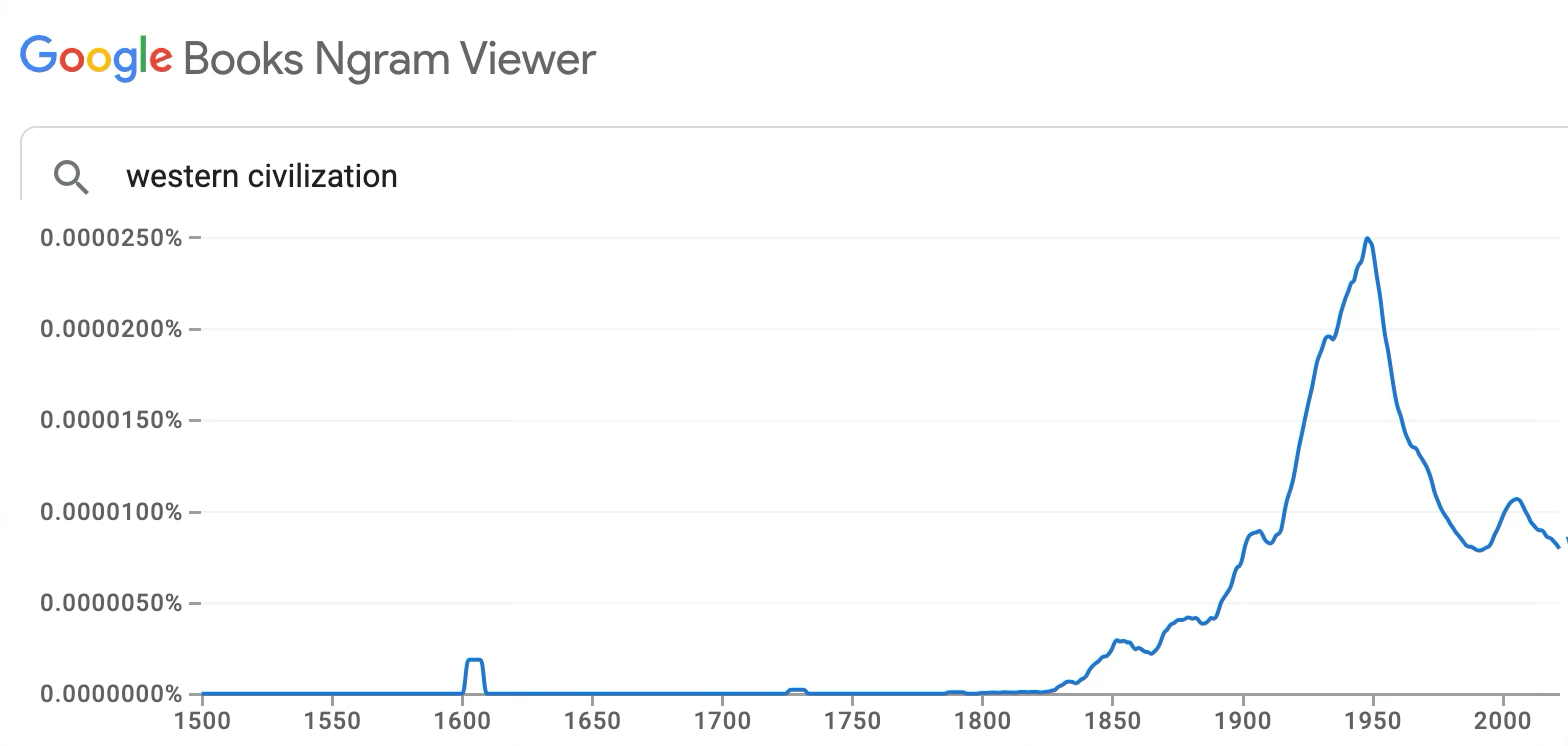
The phrase does not even begin to take off until after 1840 or so. And by then, there was no sense in which Portugal, Spain, Italy, and southern France were no longer securely among the relatively rich. The United States, and Canada too, were very rich indeed, and the United States’s population was growing rapidly. Even as of the early 1800s, “North Atlantic” made more sense than did “West”.
And today? “Global North”? “Global North” is not quite
...This excerpt is provided for preview purposes. Full article content is available on the original publication.