Let's save the human species!

Take a look at the marvel that is modern China. The endless gleaming lines of bullet trains. The air taxis and the drone delivery services and the driverless cars. The bubble tea franchises and the cavernous malls and the fast fashion and the pay-with-your-face apps and the robot waiters and the automated factories. The Shanghai clubs and the side streets of Chongqing and the manicured parks of Shenzhen.
You are looking at the peak. China will continue to be a spectacular, world-leading civilization for a couple more decades, but sometime around the century’s halfway point, demographic decline will begin to sap its vitality. Sometime around the mid-2010s, China’s birth rate fell off a cliff, and has not stopped falling since:
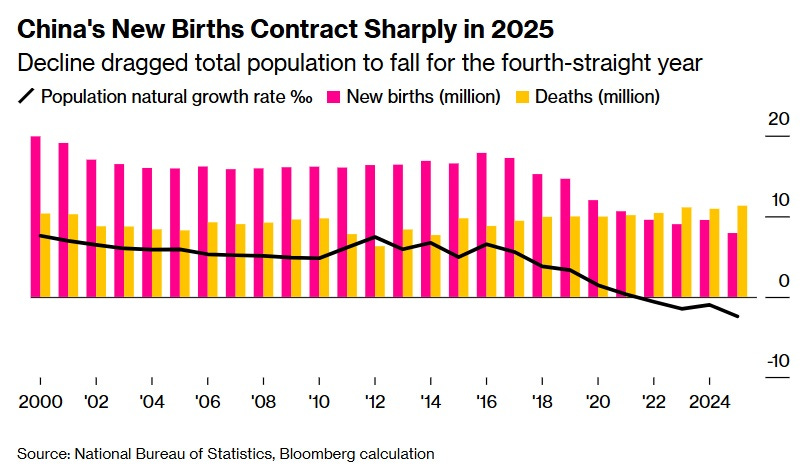
It’s difficult to state just how stark and catastrophic of a collapse this is. The number of births in China fell by 17% in just the last year. In fact, as economist Jesús Fernández-Villaverde recently pointed out, China had fewer births in 2025 than in 1776, when its population was less than a fifth of what it is now.
China’s total fertility rate now stands at around 0.93, less than half the replacement level. At that rate, every four grandparents will have fewer than one grandchild. Fernández-Villaverde explains what this means for the future of China’s population:
[I]f China could somehow sustain 7.92 million births per year from now on, its population would eventually stabilize at roughly 625 million, far below today’s 1.405 billion. In reality, as smaller cohorts reach childbearing age, births will fall well below 7.92 million. Hence, 625 million is a very generous upper bound[.]
But this isn’t a post about China; it’s about the whole world. Those who expect China’s low fertility to end its bid to dominate the globe are in for a severe disappointment, since fertility is falling in the rest of the world as well. It’s true that China is an especially severe case — a TFR of less than 1.0 puts it in a special category with Korea, Taiwan, Singapore, and Thailand (Japan, interestingly, is still slightly higher). But over the past decade, fertility has begun collapsing all over the world, much faster than it had been declining before.
Fernández-Villaverde has a good set of slides from 2023 explaining why the new fertility crisis is different and more urgent than traditional concerns. In earlier times,
...This excerpt is provided for preview purposes. Full article content is available on the original publication.