The Energy Affordability Bait and Switch
Before we get into today’s post, we have some exciting news.
This is our 100th post on the EBB Substack! Whether you’ve been around for all 100, or are relatively new, we just want to thank everyone for making EBB what it is. We hope to keep delivering great content for you all that can be used to advocate for rational energy policies around the country.
Now, into the actual piece.
The Energy Affordability Bait and Switch
The energy world seems to got through phases of what it deems the “it” thing.
For a while, it was decarbonization. Then, after thermal plants started shuttering and blackouts became very real possibilities due to a lack of power supply, reliability became front and center. Last year, all of the talk was about the skyrocketing demand for power from data centers.
Currently, energy affordability is suddenly the New Kid In Town, now that prices have swung dramatically upward in the last few years in much of the country, but predominantly in blue states.
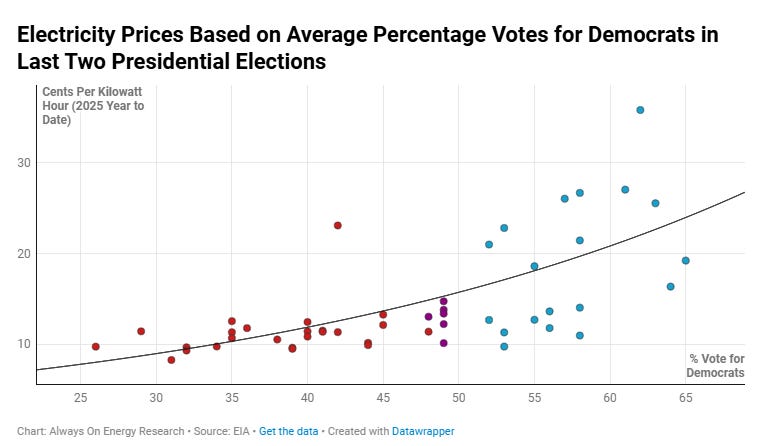
Energy costs are increasingly becoming a larger percentage of American family incomes, and while political leaders across the spectrum have all seemingly taken up the cause of lowering costs, some may just be paying lip service to the new “it” thing.
Many blue states have been forced to pull the plug on some of their more expensive energy initiatives, such as in New York and California (as we noted in a recent post), yet Democrats still can’t seem to help themselves from pursuing outrageously expensive energy policies.
Like all new kids on the block, they may just be biding their time until the next one comes around—using “energy affordability” to pursue the same unaffordable policies.
Take the newly elected governors in Virginia and New Jersey, for example.
Virginia Rejoining RGGI
In her first address to the Virginia legislature, newly elected Virginia Governor, Democrat Abigail Spanberger, made quite the splash.
Not only did she recommit the state to building more wind, solar, and battery storage, which will raise costs and won’t be able to meet the state’s anticipated growth in demand, she also announced that Virginia will be rejoining the Regional Greenhouse Gas Initiative (RGGI) that former Republican Governor Glenn Youngkin pulled out of in 2024.
Governor Spanberger noted that her decision to rejoin was based on electricity costs, saying, “Withdrawing from RGGI did not lower energy costs. We
...This excerpt is provided for preview purposes. Full article content is available on the original publication.