Is your system fair? Striking new data from 42 countries
Is your system fair? This is the question that occupies researchers who work in the field of System Justification Theory. They want to understand whether - and why - people regard the economic and political system they live under as fair, just and legitimate.
Surveys are conducted to measure this by presenting people with four statements:
• “In general, I find society to be fair”
• “In general my country's political system operates as it should”
• “Everyone in my country has a fair shot at wealth and happiness”
• “My country's society is set up so that people usually get what they deserve”
People are generally asked to respond on a scale of 1 to 7: Completely Disagree —> Disagree —> Somewhat Disagree —> Neutral —> Somewhat Agree —> Agree —> Completely Agree.
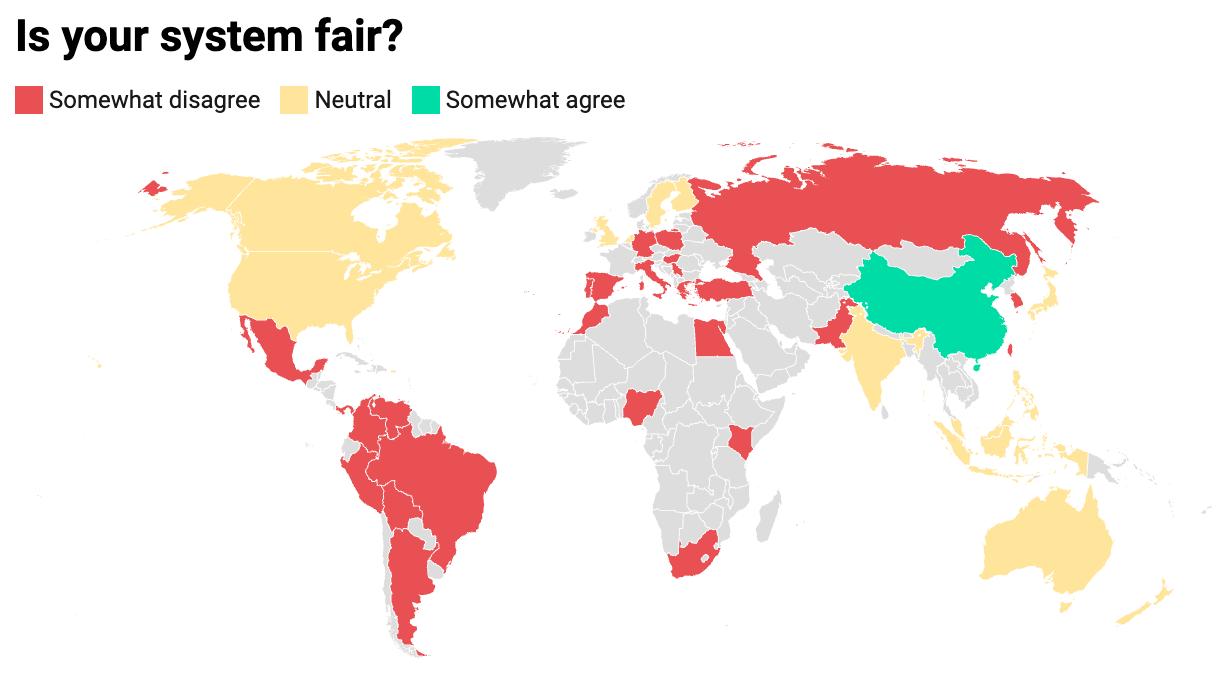
A recent study, published last year in the journal Political Psychology, explored survey data for 24,000 people in 42 countries around the world. The results show that, on average, people do not justify the system they live in. The average response across all countries in the sample is 3.2, close to “somewhat disagree”.
When we break this down further, we see that for 26 of the countries, people on average somewhat disagree that their system is fair. This is true for example in Nigeria (2.5), Italy (2.8), and Taiwan (3.4). For 15 of the countries, the average response is on the lower side of the neutral range, including in the UK (3.6) and the US (3.7), with New Zealand (4) being smack in the middle.
There is only one country where the survey results indicate that citizens generally say that the system they live in is fair, and that is China. China has an average score of 4.8, with a 95% confidence interval of 4.7-4.9, indicating “somewhat agree”. Indeed, China has the highest score in the sample by a substantial margin. Notably, there are no countries where the average response is “agree” or “completely agree”, indicating there is much need for improvement across the board.
The results for China may seem surprising, given that China has fairly high income inequality as measured by the Gini coefficient, seeing only marginal reductions in recent years. On the other hand, there have been dramatic material improvements in most people’s lives over the past decade or two. The wages of manufacturing workers have increased 8-fold since 2005, and
...This excerpt is provided for preview purposes. Full article content is available on the original publication.