The central event of this article - provides comprehensive historical context on the dismissal of Whitlam, the legal mechanisms involved, the role of Governor-General John Kerr, and the political aftermath that readers would benefit from understanding in detail
The article specifically mentions the 'reserve powers' of the Constitution used to dismiss Whitlam - this constitutional concept is central to understanding how a democratically elected government could be removed by an unelected representative of the Crown
The author frames the 1975 crisis within broader decolonization processes, mentioning Australia's decolonization of Papua New Guinea and Portugal's of East Timor - understanding this global historical movement provides essential context for the article's thesis about American neo-colonialism
Today marks the 50th anniversary of the dismissal of the Whitlam Government (Labor or progressive) in Australia. Does this event still matter amid the churning of the world in 2025?
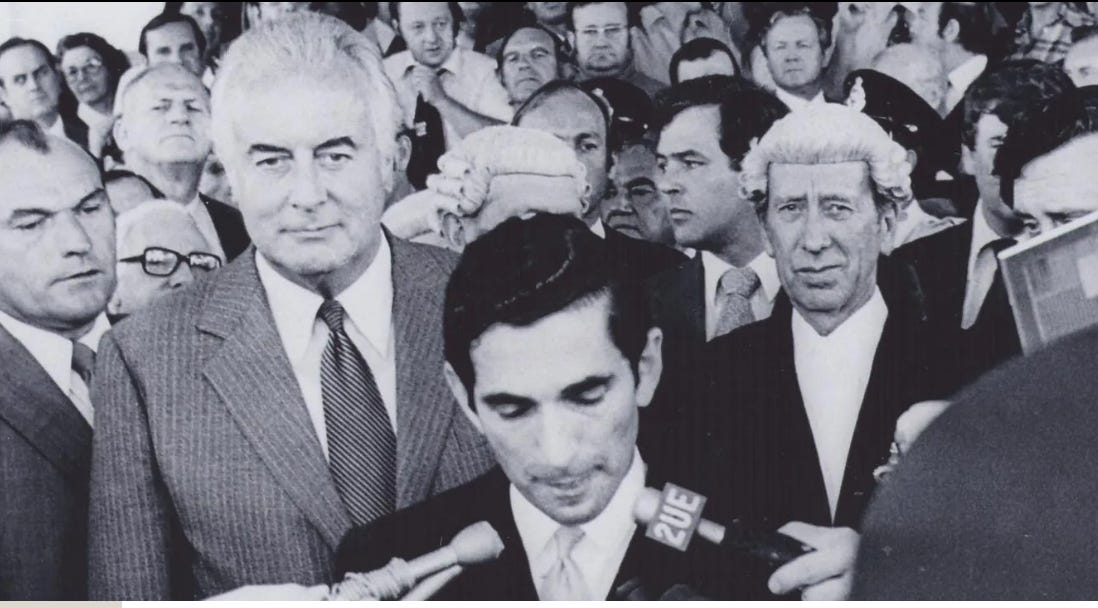
On 11 November 1975 Prime Minister Gough Whitlam was sacked by the Governor General using the ‘reserve powers’ of the Constitution, reserved for the monarch’s representative. Yes, for non-antipodean readers, the Queen of England was still the Queen of Australia. In response, Whitlam defiantly stood on the steps of Parliament House and after the Governor-General’s secretary completed his formal proclamation with the salutation, “God Save the Queen,” Whitlam, the barrister, responded with the words, legendary in Australian political history,
Well may you say ‘God save the Queen’ because nothing will save the Governor General.
Gough Whitlam, 11 November 1975
11 November 1975, Whitlam stands behind right shoulder of Governor-General’s Secretary announcing his dismissal
A three-minute summary of these events with archival footage of this moment is below, especially for non-Australian readers.
The history of Australia’s greatest constitutional crisis remains passionately debated, although after 50 years clear memories are clouded by political mythologies. Was it a coup arranged by the CIA or the Palace? Did it expose irredeemable flaws in Australian democracy? Who was to blame? Whose villainy was blackest? Has Australia ever since enjoyed full national sovereignty within the American alliance?
And why, despite Gough’s plea to the nation to “maintain the rage,” did the Australian electorate validate the decision by the despised Governor General, Sir John Kerr, his dismissal of the legendary reforming Labor Government, not once, but twice. In both the 1975 and 1977 elections Whitlam and the Labor Party were defeated in landslides. In 1975 the ALP lost 30 seats and suffered a 7.4 per cent swing in votes. New Liberal-National (conservative) Prime Minister Malcom Fraser enjoyed a 91 to 36 majority in the new Parliament. In 1977 the majority changed marginally to 86 to 38.
Democracy threw out another inconvenient truth. In spite of Gough’s ominous warning, or because of it, the electorate chose to save the Governor-General’s judgement. Nothing however would save his soul, which would dissolve into jeering crowds, bitter recriminations and daily alcoholic binges.
These tragic events, however, formed the political characters of several generations of elites in politics, bureaucracy, law, universities and media. I have met and worked with many of them. Some dedicated themselves to constitutional reform, including forlorn attempts to