The Carnation Revolution
“Don’t worry – today, and every year going forward, 25 April will be a national holiday.”
Captain Salgueiro Maia attempts to console a cleaning lady who, arriving for her early morning shift at the Post Office facing Terreiro do Paço and upset that soldiers are blocking her from entering her workplace, insists on speaking to the person in charge.
For a few hours on April 25, 1974 several dozen Captains in the Portuguese military seized control of the military from their more senior officers. In those few hours they used that control to nearly bloodlessly topple Europe’s oldest totalitarian government, immediately establish freedom of the press, freedom of political parties, free all political prisoners and successfully protect a process aimed at turning Portugal into a free, democratic society within a year.
Their action is known as the Carnation Revolution. Ever since, April 25th has been a Portuguese national holiday. Freedom Day.
The improbable and inspiring story is told in Alex Fernandes’ “The Carnation Revolution: The Day Portugal’s Dictatorship Fell”. It is utterly gripping.
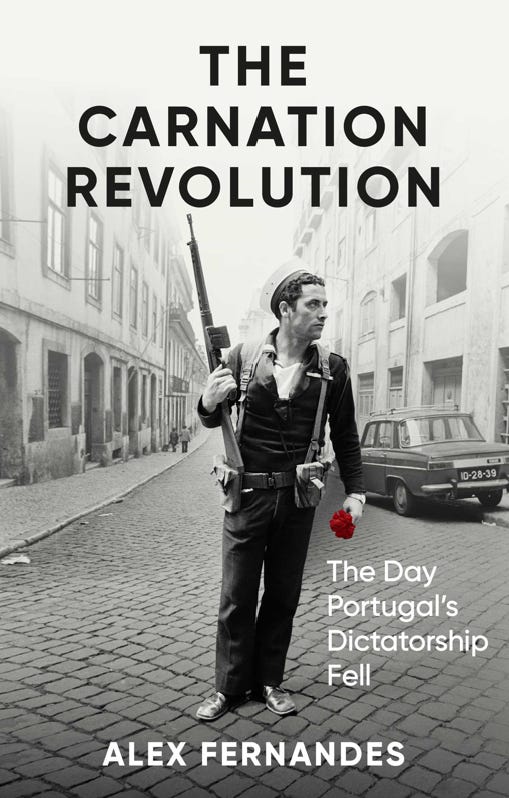
While outwardly the story of the day itself, how it came to be and what came after, rich insights emerge into leadership, the brotherhood of arms, the development and evolution of social movements, military coups, counterinsurgency, decision traps, middle management, human psychology, group decision making, action under uncertainty and more.
Above all, Fernandes’ book is an extended love letter to the people of Portugal. In learning the story of the Carnation Revolution and the passionate, argumentative, audacious and proud people on all sides, you can’t help but fall in love yourself.
“I only know how to shoot people with guns in their hands.”
Lieutenant Assis Gonçalves refuses the order to shoot the hundred or so participants in his custody of a just-failed 1927 left-wing coup
Portugal’s dictatorship began in 1926 when a military coup, backed by a majority of the population, ended sixteen years of chaos during which Portugal had forty-five governments and seemingly unending economic crisis. The new military government quickly established a right-wing, authoritarian state. The economic situation did not improve and after a failed left-wing coup in 1927, realizing it didn’t have the technical expertise to govern, the military ceded control of finances to a popular right wing academic and orator, Doctor António de Oliveira Salazar. Intelligent, analytical, politically savvy, economically knowledgeable and skilled at using the
...This excerpt is provided for preview purposes. Full article content is available on the original publication.