From Rebel to Rebuilder
Deep Dives
Explore related topics with these Wikipedia articles, rewritten for enjoyable reading:
-
Kuomintang
17 min read
The article centers on the KMT's new leadership, but readers may not know its full history—from Sun Yat-sen's founding, through the Chinese Civil War, retreat to Taiwan, decades of authoritarian rule, and transformation into a democratic party. Understanding this century-long trajectory illuminates why Cheng's rise from DPP activist to KMT chair is so remarkable.
-
Tzu Chi
1 min read
Cheng explicitly models her vision for the KMT on Tzu Chi, the Buddhist humanitarian organization, and visited its founder after her election. Most readers outside Taiwan know little about this massive NGO—one of the world's largest charities—its philosophy of 'compassion and great love,' and why invoking it carries such symbolic weight in Taiwanese politics.
-
Pan-Blue Coalition
16 min read
The article references 'pan-blue' and 'pan-green' political camps without explanation. Understanding Taiwan's political spectrum—the pan-Blue coalition favoring engagement with mainland China versus the pan-Green coalition favoring formal independence—is essential context for grasping why Cheng's political journey from one camp to the other is so significant.
Donald Trump and Xi Jinping did not talk about Taiwan—constitutionally named the Republic of China—in their recent summit in South Korea, but that didn’t stop the island from dominating headlines on the mainland in the past two weeks. The reason was not a new military flare-up, but a political one: the Kuomintang’s election of Cheng Li-wen, a former independence activist turned reformist, as its new chair.
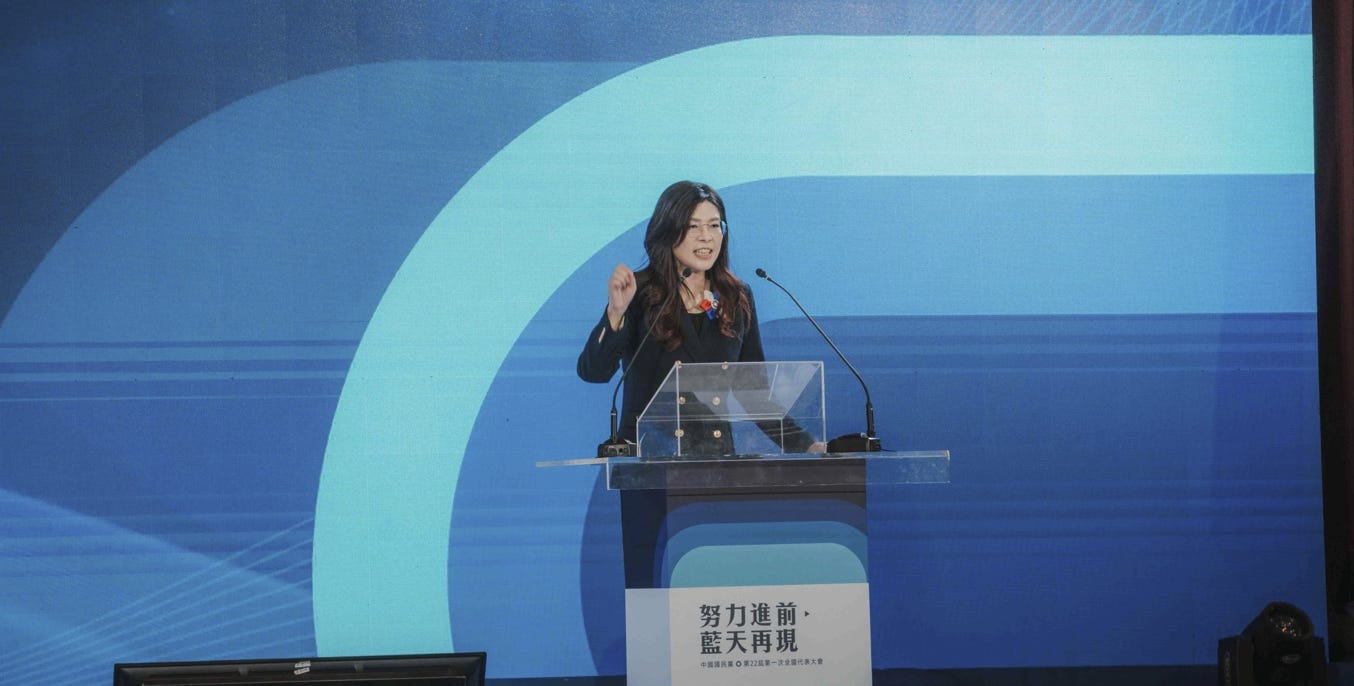
In an age of political fatigue within Taiwan’s major parties, Cheng’s rise to the helm of the Kuomintang (KMT) in late 2025 feels like more than routine succession. A lawyer by training, she studied law at National Taiwan University and Temple University in the United States, and later completed a master’s degree at the University of Cambridge. Early in her career she built credentials within the rival Democratic Progressive Party (DPP)—including activism in Taiwan’s student movement for democratization—before switching allegiance to the KMT. The significance of that shift cannot be overstated: few Taiwanese politicians have traveled the full arc from pan-green independence activism to leading the island’s principal pan-blue party, which favors steady engagement with the mainland.
What makes Cheng distinctive is not only her transformation but her clarity of tone. At 55 she is markedly younger than the KMT’s ageing elders, offering a rare sense of renewal for a party long seen as tired. She has also embraced a dual identity—calling herself both Taiwanese and Chinese—casting herself as a bridge rather than a barricade across the Strait. Her message of “engagement with confidence,” delivered in the language of peace and pragmatism, hints at a return to dialogue after years of deadlock. For the first time in a while, Taiwan’s oldest party sounds less like a relic of the past and more like a possible custodian of calm.
For all her freshness, Cheng inherits a party with a century-long lineage and deeply rooted habits. The Kuomintang remains anchored in business networks and local factions, while younger voters have grown up in a more assertive democratic age. Her task will be to give new meaning to the KMT’s long tradition of engagement. Yet if she can turn renewed intimacy with the mainland into a source of reassurance rather than fear—restoring genuine connection across the Strait and linking Taiwan’s self-confidence to a shared sense of destiny—Cheng Li-wen may help steer the two sides away from confrontation, perhaps even back toward peace, or at least check the
...This excerpt is provided for preview purposes. Full article content is available on the original publication.