The LGB and the T
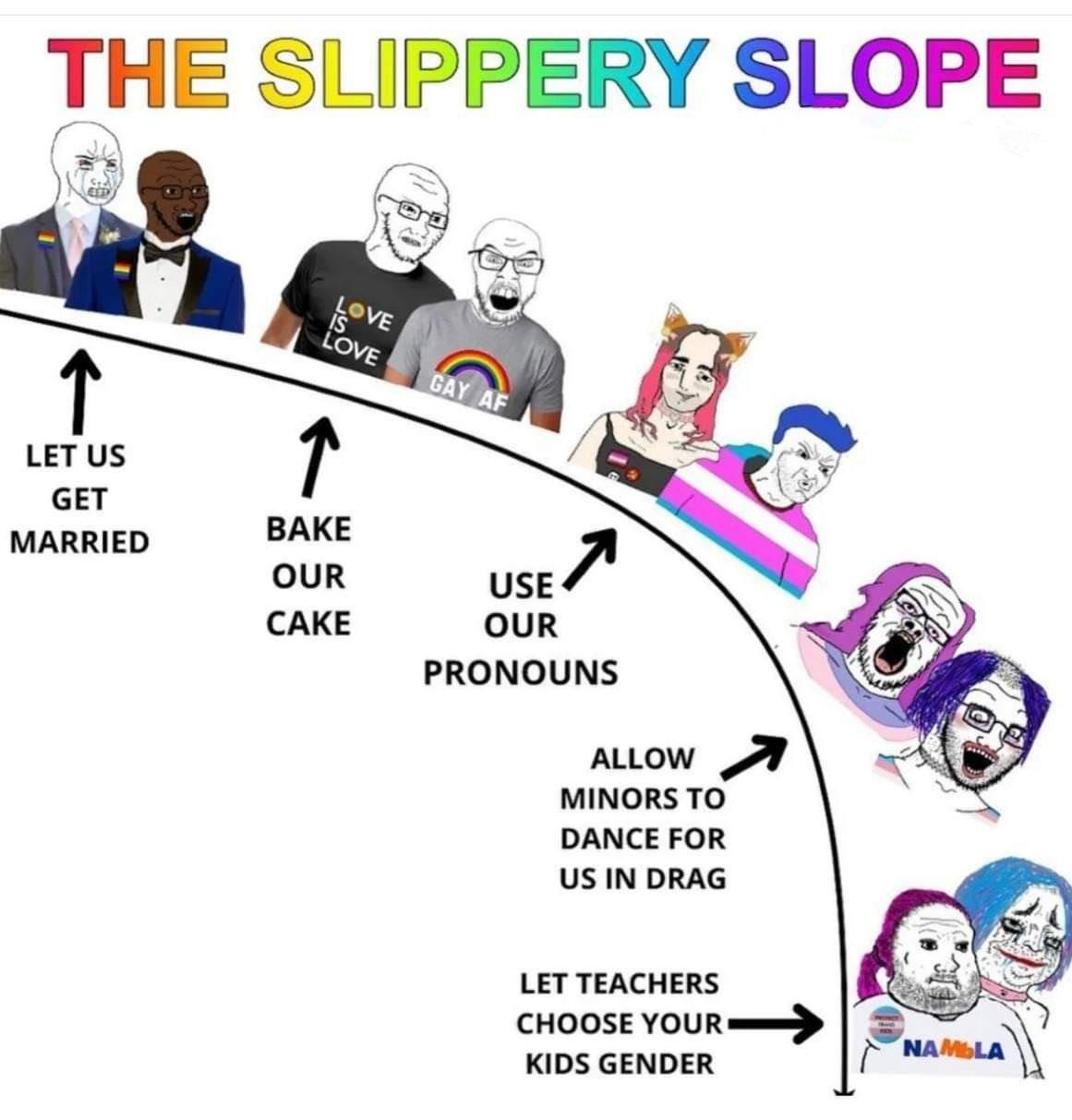
As an account of a temporal sequence, no one can deny that the LGBTQIA+ movement has followed exactly the trajectory depicted in the reactionary shitpost meme posted above. A few years after the attainment of gay marriage, the institutional juggernaut built to obtain “marriage equality” was indeed quickly repurposed to propagate the chemical castration and surgical modification of a population of mostly autistic, gay, mentally-ill, and gender nonconforming youth who have been promised by online transgender influencers and communities that all their problems can by solved by transforming themselves into members of the opposite sex.
This has taken the form of a full spectrum effort throughout the Anglosphere (concentrated in progressive areas but by no means confined to them) to induct children at the earliest ages into what I have termed a Queer Normative curriculum, whose rationale and purposes are succinctly summarized in an academic review of decades of research into Comprehensive Sex Education thusly:
“…the early grades may, in fact, be the best time to introduce topics related to sexual orientation, gender identity and expression, gender equality, and social justice related to the LGBTQ community before hetero- and cisnormative values and assumptions become more deeply ingrained and less mutable.”

Kindergarten sex education materials from Portland, Oregon public schools
The causal and conceptual linkages between the LGB and the T are less certain, however. There is a fervent debate within the synthetic “LGBTQIA+” collective summoned into being by the institutional imperatives of the nonprofit Borg that purports to represent a “community” encompassing those afflicted by congenital disorder of sex development, gays and lesbians, autogynephilic fetishists, and the “asexual” about the wisdom and morality of continual extension of the LGB alphabet to encompass new categories of the oppressed — or to subordinate the interests of some members of this group to those of others while loudly insisting that no conflict in interests can exist between these disparate groups. Organized LGB splinter groups, recognizing a threat to their own political and social gains in being classed with a group of adult fetishists seeking to induct confused children into a cult of medicalized self-harm, have come into existence, but remain outside of the mainstream of the institutional gender movement which has subsumed what was as recently as 2010 a movement that framed itself as pursuing “gay rights.”

Meanwhile, heterodox writers such as Andrew Sullivan and Katie Herzog have explicitly framed
...This excerpt is provided for preview purposes. Full article content is available on the original publication.