Jen Calleja on Markus Werner's "Festland"
For everyone who subscribes both to this Substack and the Three Percent/Open Letter Books one, you’re getting a lot of Jen Calleja content this week!
Yesterday, I posted the podcast I did with Calleja about her new book, Fair: The Life-Art of Translation, which is a really fun conversation about a really interesting entry into the subgenre of “books by translators about translation.”
Coincidentally, just after recording that podcast, I was scanning the interview between Warren Motte and Christine Montalbetti from the Spring 2015 issue of the Review of Contemporary Fiction (an issue that exists thanks in large part to Alex Andriesse, who deserves a post or podcast dedicated to all the work he did for RCF and Dalkey—some of which has yet to see the light of day) when I stumbled onto an article by Jen Calleja about Markus Werner!
I’ll post something else about Werner next week that pertains more to the books of his that were translated and published by Dalkey Archive, but for now, here’s Calleja’s piece on Festland. A piece that is written in a similar voice to Fair, so if you like this—and I’m sure you will—you might want to grab a copy of the quite entertaining and very illuminating, Fair.
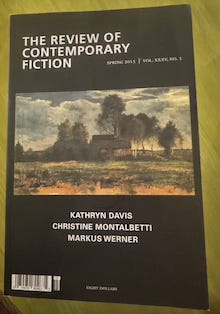
“Markus Werner’s Festland” by Jen Calleja
I first crossed paths with Markus Werner when, still wet behind the ears in translation, I reviewed Michael Hofmann’s translation of Zündel’s Exit for the Times Literary Supplement back in the summer of 2015. I’d not heard of Werner, though I was already a firm fan of Hofmann’s translations. Any translation of Hofmann’s is a friend of mine. I reveled in the book about a teacher gone AWOL and literally and figuratively falling apart in Greece, first in English and then in the original, right from page one (“O blankes Parkett” and the “spic and span floor,” “violet spew” and “den violetten Brei”).
I’m currently translating Marion Poschmann’s Die Kieferninseln (The Pine Islands) and I see a lot of Konrad Zündel’s petulant oversensitive nature in Gilbert Silvester, a dissatisfied academic researcher who dreams his wife is cheating on him and less than twenty-four hours later, high on paranoia, flees to Japan with what could be intentions similar to Zündel’s. Hofmann might be describing Gilbert when he says in a foreword to the novel that Zündel’s is “the tragic drama of
...This excerpt is provided for preview purposes. Full article content is available on the original publication.