The Free Will Debate
It amazes me how much of the systems and norms in our society perilously rely on the fundamental assumption that humans have a capacity for Free Will. The Problem of Free Will is one that has perplexed philosophers for centuries, and more recently neuroscientists, as they each try to reconcile what is known as the problem of Free Will:
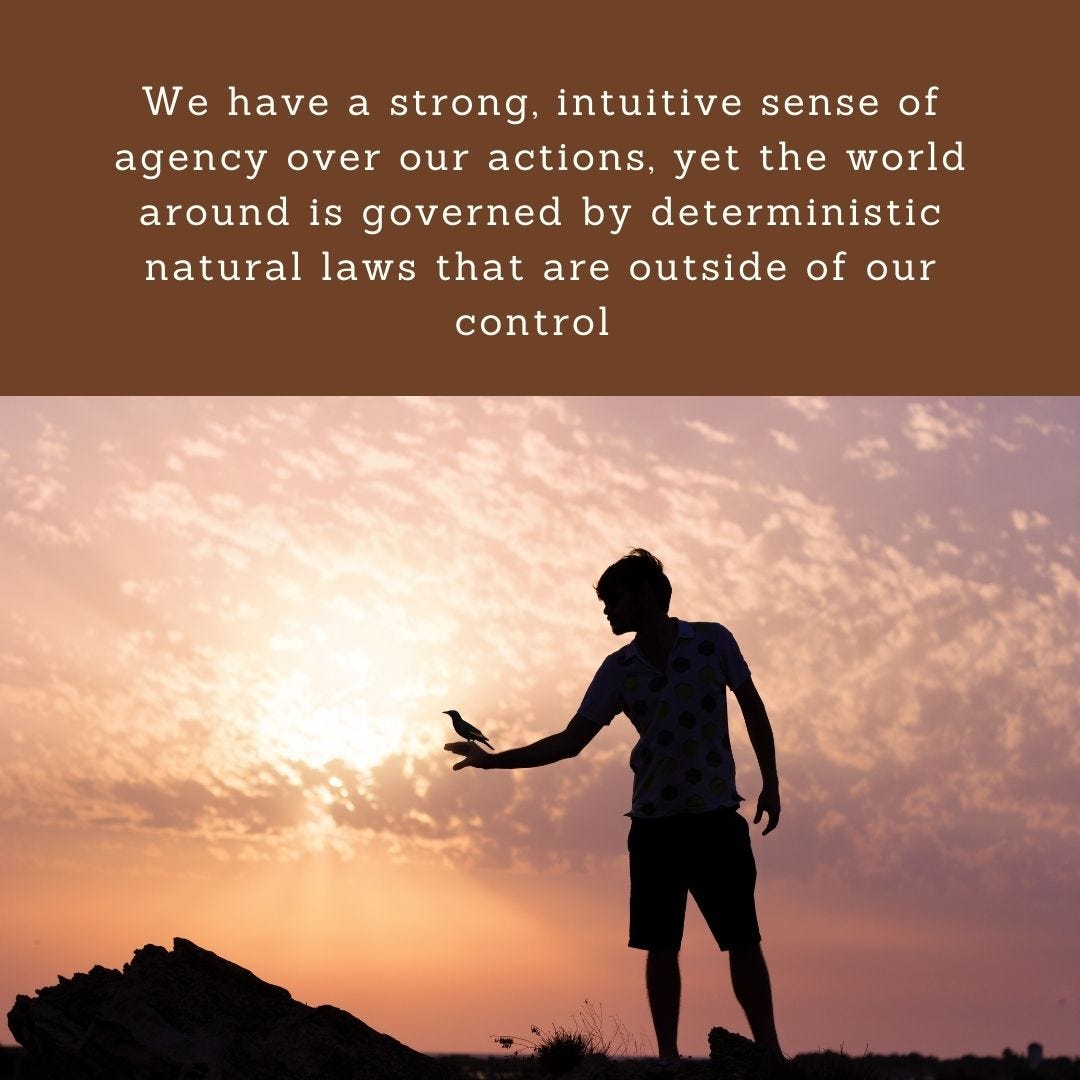
I’ve covered this topic from a couple of angles in the past in our intuition of choice and free won’t. But here I want to take an earnest look at two views on Free Will as outlined in Just Deserts: Debating Free Will, a book written by philosophers Greg Caruso and Daniel Dennett.
Two Views on Free Will
Before diving into two particular views on Free Will, I want to set a few soft boundaries to simplify our debate. First, it is worth asking: what kind of Free Will are we talking about here? I won’t be touching on the metaphysical aspects of the debate — we aren't interested in the randomness of subatomic particles, but it sure is interesting. I also won’t be talking about Free Will from a religious perspective. Most views on Free Will can fit into a variety of religious frameworks and I encourage each of you to do your own research about your own religion.
In essence, the definition of Free Will that we are questioning here is a capacity one has to control his or her own actions such that he or she justly deserves to be praised or blamed, rewarded or punished.
In Just Deserts, Greg Caruso is a Free Will skeptic meaning that he is unsure that humans have the capacity for Free Will and thusly disagrees that people truly deserve praise or blame for their actions.
Conversely, Daniel Dennett is a Free Will endorser, but of a particular kind. Dennett is what is known as a compatibilist which means that he acknowledges the deterministic nature of the natural world, but contends that there is room for humans to have Free Will.
A belief in Free Will, fundamentally, is a belief that at any give moment, we could go back in time to a moment with the exact same physical conditions and make a different choice. Unlike a skeptic like Caruso, a compabitilist reconciles the fact that the world goes on around us outside
...This excerpt is provided for preview purposes. Full article content is available on the original publication.