Is Oasis Overrated? A Statistical Analysis
Intro: Oasis is Everywhere
Over the past few months, an epidemic has swept through my friends and family: everyone I know is seeing Oasis in concert. After a fifteen-year hiatus, the most beloved Britpop band of the 1990s has reunited to considerable fanfare and $300 standing-room ticket prices. If you're unfamiliar with Oasis, you may recognize them as the band responsible for “Wonderwall.” And if you're unfamiliar with the song “Wonderwall,” then I don't know how that's possible.
Given the steep ticket prices and the band's polarizing reputation, any conversation about their reunion quickly devolves into a familiar debate: How many people actually like Oasis? My default response to this question is to label the band "overrated," a critique so common that Oasis die-hards rarely push back (because they're tired of defending the band).
After a handful of recent conversations in which I casually dismissed someone's favorite music as “overrated,” I started to question this impulse.
My behavior is oddly reminiscent of a high school bully.
If this band is readily considered “overrated,” perhaps I should figure out why.
So today we'll examine the case for and against Oasis, and explore why a musical act may be labeled “overrated” in the first place.
The Case For Oasis
Author's Note: If you're uninterested in the people who like Oasis, or any defense of the band’s cultural standing, feel free to skip ahead—the second section will give you plenty of ammo for future anti-Oasis arguments. If you'd like a nuanced take on the band's reputation, then read on.
Quantitatively speaking, there's no shortage of Oasis fandom—especially for those who came of age in the 1990s. On the strength of their first two albums alone, the band is one of the most commercially successful acts of the pre-Y2K era. The analytics site Chartmasters converts artist sales and streaming activity into a unified metric known as "Total Equivalent Album Sales," and by this measure, Oasis ranks among the 15 best-selling acts of the 1990s.
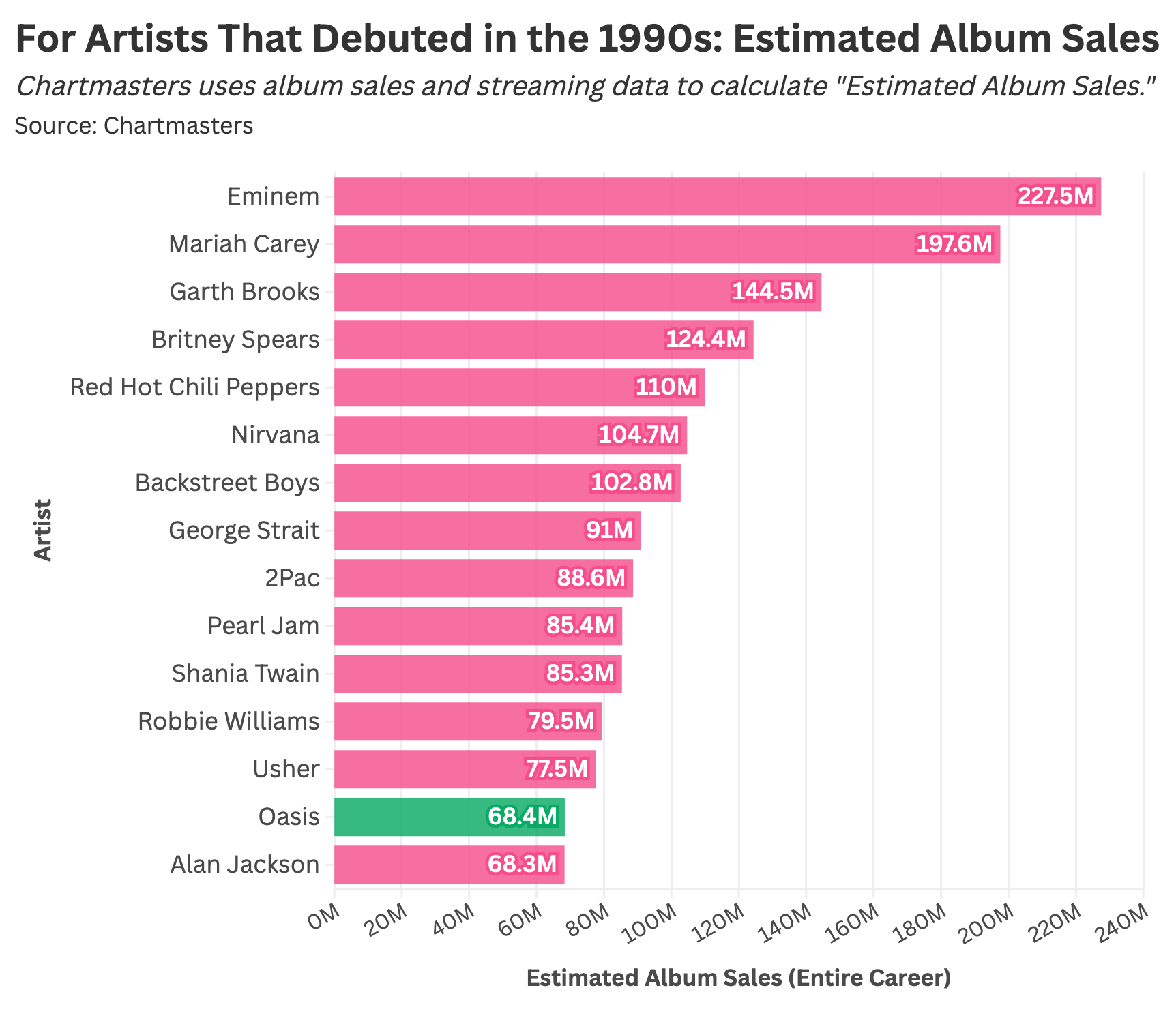
But how seriously can we take album sales in a decade that saw “Mambo No. 5,” “[The] Macarena,” and “MMMBop” top the charts? Maybe Oasis was another mega-selling ‘90s fad, alongside “Cotton Eye Joe,” MC Hammer, and purple ketchup.
The most common explanation for a polarizing cultural reputation stems from a disconnect between commercial success and critical acclaim—a pattern that holds
...This excerpt is provided for preview purposes. Full article content is available on the original publication.