"Don't Die"? What Bryan Johnson Gets Wrong
Deep Dives
Explore related topics with these Wikipedia articles, rewritten for enjoyable reading:
-
Longtermism
18 min read
The article critiques Bryan Johnson's individualistic approach to survival and contrasts it with collective, long-term thinking about species survival. Longtermism is the philosophical framework that prioritizes the long-term future of humanity, directly relevant to the author's argument about ecological survival vs. individual immortality.
-
Holocene extinction
13 min read
The article references species vanishing 'at a rate unseen in millions of years' and discusses mass extinction. The Holocene extinction (the ongoing sixth mass extinction) provides crucial scientific context for the author's claims about ecological collapse and collective survival.
-
Life extension
14 min read
Bryan Johnson's biohacking regimen is a form of life extension pursuit. This article would give readers scientific and historical context about anti-aging research, its methods, controversies, and the broader movement Johnson represents, helping readers evaluate his approach more critically.
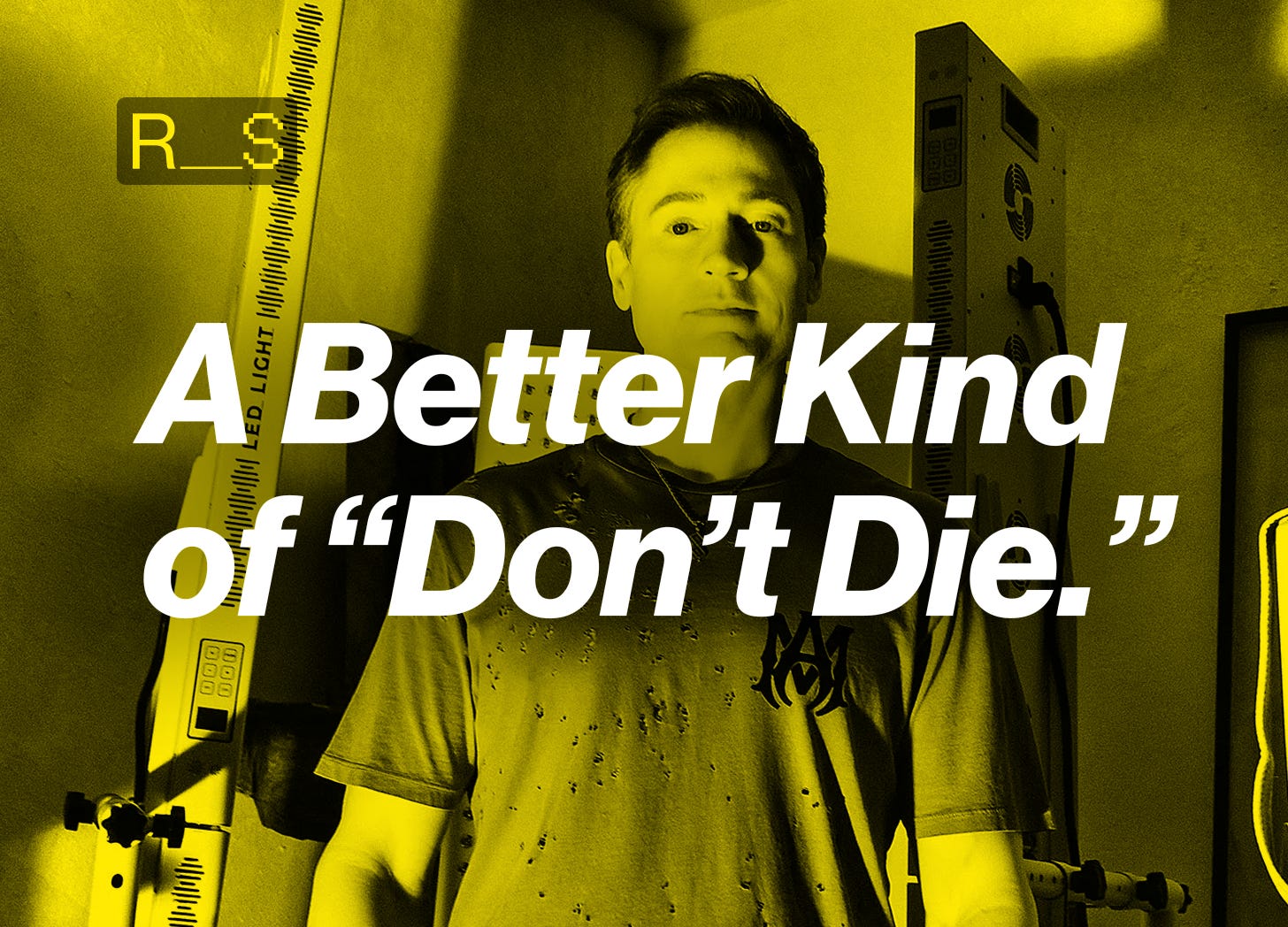
Bryan Johnson, the centimillionaire biohacker, entrepreneur, and investor who spends $2 million each year in a well-documented attempt to maintain the body of an 18-year-old, has become the mascot for a time-tested fantasy among the Silicon Valley set (especially among transhumanists and accelerationists): that death, like any other problem, can be optimized away. With his strict diets, blood transfusions, wearable trackers, and, uh, boner tracking, Johnson’s attempt to cheat death is unambiguous—and in case it managed to escape comprehension, he’s made the phrase “don’t die” his literal mantra. Unsurprisingly, it’s also the name of the Netflix documentary that chronicles his journey.
In these efforts, he’s also tried to brand “don’t die” as a rallying cry, framing his own outsized spending and lifestyle asceticism as beneficence, the upshot of which seems to be that his crusade is, at root, intended for public benefit. As flawed as this kind of god-complex justification always is among those with too much power, it’d be easier to believe that he actually believed this if he weren’t simultaneously building out a whole product line called Blueprint (again, he’s already a centimillionaire, worth nearly half a billion dollars), and if he’d proven himself to be committed to the public good in any other capacity, or even basic human decency.
For no reason whatsover, I’m including the conversation I had with Taryn Southern on the Urgent Futures Podcast:
But leaving aside the conclusions we’re left to draw about Johnson as a person, and the distorted ideas of people with too much money who—for some reason—never want to invest it in ways that would genuinely help people who urgently need it right now: “don’t die” is itself reflective of toxic late capitalist ideology. Watching the horror-show of 2025 continue to unfold, while working on my book manuscript for How to Survive the 21st Century, I felt compelled to use the momentum behind the adage to propose an alternative, more life-affirming framing.
“Don’t Die,” But Better This Time
Johnson’s version of “don’t die” is a mirror of the system that produced him—a world that demands endless growth, endless self-optimization, endless extraction. It’s not about life in any collective sense. It’s about domination over the conditions that make life fragile. It’s the capitalist death drive disguised as vitality.
Under these conditions, death is treated as an inefficiency. Aging is a bug to be fixed.
...This excerpt is provided for preview purposes. Full article content is available on the original publication.