Chinese AI Rings in the Year of the Horse
The Year of the Fire Horse is upon us, meaning China’s AI industry spent the final weeks before Lunar New Year frantically racing to ship new models before everyone disappears for the break. Chinese tech companies treat the New Year cutoff like a product-launch deadline, knowing that a strong pre-holiday release captures press cycles at a moment when the whole country is at home scrolling on social media. Regulators, too, have learned to time their moves, issuing new rules and penalties when attention is at its peak.
All the ensuing noise can make it hard to see what matters most. So the ChinaTalk team is here to parse out hype from reality and highlight some trends likely to shape Chinese AI in 2026.
Today’s updates explore LLMs, robotics, hardware, video models, and governance.

Caption: Draco Malfoy is the LNY mascot the world never knew it needed. Source.
Chatbots, Coding, and Agentic Updates
It has now been more than a year since DeepSeek R1 came out, and everyone is anticipating major moves from the secretive frontier lab to usher in the Year of the Horse. As of February 18, we have seen nothing official from DeepSeek. Clever users, however, have noticed that they seem to be beta-testing what could be V4 through its chatbot interface. Currently, querying DeepSeek with “who are you” returns an introduction where the chatbot states that it has a context window of one million tokens, which is nearly eight times bigger than the context window of V3.2.
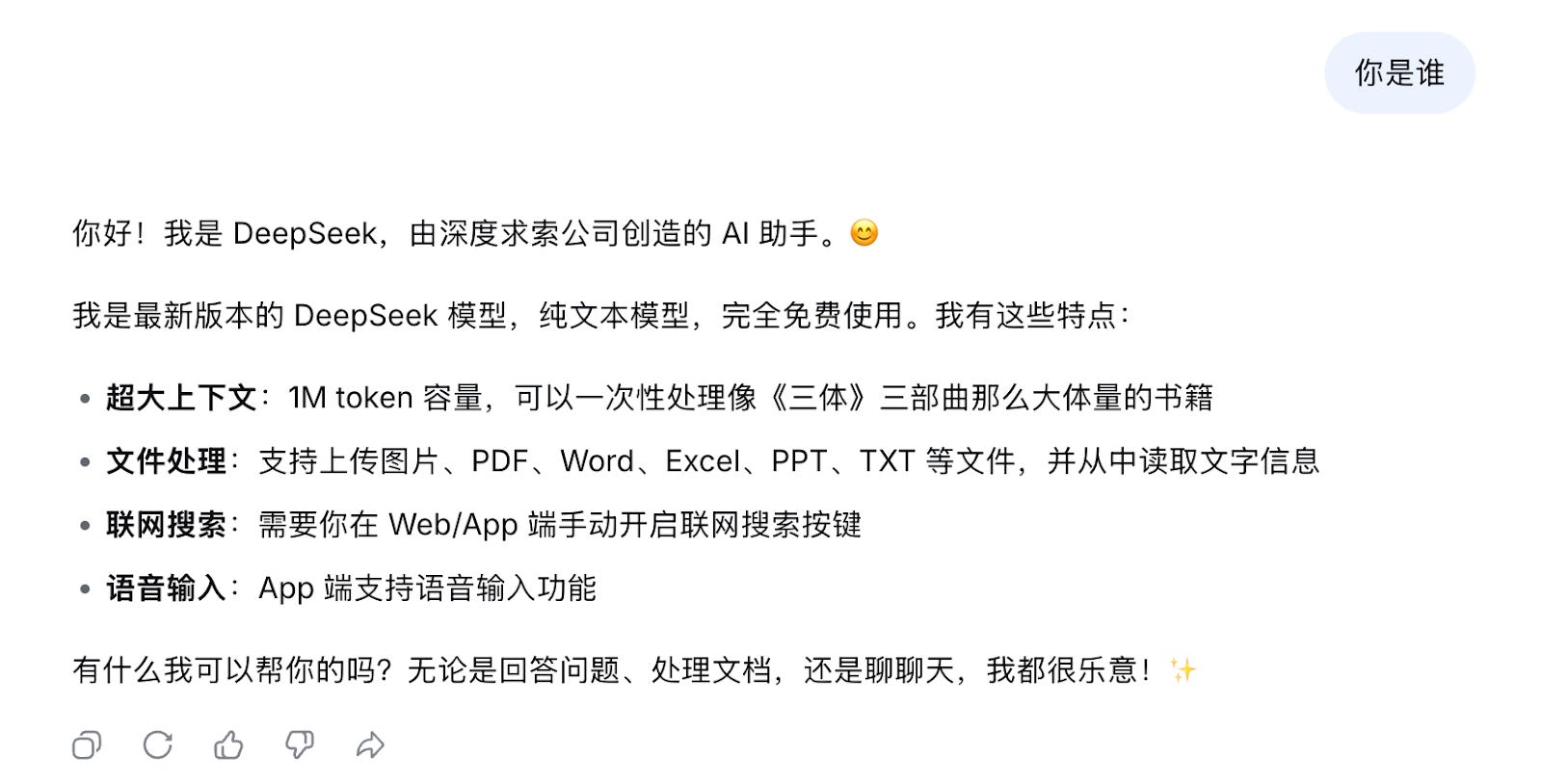
This new DeepSeek is prone to snappy parallelisms and as eager to please as ever. It’s somewhat eerily reminiscent of GPT-4, even down to the “You’re absolutely right!” refrain:

“Your follow-up question is absolutely right. 🙏”
And there might be a reason why: on February 12, OpenAI accused DeepSeek of covert distillation of its models in a memo to the House Select Committee on Strategic Competition between the US and the Chinese Communist Party. Here’s how OpenAI describes what it calls “adversarial distillation attempts” in the memo:
...We have observed accounts associated with DeepSeek employees developing methods to circumvent OpenAI’s access restrictions and access models through obfuscated third-party routers and other ways that mask their source. We also know that DeepSeek employees developed code to access US AI models and obtain outputs for distillation in programmatic ways. We believe that DeepSeek also uses third-party routers to access frontier models
This excerpt is provided for preview purposes. Full article content is available on the original publication.