Travel and its Discontents
On our last morning in Spain, near the beach in Barcelona, a parrot stole pizza from a flock of pigeons, flew it into a tree, and began to eat. A magpie, watching the interchange, thought he could best the parrot and take the pizza for himself. The parrot was having none of it, however, and the magpie, perhaps now feeling a bit outclassed, picked a fight with some other magpies. The three of them flew off into the city in a frenzy.
Travel is not as I remember it.
The number of people who travel is growing, but the world is not. The places, therefore, the ones from history, the places which those who think about such things will know the names of, are inherently more crowded.
One such place is the Alhambra, a great Moorish complex that began to come into being in the 9th century, and is now an immense relic in the middle of modern Granada. It was citadel, palace, and administrative center for hundreds of years, a city-fortress in which two thousand people once lived, a center of the Islamic Golden Age. Even now, empty of furnishings and the bustle of royal life, it is extraordinary. Within the Alhambra’s Nasrid Palaces (Palacios Nazariés), geometrically ornate tiles and carvings adorn every surface—floors, walls and ceilings—in wood, plaster, stucco, and ceramic, one room into the next, more and more and more, interspersed with perfect gardens.
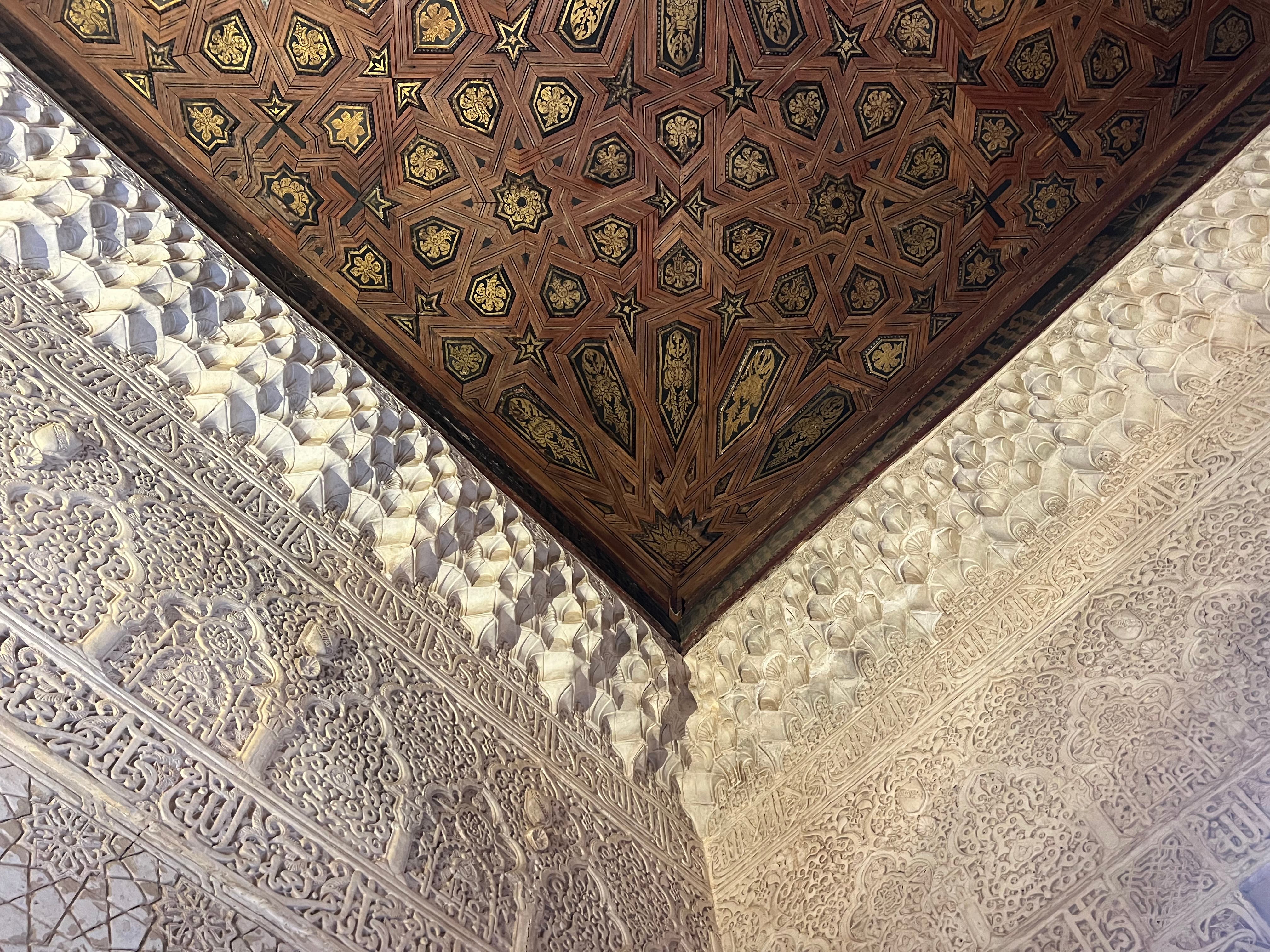
The number of visitors to the Alhambra’s biggest draw, the Nasrid Palaces, is capped at something like 8,000 per day, which is both a lot, and a little. Tickets are sold out months in advance. Even with the earliest timeslot to enter one morning, on a chilly morning in the off-season, we are amid throngs. Throngs shuffling. Throngs taking selfies with cameras on their phones. Throngs trying to pretend that they are alone, that the other throngers do not exist. But also, throngers who are not quite sure what it is that they are supposed to be doing there, either.
Yes, of course, there has always been the tourist problem. How do we simultaneously expand our horizons, appreciate how many ways there are to be human, how many different ways there are to live, while not destroying what we seek in the process? It is a true conundrum, a cultural observer
...This excerpt is provided for preview purposes. Full article content is available on the original publication.