If the Average American Ate Less Meat, How Much Climate Damage Would Be Avoided?
One approach to mitigating climate change is a sustainable lifestyle. This could include public transit, biking, avoiding flights, a smaller apartment, and a plant-based diet.
How important are such actions? Here in the United States, our individual carbon footprints are large. If we focus on consumption emissions, a metric that considers imported goods for our use, the average American produced 16.5 tons of carbon dioxide in 2022.
Using results from a recent study and a plausible carbon price, I am going to calculate how much climate damage the average American would avoid with a mostly plant-based diet.
The answer turns out to be $324 a year.
1. What’s the matter with meat?
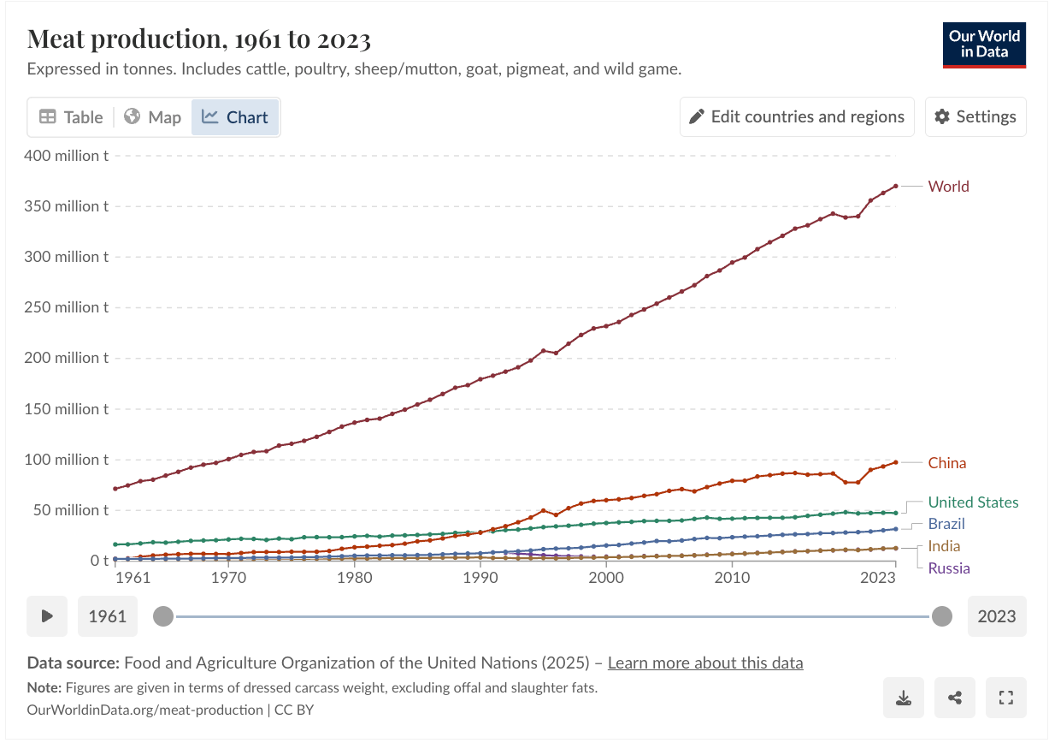
Humans eat a lot of meat when they can afford it. Global meat consumption grows every year, as economic growth enables millions to add something new on their plate. Besides being tasty, meat packs a lot of punch when it comes to protein. The figure below shows the relentless rise in global meat production, with China leading the way.
One problem with increased meat consumption is the environmental impact. Besides greenhouse gas emissions, notably methane from livestock, meat production requires a lot of land. Meat production also consumes a lot of water and produces water pollution and waste.
At the global level, meat consumption is a significant driver of climate change. According to the United Nations Food and Agriculture Organization, greenhouse gas emissions from meat production are equal to 12% of the global total. That is a large number.
But how important is meat consumption at the individual level? How much damage is caused here?
2. The study
A new study from the Technical University of Denmark suggests that a sustainable diet should contain at most 255 grams of pork or poultry (no beef, sorry). This is quite a decrease from the two kilograms of meat per week that the average American ate in 2022.
The study evaluated 100,000 different diet variations to identify those that met basic nutritional needs while limiting environmental impact. As for greenhouse gas emissions, a sustainable diet would generate about five kilograms of carbon dioxide per week.
These kinds of studies have their limitations. The debate on optimal nutrition is far from settled. The planet responds to total greenhouse gas emissions, not food-specific emissions. Meat can be produced in different ways, so the confidence intervals around greenhouse gas emissions per gram of
...This excerpt is provided for preview purposes. Full article content is available on the original publication.