Mystery of the Head Activator
Deep Dives
Explore related topics with these Wikipedia articles, rewritten for enjoyable reading:
-
Nerve net
1 min read
Linked in the article (10 min read)
-
Hydra (genus)
16 min read
The article centers entirely on hydra biology and the mystery of head regeneration in these organisms. Understanding the biological characteristics, regenerative abilities, and scientific significance of hydra provides essential context for appreciating why the 'head activator' research was so captivating to developmental biologists.
-
Morphogen
1 min read
The article describes the head activator as 'the first morphogen ever sequenced' and discusses how it was believed to guide tissue development. Understanding what morphogens are and how they control pattern formation in developing organisms is crucial for grasping why Chica Schaller's claimed discovery was so significant to the field.
By Brady Huggett
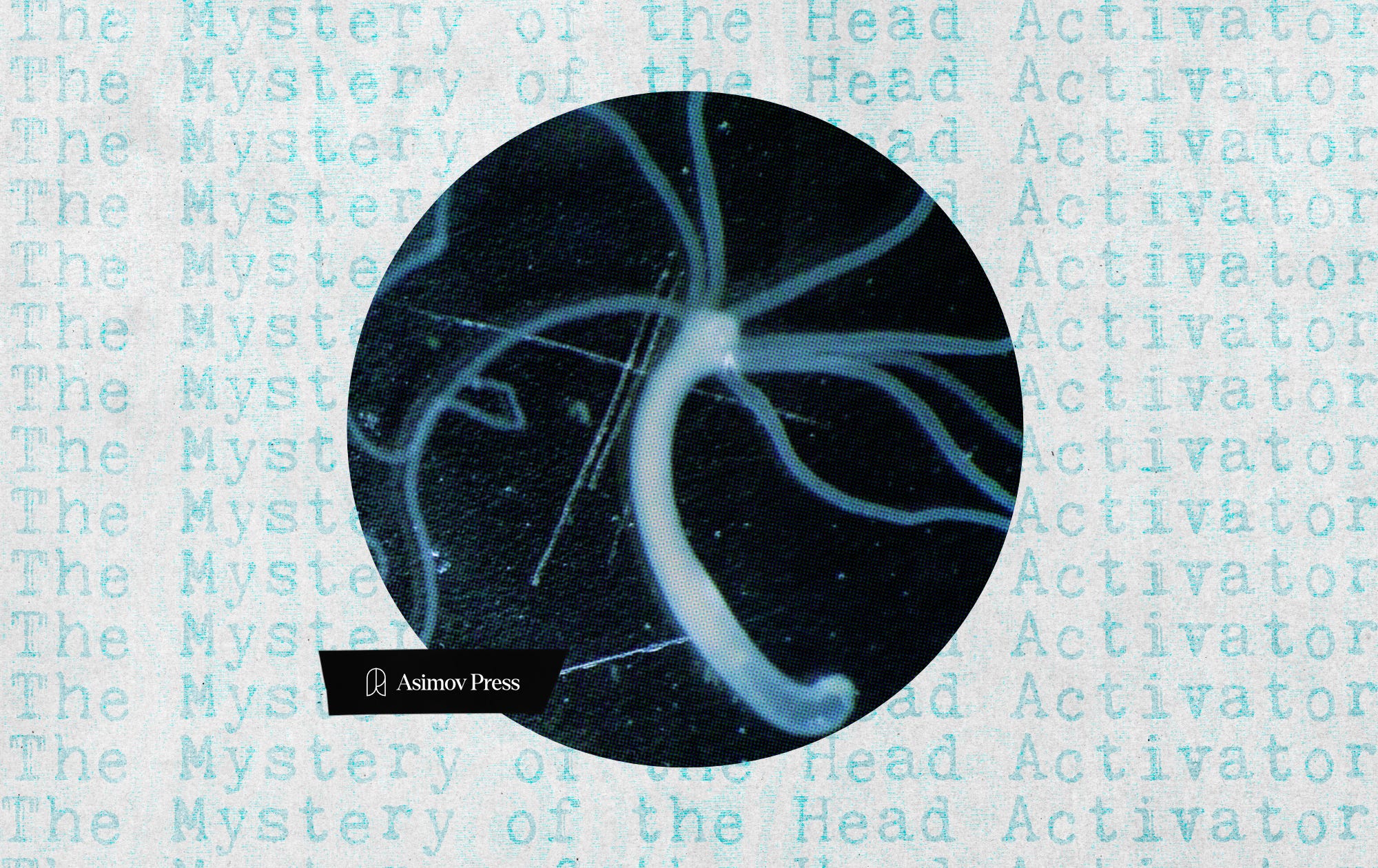
Most of the people in this story have already died, but there are still some who remember a finding that captivated the developmental biology field decades ago. The story concerns a molecule, known as the “head activator,” which was believed at that time to be a short neuropeptide necessary for head regeneration in the freshwater cnidarian hydra.
In 1973, a German graduate student named H. “Chica” Schaller published a paper under the prolix title: “Isolation and characterization of a low-molecular-weight substance activating head and bud formation in hydra.” The work was conducted in the Alfred Gierer lab at the Max-Planck-Institute for Virus Research in Tübingen, Germany. The lab had been working to understand morphogenesis (the process by which an organism develops) in Hydra attenuata. In the course of this work, they uncovered a substance that they claimed was responsible for initiating head formation in hydra.
Chica’s paper emerged as the fields of developmental biology and molecular biology were intersecting. In 1924, Hans Spemann and Hilde Mangold demonstrated the concept of an “organizer”— a cluster of cells within the newt embryo that could induce or guide the development of surrounding tissue when inserted in another species of newt. In the elapsing decades, the field had observed similar organizational activity across species, but the molecular underpinnings for these phenomena were unknown. Chica’s 1973 paper drew on these findings to propose a similar mechanism in hydra, putting her name on the developmental biology map.
Later, she and her colleague Hans Bodemüller would sequence the substance — the first morphogen ever sequenced, actually — and make it available to any interested researcher. The head activator became synonymous with Chica’s name. Over the years that followed, both she and her colleagues published a string of papers about it, as well as studies on inhibitors in hydra, and Chica was asked to present at conferences in both Europe and the U.S.
The problem was that her findings were seemingly impossible to replicate. Both her early colleagues and the people in the larger Hydra field eventually abandoned them: Stefan Berking was unable to repeat her work; Charles David watched as new explanations for hydra morphogenesis arose; and Robert Steele decided her claims weren’t worth wasting funding dollars on.
Today, while the Hydra remains a useful model for the study of nerve nets, aging, and regenerative medicine, new explanations have emerged to explain
...This excerpt is provided for preview purposes. Full article content is available on the original publication.