Terror, Violence and Poetic Defiance in Russia
Deep Dives
Explore related topics with these Wikipedia articles, rewritten for enjoyable reading:
-
Oprichnina
12 min read
The article repeatedly references Ivan the Terrible's oprichniki as a symbol of state terror that echoes through Russian history to the present day, including Sorokin's novel 'The Day of the Oprichniki'. Understanding this specific institution of political repression provides crucial context.
-
Great Purge
16 min read
The article discusses Stalin's Terror of the 1930s as central to debates about Russian state violence, mentioning the purges, show trials, and NKVD arrests. This specific historical period is essential context for understanding the article's arguments about continuity in Russian political violence.
-
Hannah Arendt
12 min read
The article critiques the 'totalitarian model' and specifically mentions Arendt's 'Origins of Totalitarianism' (1951) as foundational to this framework, noting its recent revival. Understanding Arendt's work and its historical context illuminates the historiographical debate at the article's core.
This full post is on me for all readers. Please enjoy the full deep dive and voiceover. My 2026 plan for for paid subscribers is coming soon. Please join me to learn more from history.
Is Russia built on a history of violence? Do its people live under the shadow of terror? And, if that is so, how did its poets, like Pasternak, Akhmatova or Sergei Eisenstein, defy terror and state violence to create the most enduring, compassionate art of the 20th century?
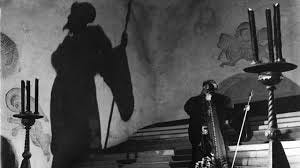
In Eisenstein’s film Ivan the Terrible, directed under the scrutiny of Stalin, Ivan’s shadow haunts the Kremlin walls, just as the history of terror and state violence haunts Russian history. The shadows generate the Russia Anxiety.
Welcome to week three of the Russia World History Tour. This week we ask whether Russian history is exceptional in its terror and violence.
Ivan’s Shadow & Terror in Russian History
Mark B. Smith begins chapter five of The Russia Anxiety, “The Terror Moment: Is Russia Built on a History of Violence?” with the stories of the most spectacular state violence which “Russia’s cruellest Tsar” inflicted during the years of the oprichniki.
Ivan was more complex than Western caricatures of the Terrible. I have long harboured a theory he suffered borderline personality disorder. Yet there is no doubt he was cruel, violent, and sadistic. He practised state violence in a European cultural era of spectacular state violence. Notoriously on 25 July 1570 at Poganaya meadow in Moscow, Ivan, personally and through his executioners, publicly tortured, mutilated and killed 116 of his leading and most senior officials. You can read the details in de Madariaga’s Ivan the Terrible; I will spare you the horror, but note the reflection of Soviet historian, A.A. Zimin (1920-1980),
The Russian capital had seen many horrors in its time. But what happened in Moscow on 25 July, in its cruelty and sadistic refinement, outdid all that had gone before and can perhaps be explained only by the cruel temperament and the sick imagination of Ivan the Terrible.”
Quoted Madariaga, Ivan the Terrible, p. 259
Zimin and the film director Eisenstein would have witnessed in his youth another inexplicable act of cruel, personally directed state violence, Stalin’s terror and the purges of the 1930s. Ivan IV and Stalin stand like
...This excerpt is provided for preview purposes. Full article content is available on the original publication.