It's Time to Read 'Mein Kampf' Again
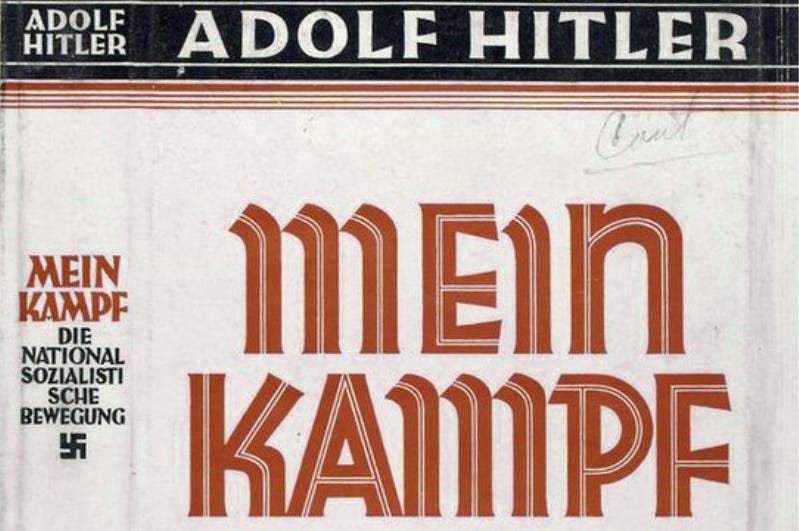
Hitler’s manifesto has a very strange publication history. The first volume, written during Hitler’s imprisonment in Landsberg after a failed Munich coup, was published in 1925. The second volume, detailing a strategy for the preservation and development of an Aryan, German race, was published in 1926. After Hitler’s death, the Bavarian government acquired the publishing and distribution rights to Mein Kampf, and refused to make the book publicly available until their copyright expired and it was again legally distributed in Germany in 2016, for the first time since WWII. Within this 80-year period, however, many cases were made for lifting the ban on Mein Kampf – with Europe having regained some relative stability after the war, a period of political calm was claimed to rationally justify a moment of reflection, for Germans to confront their past by being exposed to the thoughts of their most tyrannical leader. But this schematic rationale didn’t really occur. In fact, one of the more notable efforts to legalise the sale of the book coincided with one of the most acute economic crises since WWII: the 2008 financial crash. Stephan Kramer, then the secretary-general of the Central Council of Jews in Germany, argued not during a period of stability, but during one of the greatest crises of global capitalism, that the time was right for the book to once again be made available to the general reader, not as propaganda, but as an education in ideology.
Yet Kramer’s hopes for a public education by exposure to Mein Kampf did not come to fruition. In fact, the prolonged censorship of the book only fuelled the right-wing revival of Hitler’s ideas. When the ban on the book was eventually lifted in 2016, independent extremist publishers soon began releasing uncritical and unannotated editions. With the implicit endorsement of Hitler’s message through these editions, the distribution of unabridged versions of Mein Kampf was soon ruled as an “incitement of masses”, and hence illegal under German law. In America, Mein Kampf had a more continuous, albeit regulated, distribution through the US Government and under the protection of the First Amendment. In 1979, however, alongside the dawn of neoliberalism through the election of Margaret Thatcher, as well as the early seeds of Islamic theocracy following the Iranian Revolution, Houghton Mifflin bought the rights to the book from the government, leading to a strange predicament in which they were
...This excerpt is provided for preview purposes. Full article content is available on the original publication.