We Are Not Low Creatures

We are not low creatures.
This is what I have been thinking this week. Even though humanity often does, at its worst, act as low creatures.
Some act like vultures, cackling over the dead. Or snakes, who strike to kill without warning, then slither away. Or spiders, who wait up high for victims, patient and hooded and with the blackest of eyes.
But as a whole, I still believe that we are not low creatures. We must not be low creatures. We simply need something to help us remember.
An arrow-shaped rock on Mars, only a few feet across, and found sitting at the bottom of an ancient dried-up river, helped me remember. For, on Wednesday, and therefore lost amid the news this week, a paper was published in Nature. It was the discovery that—arguably for the first time in history—there are serious indications of past life on Mars.
Specifically, these “leopard spots” were analyzed by the rover Perseverance.
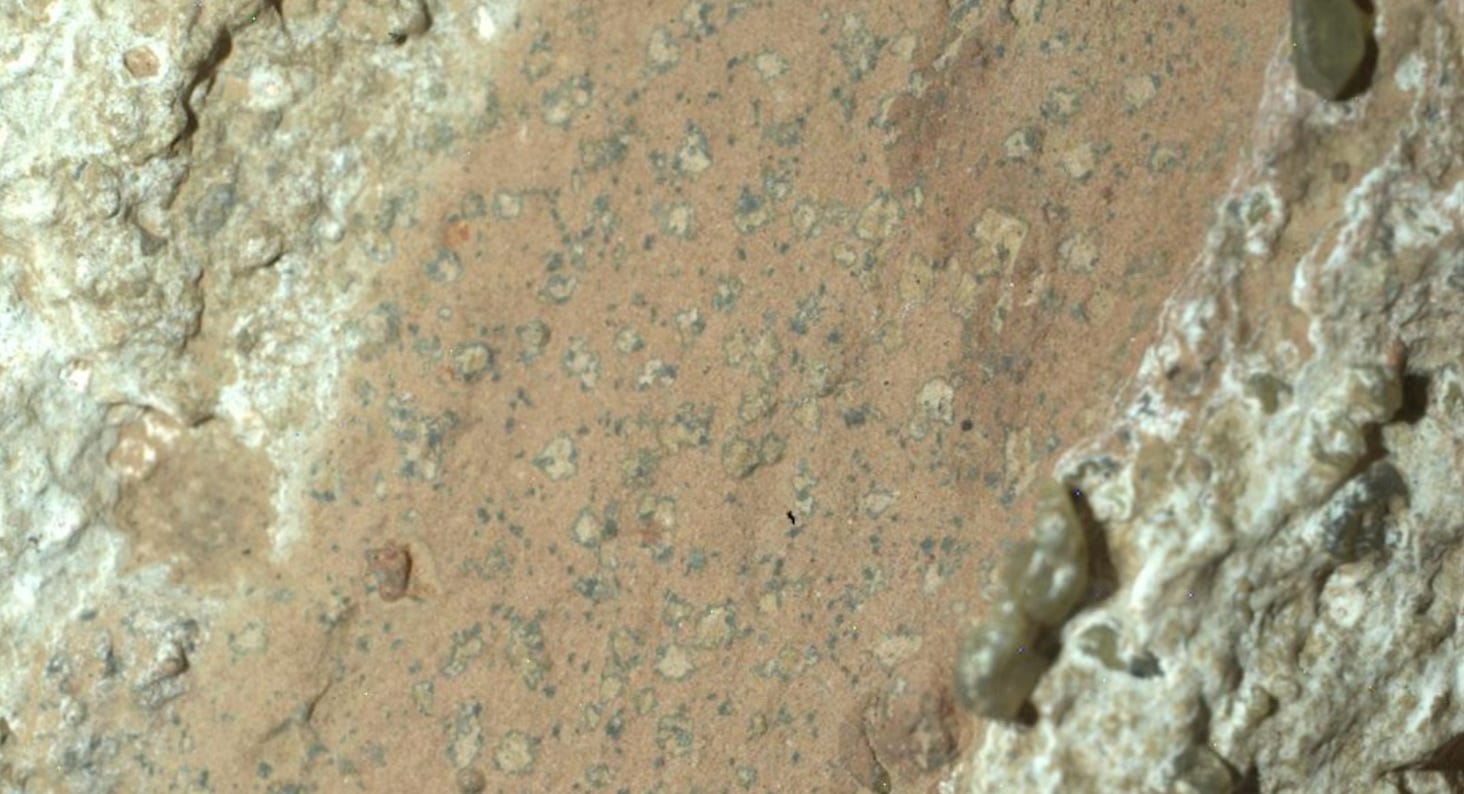
According to the paper, these spots fit well with mineral leftovers of long-dead microbes.
Minerals like these, produced by Fe- and S-based metabolisms [iron and sulfur metabolisms], provide some of the earliest chemical evidence for life on Earth, and are thought to represent potential biosignatures in the search for life on Mars. The fact that the reaction fronts observed in the Cheyava Falls target are defined by small, spot-shaped, bleached zones in an overall Fe-oxide-bearing, red-coloured rock invites comparison to terrestrial ‘reduction halos’ in modern marine sediments and ‘reduction spots’, which are concentrically zoned features found in rocks of Precambrian and younger age on Earth.
It matches with what we know about some of the oldest metabolic pathways here on Earth, and there are not many abiotic (non-biological) ways to create these sorts of patterns, and of those abiotic ways (the null hypothesis) there is no evidence right now that this rock experienced those.
Maybe this helps people contextualize it: If this exact same evidence had been found on Earth, the conclusion would be straightforwardly biological, and an abiotic explanation would be taken less seriously—such a finding would likely end up in textbooks about signs of early life on Earth and used to argue for hypotheses about how life evolved here. Remember, without fossils, all we have are similar traces of the early life on Earth. What are cautiously called “biosignatures” on Mars are the exact
...This excerpt is provided for preview purposes. Full article content is available on the original publication.