#91. Rousseau’s Errors: They Persist in Some Educational and Child-Rearing Theories Today*
Deep Dives
Explore related topics with these Wikipedia articles, rewritten for enjoyable reading:
-
Jean-Jacques Rousseau
12 min read
The article critiques Rousseau's educational philosophy extensively but assumes reader familiarity with his broader philosophical contributions and historical context. Understanding his life, other works, and influence on Enlightenment thought provides essential background.
-
Emile, or On Education
11 min read
The article analyzes this specific work in depth but readers would benefit from understanding its historical reception, influence on subsequent educational movements, and the controversy it sparked when published.
-
Sudbury school
10 min read
The author contrasts Rousseau's approach with the Sudbury Valley School model of self-directed education. Understanding this democratic free school philosophy provides crucial context for the alternative the author advocates.
Dear friends,
In Letter #90 I described the difference between progressive education and Self-Directed Education and explained why, though I am sympathetic with many of the goals of progressive education, I’m an advocate, instead, of Self-Directed Education. As follow-up to that, I thought you might enjoy this essay, a slightly modified version of one I wrote 16 years ago, about Rousseau’s philosophy of education, which might be understood as an absurd exaggeration of some of the views of progressive education.
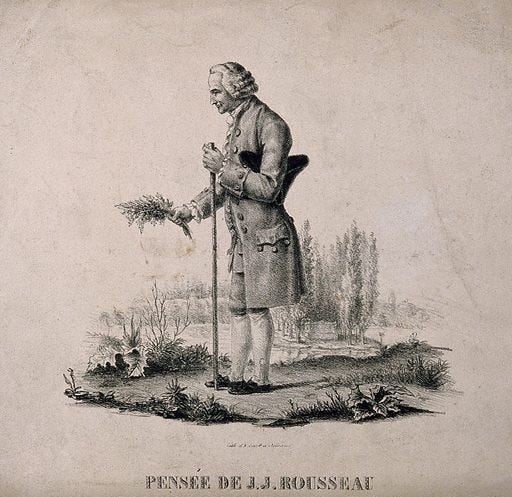
Jean-Jacques Rousseau is known as the "back-to-nature" educational theorist He is referred to frequently in education texts as the originator of child-centered, natural means of education. Those of you who have read my previous writings know I have been writing about children's natural means of education for many years, so you might assume I would be inspired by Rousseau. I am inspired--inspired to point out how very wrong he was.
Rousseau's sole work on educational theory is his book Émile, first published in 1760, which describes the education of a fictitious boy, whose name is the title of the book. The book is partly a novel and partly a philosophical treatise on the natural goodness of human beings and how to preserve that goodness through an education that does not corrupt.
Pity poor Émile! He is subjected in Rousseau's work to the most extreme form imaginable of what today some might call child-centered or progressive education. Émile spends the first 25 years of his life in the company of his tutor, referred to as the master, who is presented by Rousseau in the first person. The master is an extraordinarily intelligent, accomplished, devoted man who continuously studies Émile, gets to know his every motive and whim and uses that knowledge to provide the boy with just those experiences that best impart the exact lessons that the master deems appropriate. The student-teacher ratio is one-to-one.
The master controls the boy constantly, not through orders but through what two centuries later Skinnerian psychologists would refer to as "behavioral engineering." He manipulates Émile's environment in such a way that the boy always chooses to do exactly what the master believes is good for him. For this to happen, Émile must, for his first 15 years, be isolated from other social forces, including other children. The master is his sole companion. The boy also must be isolated from all literature
...This excerpt is provided for preview purposes. Full article content is available on the original publication.