Goliath's Curse: How & Why Societies Collapse, & What We Can Do About It - Luke Kemp | #54
ICYMI 👉 I’m going Live on Substack with today at 12pm EDT/9am EDT for “How to Tell Strategic Stories that Clarify Climate Crisis.” Come with questions!
Welcome to the Urgent Futures podcast, the show that finds {signals} in the noise. Each week, I sit down with leading thinkers whose research, concepts, and questions clarify the chaos, from culture to the cosmos.
👉 Never miss an episode! 👉 Subscribe to Urgent Futures now: Youtube | Apple Podcasts | Spotify.
And if you’re loving the show, please share it with a friend who you think would as well!
My guest this week is Luke Kemp.
Luke researches the end of the world. He is a Research Affiliate at the Centre for the Study of Existential Risk (CSER) at the University of Cambridge. He has advised and led foresight studies for multiple international organisations, including the WHO and Convention on Biological Diversity. His work has been covered by media outlets such as the BBC, the New York Times, and the New Yorker. He is the author of the bestselling book Goliath’s Curse: The History and Future of Societal Collapse.
I’ll be frank. If you’re looking to understand collapse from a systemic point-of-view, with the most contemporary research available, you have to start with Goliath’s Curse.
Buy Goliath’s Curse here!
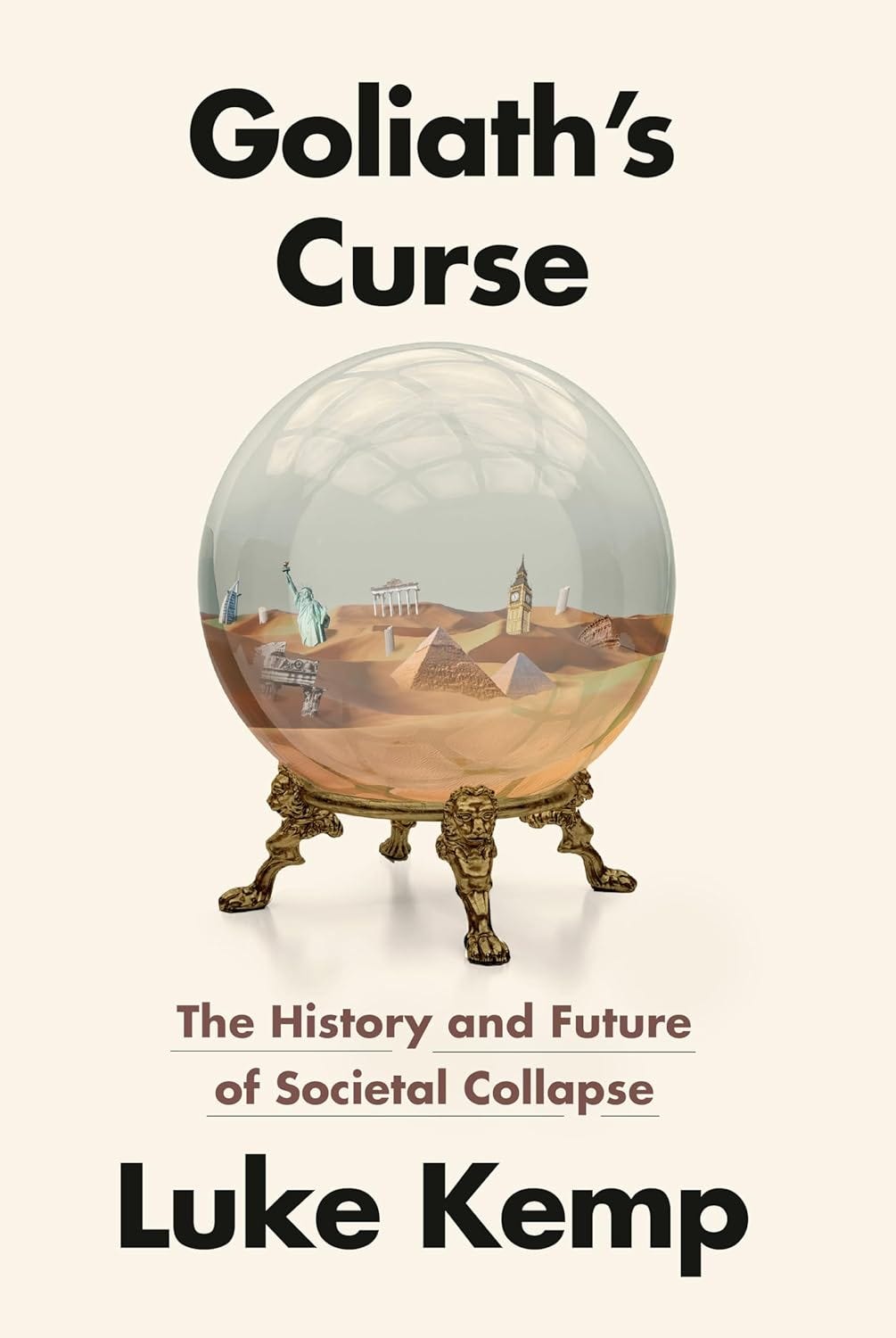
“Collapse” is one of those words that’s bandied about a lot—especially with conversations about the future of the United States and U.S. hegemony—and is therefore prone to debate, misconceptions, and a variety of uses. Luke cuts through that noise to make the case that collapse isn’t just a sensationalist concept or a fringe worry—it’s a recurring feature of history in human societies, a cocktail of human evolutionary psychology and the power of symbolic communication, which allows us to craft stories and ideologies that, among other things, grant particular people the ability to cast themselves as more deserving of finite resources and form dominance hierarchies.
Before I go any further, I also want to give a huge shoutout to Onassis ONX Studio for making the space for this interview.

Combining empirical research, historical case studies, and contemporary global trends, he shows how what he calls goliath fuel—stuff like lootable resources and new technologies—allows for the formation of “goliaths,” a word he uses to sidestep the colonialist implications of “civilization,” going to pains to demonstrate how many of the empires we glamorize today were
...This excerpt is provided for preview purposes. Full article content is available on the original publication.