We Found Errors in Lazard's Firming Cost Calculations
Deep Dives
Explore related topics with these Wikipedia articles, rewritten for enjoyable reading:
-
Capacity factor
10 min read
The article discusses Effective Load Carrying Capacity (ELCC) and firming costs, which are directly related to capacity factor - a crucial metric for understanding why intermittent renewables need backup generation and how their actual output compares to nameplate capacity
-
Midcontinent Independent System Operator
10 min read
MISO is central to the article's error discovery and firming cost calculations. Understanding how this regional transmission organization manages the grid across 15 U.S. states provides essential context for the technical discussion
-
Westinghouse Electric Company
10 min read
The article ends discussing an $80 billion nuclear reactor deal involving Westinghouse. The company's history as a nuclear power pioneer and its recent corporate restructuring provides valuable context for understanding the significance of this government partnership
Our readers know that we are often critical of Lazard’s Levelized Cost of Energy Plus (LCOE+) report because we think it intentionally skews its analyses to make wind and solar look artificially affordable while ignoring additional hidden costs like those for transmission, taxes, and providing backup for these intermittent generators.
So you can imagine our delight last week when we identified an error in their LCOE+ report regarding the company’s calculations of its cost of “firming” wind and solar resources, and they were forced to issue a correction to their slides. Sadly, they did not mention that they corrected their slides or credit us for finding the error.
How rude.

About LCOE and Lazard’s New Firming Cost Metric
We’ve already written several articles about what the LCOE is and its shortcomings for comparing the cost of dispatchable and non-dispatchable resources. You should check them out if you’re just getting acquainted with our work.
Today’s piece examines Lazard’s newish Levelized Firming Cost Metric and how it attempts to address the fact that its previous reports did not incorporate any load balancing or system cost increases stemming from adding intermittent wind and solar to its system. It’s Lazard’s way of making wind and solar more comparable to dispatchable resources like coal, natural gas, and nuclear.
According to Lazard:
Lazard’s Cost of Firming Intermittency analysis builds on the LCOE results by evaluating system-level costs associated with supplementing intermittent renewable energy on the grid with firm capacity to ensure reliable electricity delivery during peak demand periods.
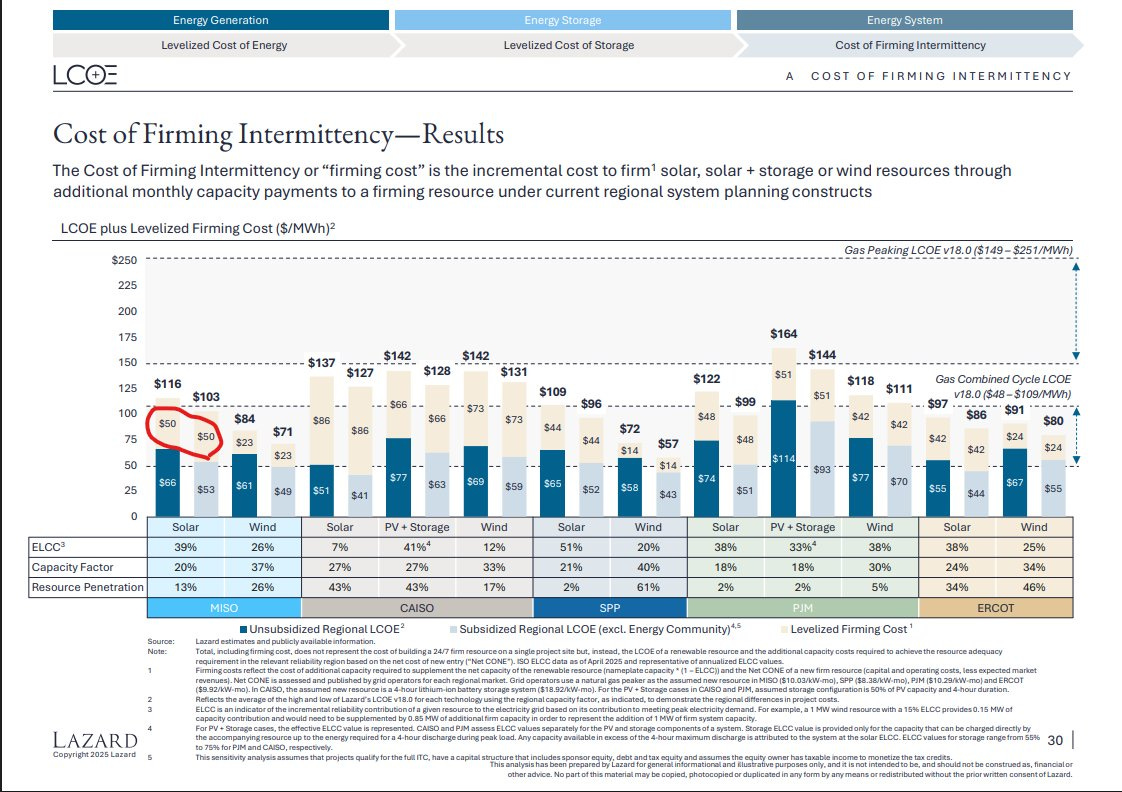
Lazard assesses the firming cost based on the capacity value of a resource (generally expressed as Effective Load Carrying Capacity, or ELCC) and the net Cost of New Entry (CONE) costs, expressed in dollars per kilowatt-month, published by grid operators for each regional market to determine the cost of new capacity in these markets. The equation can be seen below.

While working on another project, we realized that there was an error in Lazard’s firming cost math for solar projects in the Midcontinent Independent System Operator (MISO) region. Using the MISO variables provided in Lazard’s report, we determined that it overestimated firming costs under its own methodology.

Lazard’s original report said the firming cost of wind and solar in the region was $50 per megawatt-hour (MWh). However, based on the assumptions in their report, we calculated a cost of $41.91 per MWh.
So we reached out to
...This excerpt is provided for preview purposes. Full article content is available on the original publication.