After the Last David Graeber Post; or, Once Again Unto the Breach...
Deep Dives
Explore related topics with these Wikipedia articles, rewritten for enjoyable reading:
-
Teotihuacan
13 min read
Central to the article's discussion of whether large cities can exist without centralized hierarchy. Scheidel identifies it as the single solid case of a non-royal large city, making understanding its actual archaeology and governance structure essential context.
-
Cahokia
12 min read
The article's climax uses Cahokia as a test case for whether alternatives to hierarchical grain states were possible in the Americas. Understanding this pre-Columbian city's rise and mysterious abandonment illuminates the debate about state formation.
-
Hydraulic empire
14 min read
The article discusses 'grain states' and how control over agriculture led to hierarchical societies. The hydraulic empire theory (Wittfogel's concept linking irrigation to despotism) is foundational to these debates about why states formed as they did.
The perils of Speculative Nonfiction, the Grand Narrative trap, the importance of basing yourself in reality, & the recognition that it is not ideas that control social reality, but rather underlying modes of production, distribution, coërcion, and communication that set the boundaries of the playing field on which ideas contend for honors in influencing—not controlling—social reality…
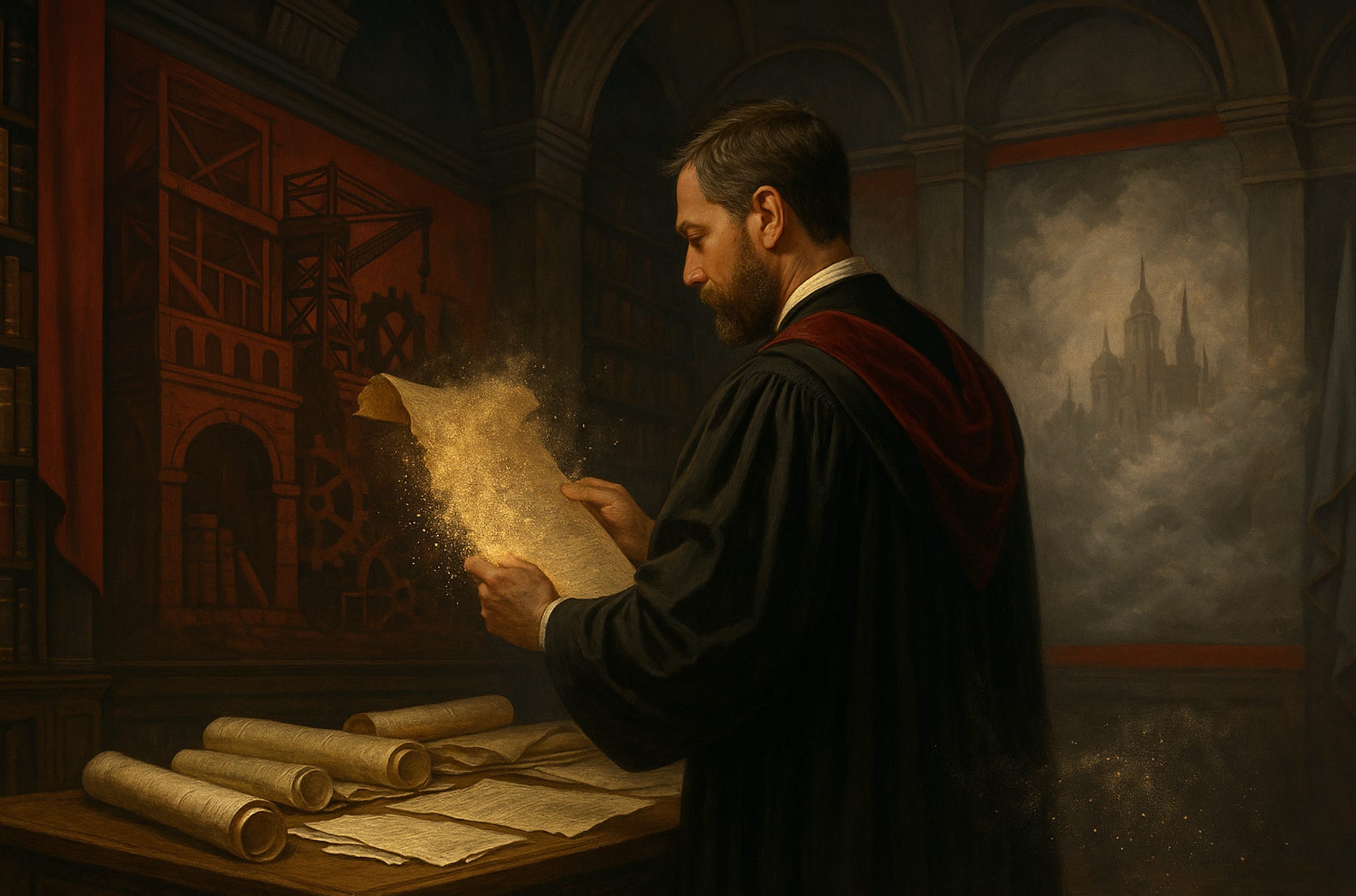
Can we “rediscover the freedoms that make us human” by rewriting the past into fake patterns? Or does such fact-unmoored idealism trap us in a cage of our own making? The case of Graeber and Wengrow’s The Dawn of Everything offers a cautionary tale for would-be utopians and their readers. It claims to be a bold reimagining of human history. But since the scaffolding of fact is too thin to support the Grand Narrative, they resort to fake facts, and so we leave us with more than faërie gold? “Speculative Nonfiction” is not, I think, a useful intellectual genre.
On my mind because <http://readwise.io> surfaced this today:
Bret Devereaux: <https://bsky.app/profile/bretdevereaux.bsky.social/post/3lyawbqzsmk2g>: ‘For as often as I get asked "What do you think of Graber and Wengrow's The Dawn of Everything" I need to just have a blog post titled, "What I think of The Dawn of Everything" which is just a link to @walterscheidel.bsky.social's devastating review (here: escholarship.org/uc/item/9jj9...)…

Indeed.
Here are some highlights from Scheidel:
...Walter Scheidel: Resetting History’s Dial? A Critique of David Graeber & David Wengrow, “The Dawn of Everything: A New History of Humanity” <https://escholarship.org/uc/item/9jj9j6z7>: ‘Graeber and Wengrow condemn “conventional narratives of world history, which present the planting of a single seed as a point of no return” (260). Yet as hyperbolic as this claim is made out to be, it is, in the end, true…. Farming had managed to spread almost everywhere 2,500 years ago and… unlocked terrestrial carrying capacity in ways that allowed our species to grow in number by three orders of magnitude between the end of the Holocene and today…. [Their] directing the spotlight at hybrid forager-farmers and at developmental lags, detours and hiatuses [in the process of the conquest of humanity by agriculture and our consequent enslavement in societies-of-domination] is… worthy…. Yet… a trap that was slow in closing was, in the end, a trap….
Strenuous mental gymnastics…. The authors advance the “speculative” claim that certain structures
This excerpt is provided for preview purposes. Full article content is available on the original publication.