Objections to Direct Realism
Deep Dives
Explore related topics with these Wikipedia articles, rewritten for enjoyable reading:
-
Sense data
13 min read
The article argues against indirect realism's claim that we perceive mental representations rather than physical objects. Sense data is the central concept in this debate - the supposed mental intermediaries that indirect realists claim we directly perceive. Understanding sense data theory is essential context for Huemer's rebuttals.
-
Thomas Reid
14 min read
Huemer directly cites Thomas Reid's response to the argument from perspective, specifically Reid's distinction between angular and linear magnitude. Reid was a foundational figure in direct realist philosophy and the Scottish Common Sense school, making his philosophical contributions highly relevant background.
Objections to Direct Realism

Here, I rebut objections to direct realism.*
[ *Based on: Skepticism & the Veil of Perception (Rowman & Littlefield, 2001), ch. 6. ]
There are many objections to direct realism that the proponents of the objections seem to think are really great but that are in fact not great at all. Many of the objectors seem to have little idea of what direct realism is and don’t bother to try to define it. If you don’t know what it is, see my earlier post, “A Version of Direct Realism”. I won’t here repeat that account but will just launch into the objections.
1. The Argument from Perspective
David Hume’s “refutation” of direct realism:
But this universal and primary opinion of all men is soon destroyed by the slightest philosophy, which teaches us, that nothing can ever be present to the mind but an image or perception …. The table which we see seems to diminish as we remove farther from it. But the real table, which exists independent of us, suffers no alteration. It was, therefore, nothing but its image which was present to the mind. These are the obvious dictates of reason, and no man who reflects ever doubted that the existences which we consider when we say this house and that tree, are nothing but perceptions in the mind and fleeting copies or representations of other existences which remain uniform and independent. [Enquiry, XII.1, punctuation modernized]
It looks like the syllogism is:
The table we see seems to diminish when we move away from it.
The real table does not diminish.
Therefore, the table we see is not the real table.
This is logically invalid. There is no contradiction in an object seeming to do x without doing x, so there is no reason why [the table we see] may not be identical to [the real table].
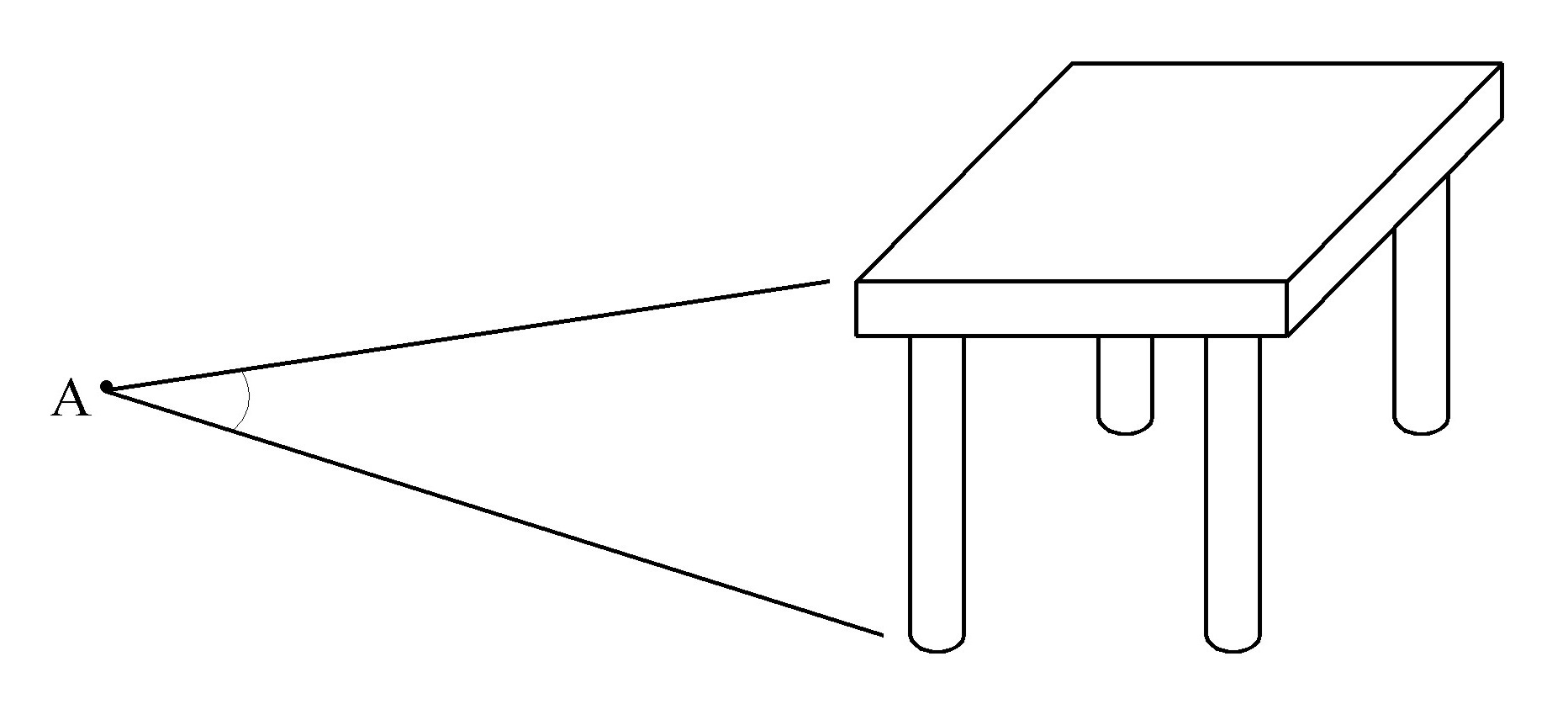
Thomas Reid suggested that one is directly, visually aware of the angular magnitude of the table, rather than its linear magnitude. This is the size of the angle that the table subtends at the eye. The angular magnitude changes as you move away from the table, so there is not even any illusion here. The angular magnitude of the table is a relational property, but it is a perfectly objective, physical feature, not something in the mind, so
This excerpt is provided for preview purposes. Full article content is available on the original publication.