Home Education Resources
My wife Helen is slightly obsessed with education. One of her childhood hobbies was designing optimal syllabi. Now, when she’s not exploring grand metaphysical systems better than Berkeley’s, she’s planning and researching how to better educate our crazy smart, neurodiverse 8-year-old. I think a lot of the stuff she’s found is rather awesome, so figured I’d share some examples below in case other parents find it of value—or have their own suggestions to share in return!
Background
We do a lot of our homeschooling over meals: I’ve read our son many interesting non-fiction books over breakfast; as a family we listen to (and discuss) history over lunch, and watch (and discuss) science lessons over dinner. It might not work for everyone, but our kid picks up an immense amount this way. It leaves us (Helen, really) only needing to do “formal” lessons—and associated practice, which admittedly can be more tedious—for math and writing.1
Our general goal for these early years is to balance foundational skills (in math and language) with breadth of understanding (science, history, plus hints of philosophy/politics/economics) while nourishing love of learning throughout. It’s basically low-key aristocratic tutoring by a couple of Princeton philosophy PhDs, and seems to be working out pretty well so far!2
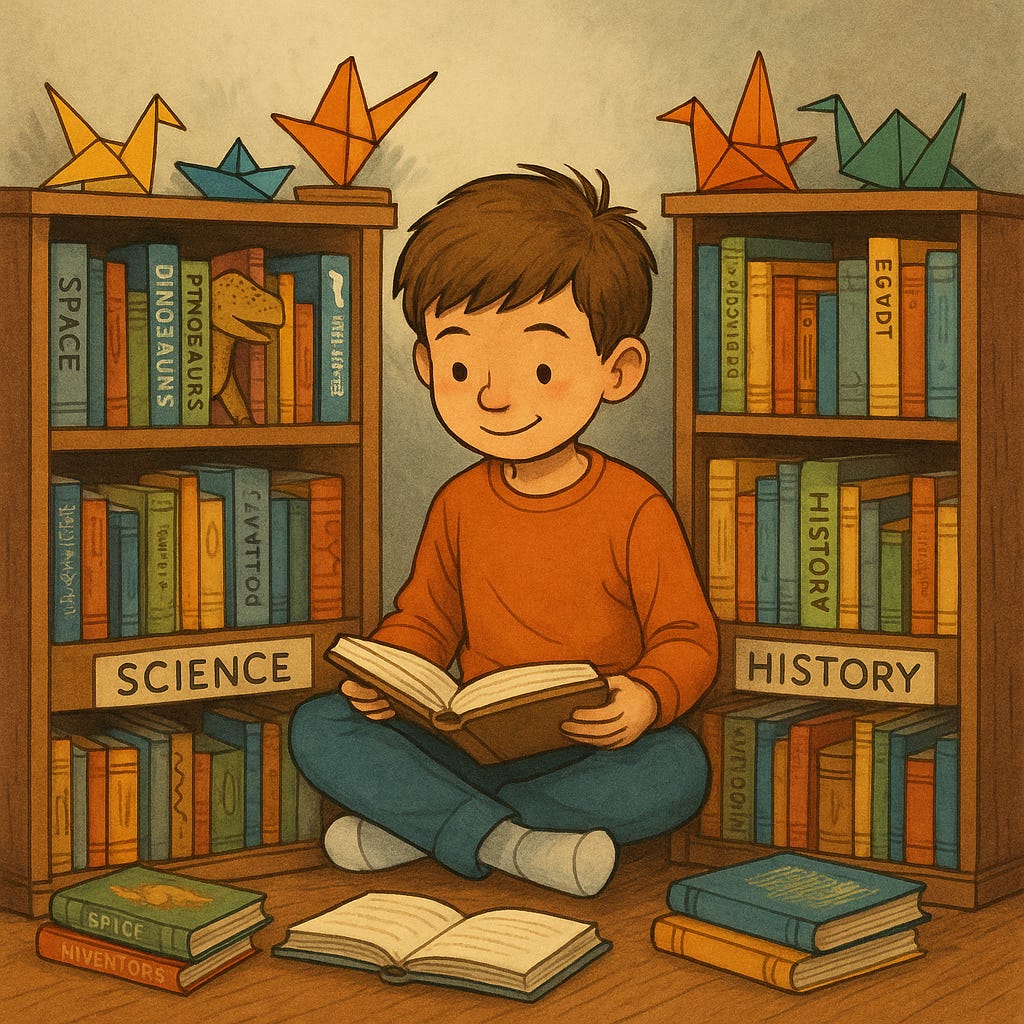
Outside of meals, math & writing practice, and social events, our son can basically do what he wants with his time.3 Much is spent in storytelling, crafts, and fiction reading. But Helen has also assembled a pretty amazing non-fiction children’s library for our son over the years, which he puts to good use. He’s learned an immense amount from self-directed reading on whatever topics he’s interested in (everything from plant biology to the Haitian revolution). Whenever he asks questions that go beyond our knowledge during mealtime discussions, Helen replies, “Let me buy you a book on that.” He soon knows more about the topic than we do.
Helen isn’t sufficiently keen on blogging to spend time writing up the details of her lessons (even though, e.g., she developed a unified strategy for teaching spelling, grammar, and writing that seems far more promising than orthodox approaches).4 But let me share some favorite resources (bearing in mind that they benefit from supplemental teaching / shared attention):
Math and logic
Beast Academy - conceptually-focused full math curriculum.
Global Math Project - fun conceptual lessons, e.g. understanding arithmetic operations via exploding
This excerpt is provided for preview purposes. Full article content is available on the original publication.