Are AI Datacenters Increasing Electric Bills for American Households?
Are AI Datacenters Increasing Electric Bills for American Households?
SemiAnalysis x Fluidstack is launching GTC with a 48-hour, full-stack AI infrastructure hackathon on March 15th from Power to Prefill, Dirt to Decode. With speakers from OpenAI, GPU MODE, and Thinking Machines, plus compute grants and GPU cluster access, come build with the best: APPLY HERE.
The topic of datacenter load growth and impact on power prices remains broadly misunderstood, akin to the water consumption myth that we debunked recently. It was at the forefront of the 2025 New Jersey elections, after a ~20% jump in residential electricity rates overnight in June 2025. Some even began finger-pointing at the 300MW Nebius AI Datacenter for Microsoft in the state, a laughable claim given >85% of its power is self-generated. Are AI datacenters really causing households to pay electricity 20% more expensive?
This report explores the question by analyzing the two biggest energy markets in the US, which are also the largest AI Datacenter hubs: the PJM interconnection area – the grid operating covering 13 eastern US states (including New Jersey) - and ERCOT, who oversees the electric grid in Texas. In the Lone Star State, prices have been roughly stable for the last three years. On the other hand, the 67 million residents of the PJM area are set to see their bill increase by an average of ~15% in 2026 relative to the “pre-AI-Datacenter” era? Why such a divergence? In short, empirically the fault is government policy, not AI.
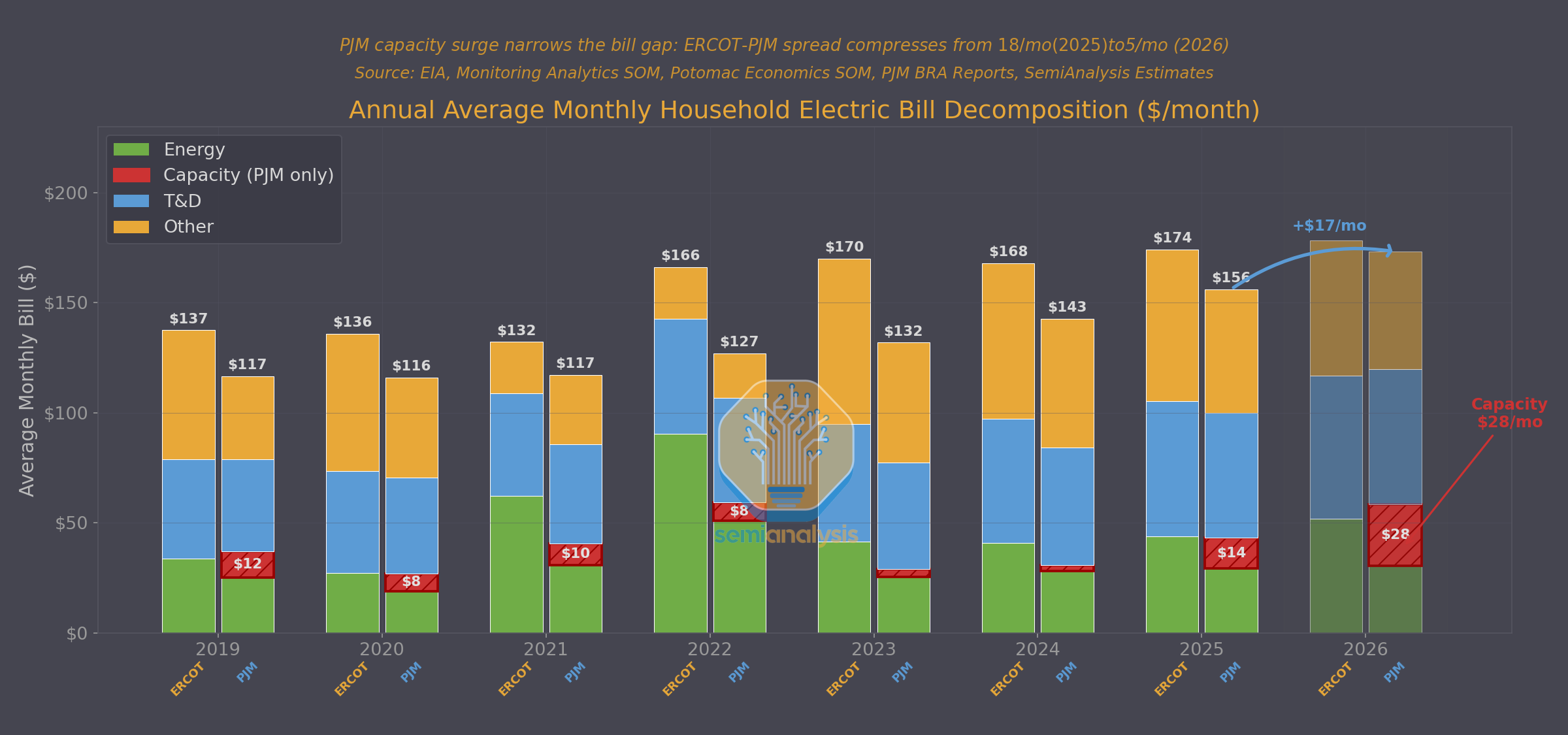
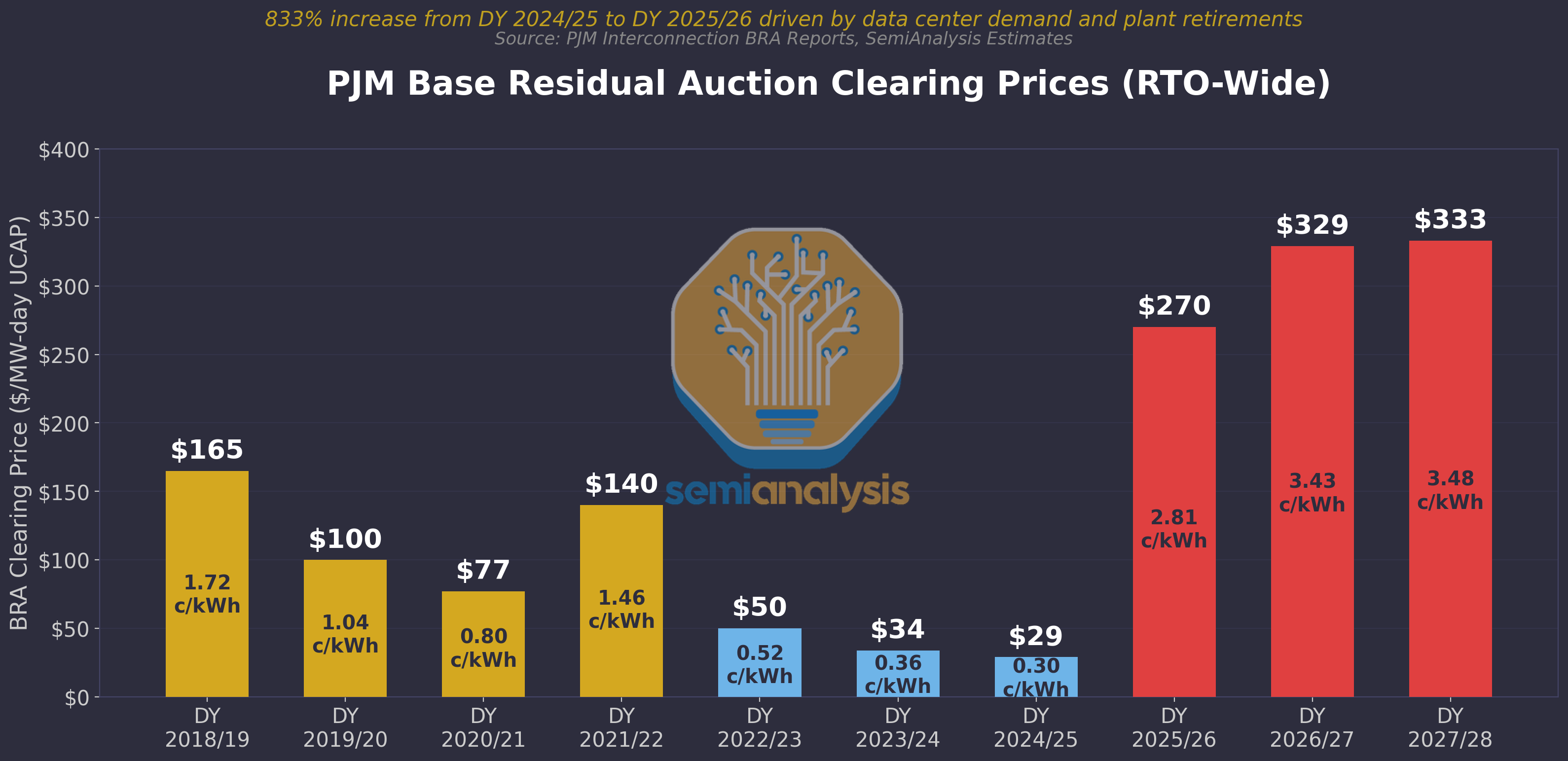
In PJM, we think poor market design is the main culprit. Most of the 15% increase in household electricity bills in PJM is driven by a widely misunderstood and somewhat obscure mechanism: the BRA capacity auction. The 2025/26 auction increased 9.3x over the prior year, as shown below. Worse: this increase is driven by a “simulation” and doesn’t reflect actual conditions. Is is largely a function of the demand and supply forecast made by a central planner (PJM), which as we’ll explain, has a history of huge miscalculations.
Many are finger-pointing at the surge in AI datacenters, and it is understandable. The PJM area is at the forefront of the AI boom, with Google notably training its Gemini model around Columbus Ohio, while Anthropic/Amazon’s “Project Rainier” and Meta’s “Prometheus” in Indiana and Ohio are both
...This excerpt is provided for preview purposes. Full article content is available on the original publication.