← Back to Library

Typewriter interview with Elizabeth McCracken

Deep Dives

Explore related topics with these Wikipedia articles, rewritten for enjoyable reading:

  • Smith Corona 10 min read

    The interview was conducted on a Smith Corona GT Ghia typewriter. Understanding the history of this iconic American typewriter company provides context for the analog writing tools that many authors still cherish.

  • Carnegie library 11 min read

    Elizabeth McCracken is a former public librarian, and the Carnegie library movement fundamentally shaped American public libraries. This provides rich historical context about the institution where she worked.

Typewriter interview with Elizabeth McCracken

By Austin Kleon

A photo of a typewriter, some flowers, and Elizabeth's book, A Long Game

Hey y’all,

Elizabeth McCracken is the acclaimed and bestselling author of nine books. A former public librarian, she has taught writing for over 35 years. To celebrate the release of her latest book, A Long Game: Notes on Writing Fiction, she borrowed my Smith Corona GT Ghia and typed these answers while packing up her office in Austin, Texas to move with her family to England.

(For a plain-text version of this interview with links and notes, see the P.S. below.)
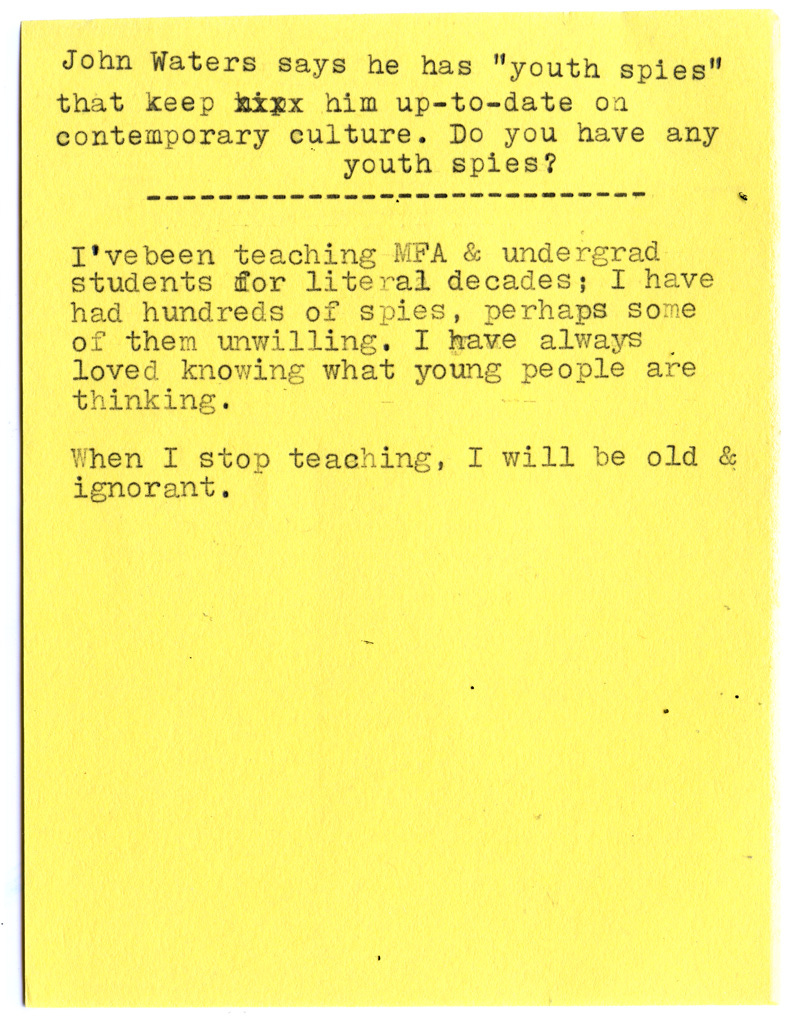
John Waters says he has “youth spies” that keep him him up-to-date on contemporary culture. Do you have any youth spies?  I’ve been teaching MFA & undergrad students for literal decades; I have had hundreds of spies, perhaps some of them unwilling. I have always loved knowing what young people are thinking.  When I stop teaching, I will be old & ignorant.
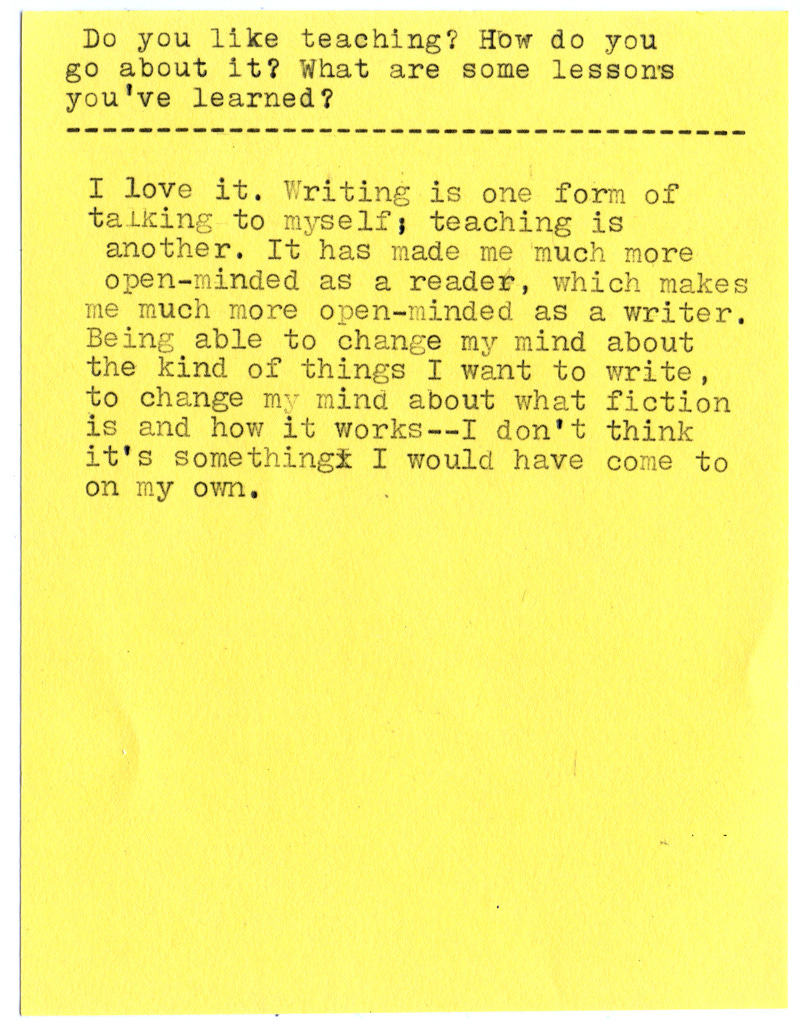
Do you like teaching? How do you go about it? What are some lessons you’ve learned?  I love it. Writing is one form of talking to myself; teaching is another. It has made me much more open-minded as a reader, which makes me much more open-minded as a writer.  Being able to change my mind about the kind of things I want to write, to change my mind about what fiction is and how it works—I don’t think it’s something I would have come to on my own.
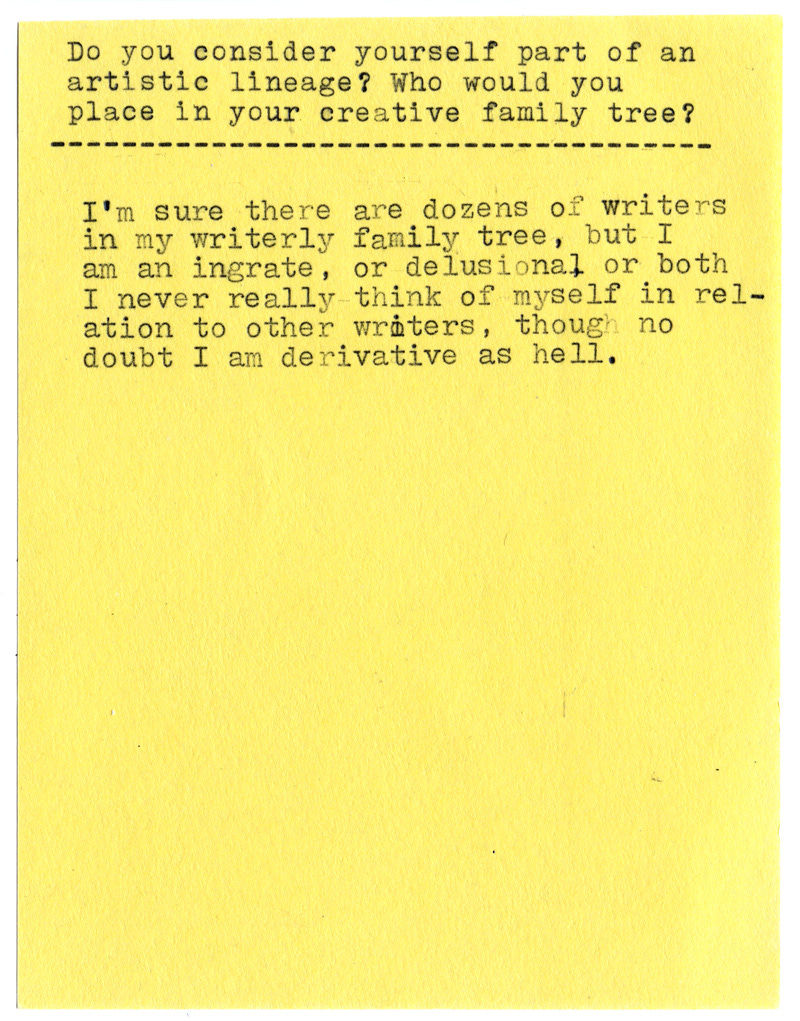
Do you consider yourself part of an artistic lineage? Who would you place in your creative family tree?  I’m sure there are dozens of writers in my writerly family tree, but I am an ingrate, or delusional or both I never really think of myself in relation to other writers, though no doubt I am derivative as hell.
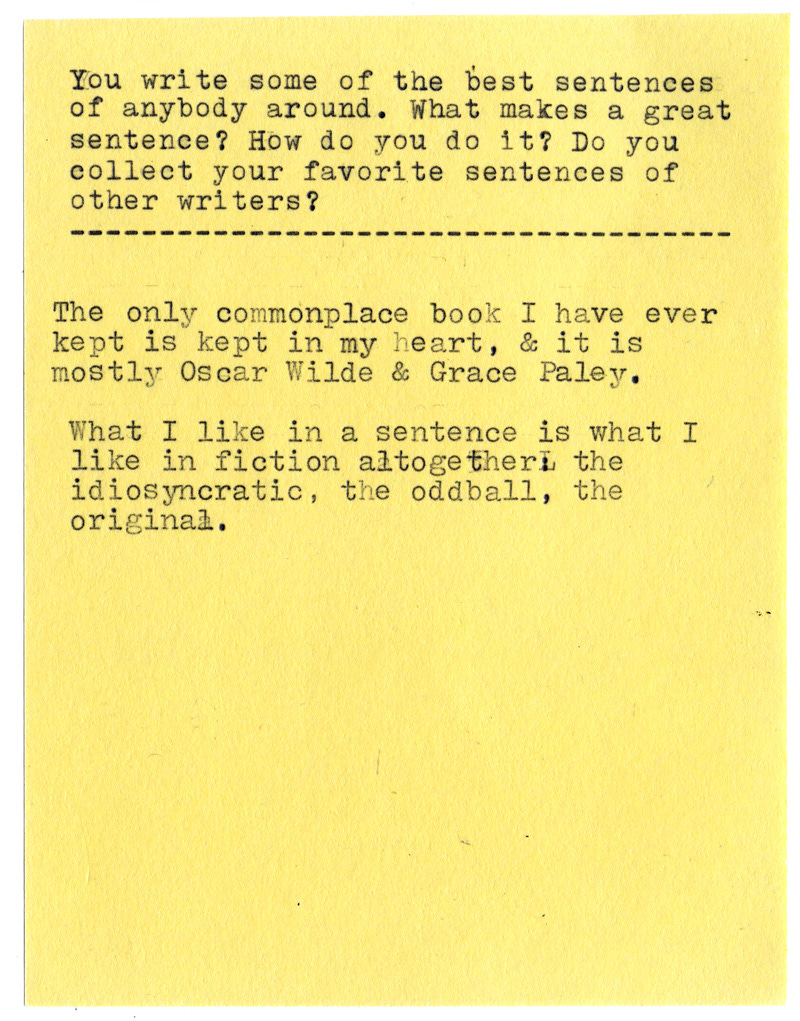
You write some of the best sentences of anybody around. What makes a great sentence? How do you do it? Do you collect your favorite sentences of other writers?  The only commonplace book I have ever kept is kept in my heart, & it is mostly Oscar Wilde & Grace Paley.  What I like in a sentence is what I like in fiction altogether: the idiosyncratic, the oddball, the original.
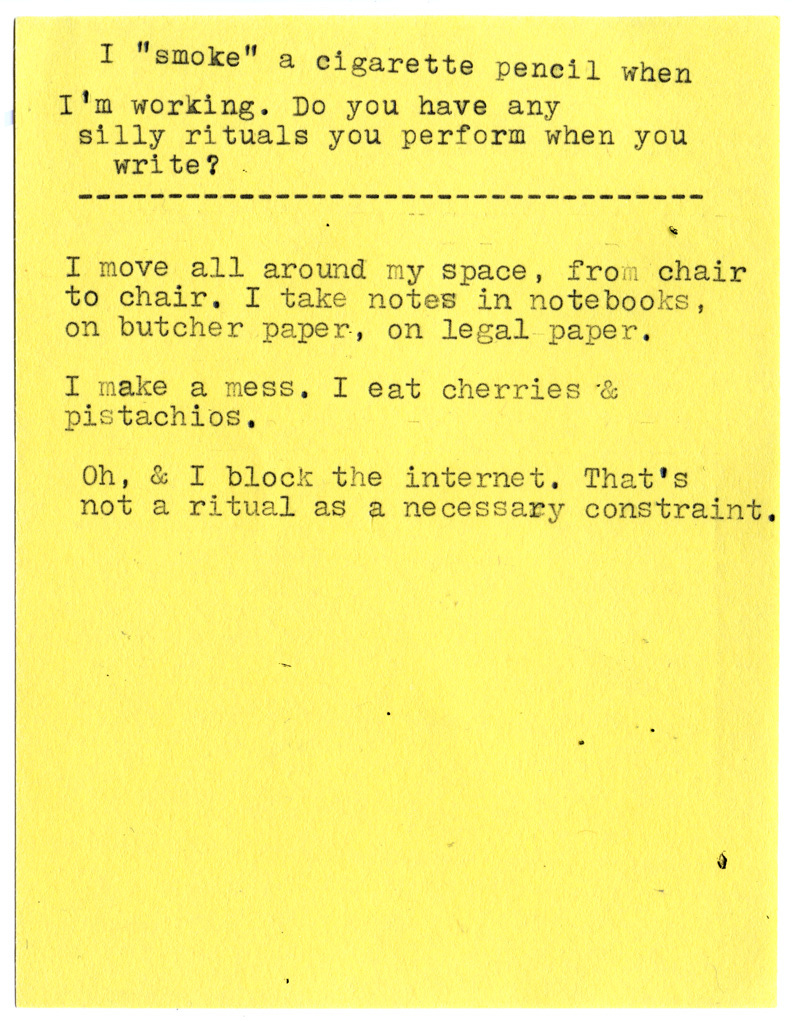
I “smoke” a cigarette pencil when I’m working. Do you have any silly rituals you perform when you write?  I move all around my space, from chair to chair. I take notes in notebooks, on butcher paper, on legal paper.  I make a mess. I eat cherries & pistachios.  Oh, & I block the internet. That’s not a ritual as a necessary constraint.
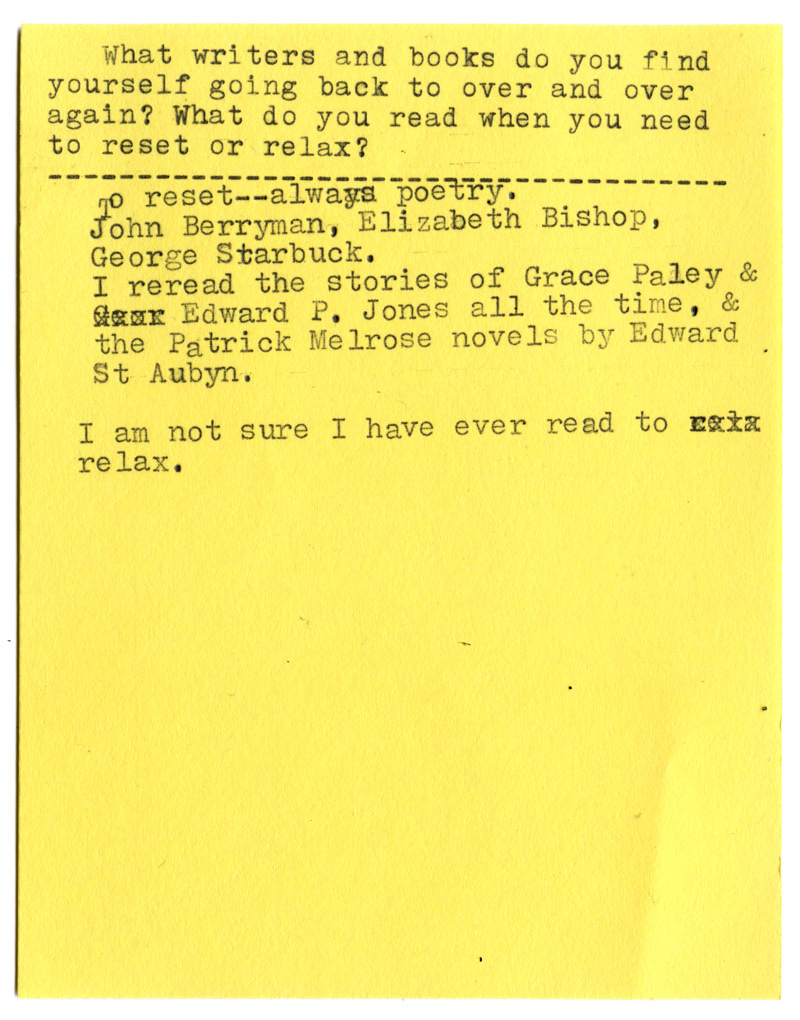
What writers and books do you find yourself going back to over and over again? What do you read when you need to reset or relax?  To reset — always poetry.  John Berryman, Elizabeth Bishop, George Starbuck.  I reread the stories of Grace Paley & Edward P. Jones all the time, & the Patrick Melrose novels by Edward St. Aubyn.  I am not sure I have ever read to relax.
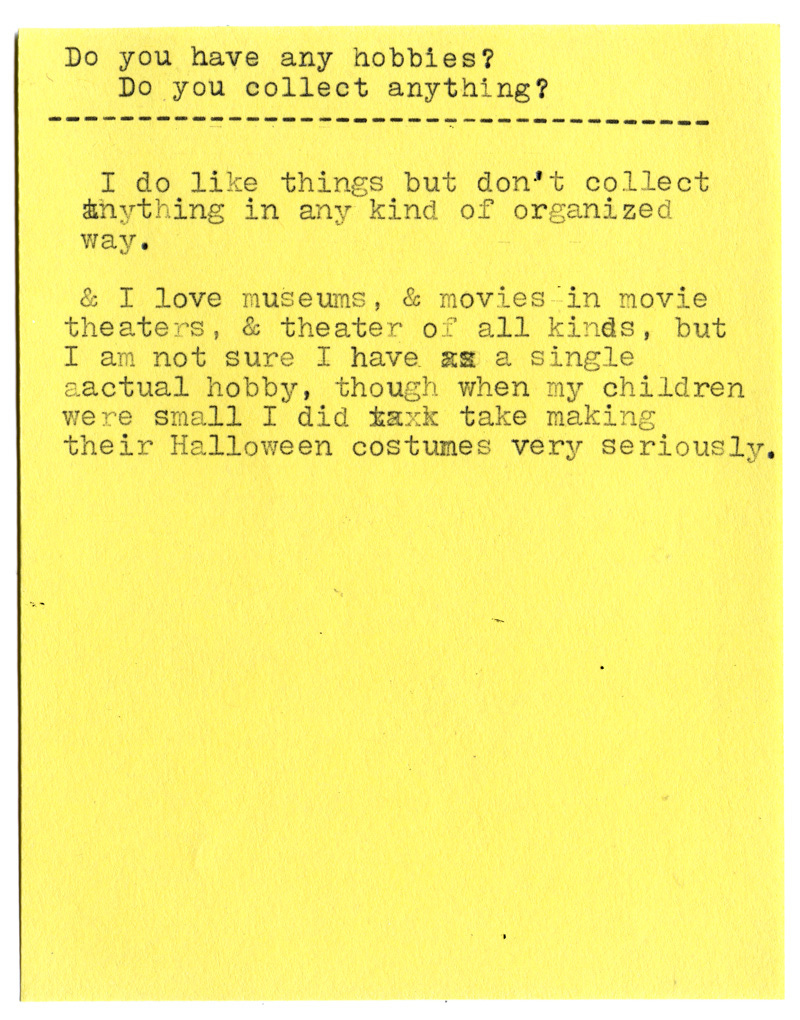
Do you have any hobbies? Do you collect anything?  I do like things but don’t collect anything in any kind of organized way.  & I love museums, & movies in movie theaters, & theater of all kinds, but I am not sure I have a single actual hobby, though when my children were small I did take making their Halloween costumes very seriously.
Describe a perfect day where you live.  [I realized later this was a hard question, given Elizabeth is in between places! I asked her if it was okay to leave it in blank — for comic effect — and she said it was okay.]
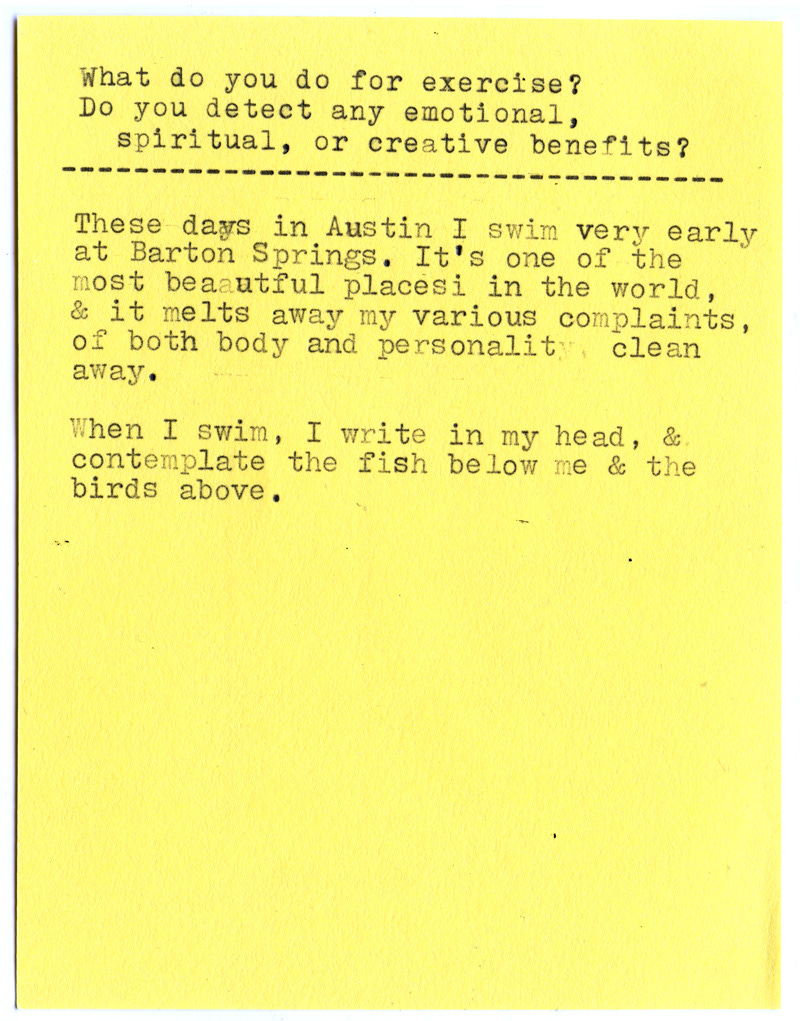
What do you do for exercise? Do you detect any emotional, spiritual, or creative benefits?  These days in Austin I swim very early at Barton Springs. It’s one of the most beautiful places in the world, & it melts away my various complaints, of both body and personality clean away.  When I swim, I write in my head, & contemplate the fish below me & the birds above.

Thanks to Elizabeth for being the 14th participant in this series of typewriter interviews. Subscribe to her newsletter, Release McCracken, and buy a copy of A Long Game: Notes on Writing Fiction.

xoxo,

Austin

P.S.

Here’s a full transcription of the interview with some notes and links:

Read full article on Austin Kleon →