The Bioelectric Tech Stack
Welcome to Decoding Bio’s BioByte: each week our writing collective highlight notable news—from the latest scientific papers to the latest funding rounds—and everything in between. All in one place.
Why has China produced a growing number of profitable biomanufacturing firms, while the West has accumulated stalled pilots and failed scale-ups - despite comparable scientific capability?
Over the past few years, I’ve heard more open discussion about how hard it is to scale biology. At the same time, “biotech” has become a broad label covering a wide range of technologies and capabilities. It increasingly seems useful to think of it less as a single sector and more as a set of enabling industrial technologies, each with different constraints. This piece is a first attempt to explore that framing.
What has made this framing feel increasingly necessary is not just that outcomes differ, but that they differ systematically. Similar biological capabilities are producing very different industrial results, not because of differences in scientific sophistication, but because of how biological systems are embedded (or not embedded) in physical infrastructure.
A few weeks ago, while on a robotics trade mission across China, a city government was pitching its manufacturing base to international robotics companies. What stood out was not just existing capacity, but how readily legacy industrial infrastructure could be repurposed across radically different robotics applications.
This was the result of long-term mastery of what commentators increasingly call the electric tech stack: the emerging industrial paradigm built around electricity, power electronics, motors, sensors, and control systems. Chinese firms have developed depth across this stack, a pattern clearly visible in how major players span multiple layers.
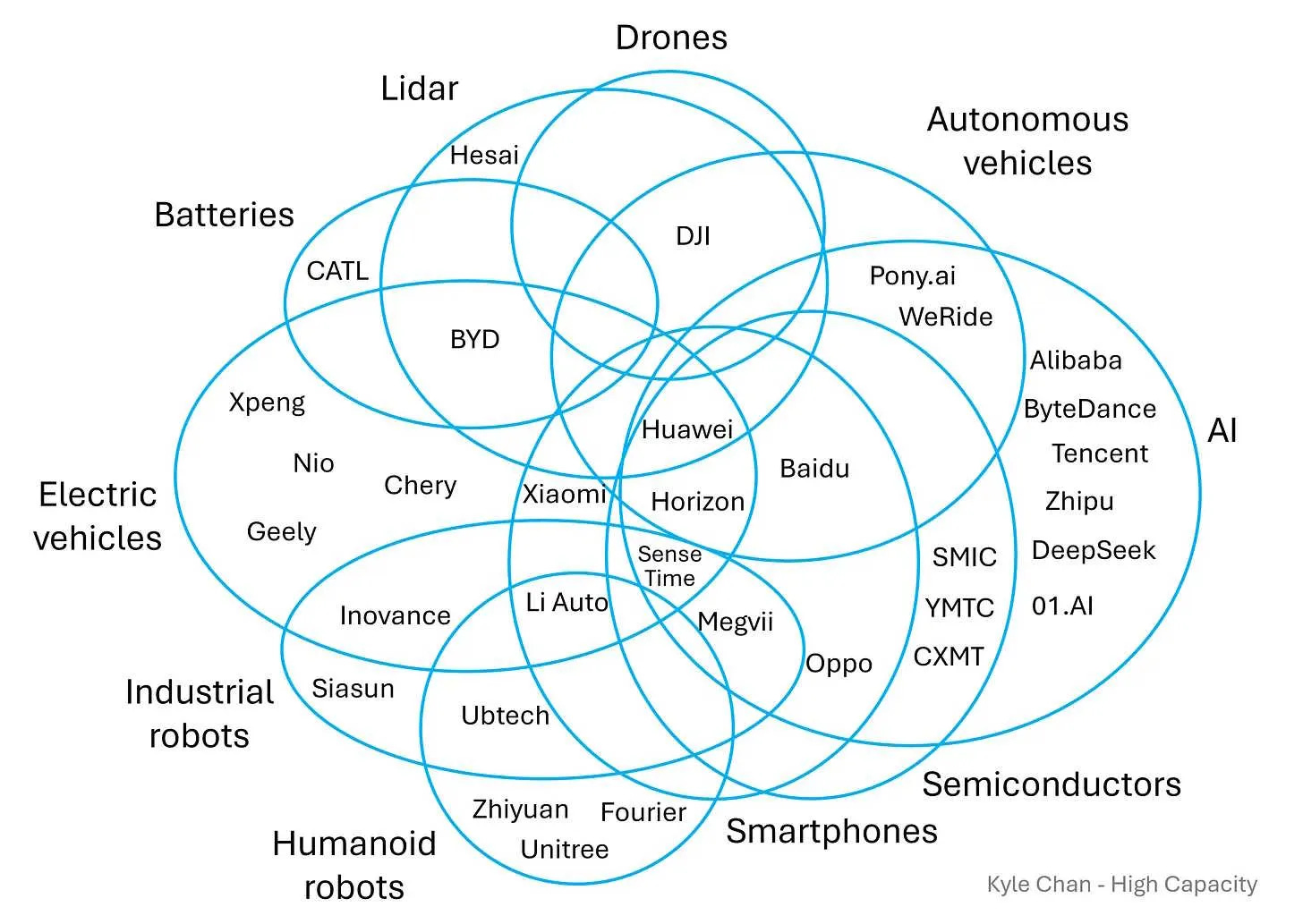
What matters is how transferable this stack has become. That transferability is not accidental; it is the result of sustained investment in physical layers that make new applications legible, affordable, and repeatable; a pattern that increasingly distinguishes Chinese industrial systems from Western ones. Once in place, it can be applied to almost any physical system. A classic example of this was XiaoMi expanding from making smartphones to electric cars.
Biology, I would argue, is about to occupy a similar position, but in a very different part of the system.
Why Biology Is Becoming the Chemical Layer of the Electric Economy
Over the last decade, technology discourse has been dominated by software, and more recently by AI. In parallel, a clearer mental model of the electric
...This excerpt is provided for preview purposes. Full article content is available on the original publication.