RKUL: Time Well Spent, 11/27/2025
Deep Dives
Explore related topics with these Wikipedia articles, rewritten for enjoyable reading:
-
The Double Helix
9 min read
Linked in the article (7 min read)
-
Arthur Jensen
13 min read
Linked in the article (13 min read)
-
W. D. Hamilton
15 min read
Hamilton is described as 'the most distinguished Darwinian since Darwin' by Dawkins, yet the article notes he remained largely unknown to the general public despite his foundational contributions to evolutionary biology including kin selection and inclusive fitness theory. His ideas influenced Dawkins, Ridley, and Wilson's Sociobiology.
Your time is finite. Your phone and the internet stand ready to help you squander it. Here are my latest picks for spending it well instead. Feel free to add more in the comments.
Books, what else?
James Watson died on November 6th, 2025. Born in 1928, in his 97 years, he witnessed sea changes in culture, technology and of course science. Along with Francis Crick, he puzzled out the structure of DNA, the substrate of genetic inheritance. He, Crick and Maurice H. F. Wilkins shared the 1962 Nobel Prize in Medicine for that discovery. Watson was no one-trick pony; appointed director of Cold Spring Harbor Laboratory in 1968, he transformed it into one of America’s premier centers of biological discovery, steering it past its eugenicist past. In 1990, Watson helmed the Human Genome Project, departing after two years over a disagreement concerning gene patents. In 2013, the Supreme Court invalidated the concept of gene patents, coming down on the side Watson (and most geneticists, frankly) had always favored.
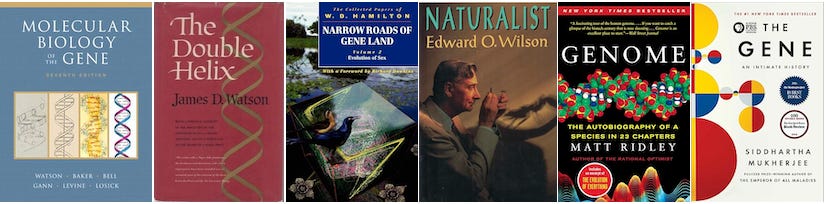
Americans had many reasons to know Watson better than Crick. First, and foremost, Watson was American, while Crick was English (though after 1977 Crick moved to the US from Cambridge, England. There, until his death in 2004,Crick devoted 30 years of his scientific career to neuroscience and understanding consciousness). Second, Watson was a more voluble, flamboyant and provocative figure than the more focused Crick. But perhaps most importantly, Watson wrote a scientific autobiography of their Nobel-prize winning discovery, The Double Helix: A Personal Account of the Discovery of the Structure of DNA. The Double Helix, a personal memoir, presented Watson’s particular perspective on how he and Crick discovered the structure of DNA. The book has gone through 213 printings in various editions and languages across the world, capped off by 2012’s Annotated and Illustrated Double Helix. People have faulted Watson’s narrative in various ways, most prominently for giving short shrift to Rosalind Franklin’s contributions, but it remains the definitive account of DNA’s discovery and the prose captures the excitement of biological science in a post-war England then just springing back to life and normalcy. If you want to understand how scientists came to grasp DNA’s structure, The Double Helix there is no better place to start, even acknowledging that it is not the entire story.
If Watson’s authorship of The Double Helix
...This excerpt is provided for preview purposes. Full article content is available on the original publication.