The stakes in the Affordable Care Act subsidy debate
Deep Dives
Explore related topics with these Wikipedia articles, rewritten for enjoyable reading:
-
Affordable Care Act
13 min read
The article discusses enhanced ACA subsidies but assumes familiarity with the law's structure. Understanding the original 2010 legislation—its insurance marketplaces, individual mandate, Medicaid expansion provisions, and political battles—provides essential context for why these premium tax credits exist and why their expiration is so consequential.
-
Poverty in the United States
13 min read
The article repeatedly references percentages of the federal poverty line (400%) as eligibility thresholds but doesn't explain how this metric is calculated, its history dating to Mollie Orshansky's 1960s research, or why critics argue it understates actual poverty. This provides crucial context for understanding who qualifies for subsidies.
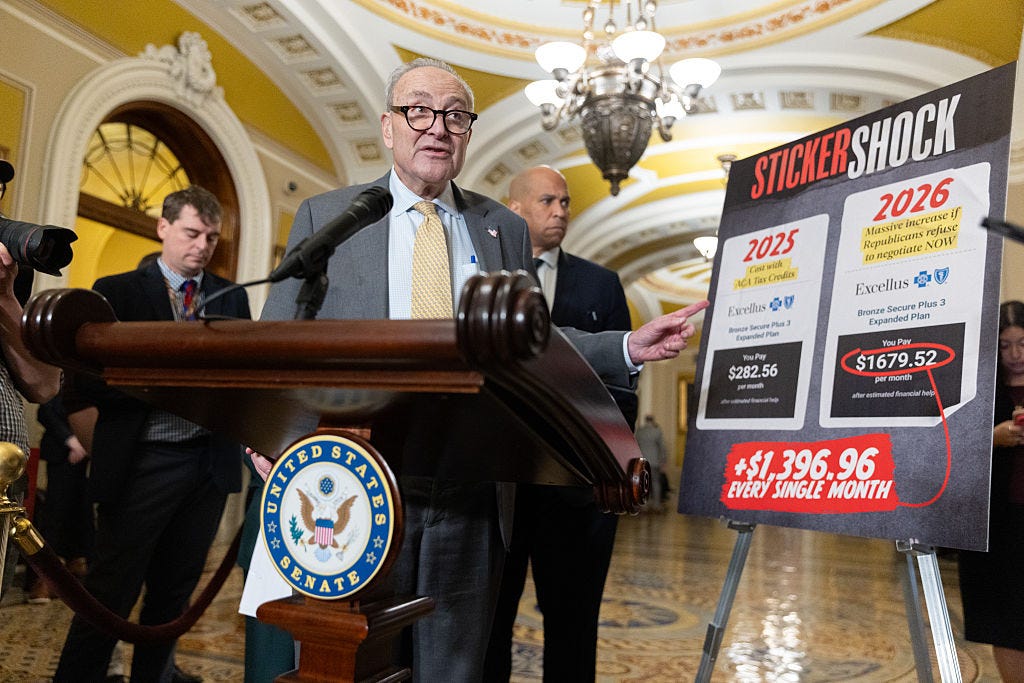
Senate Minority Leader Chuck Schumer announced Thursday that Senate Democrats are prepared to force a vote next week on a clean, three-year extension of the enhanced Affordable Care Act (A.C.A.) premium subsidies. On the same day, a bipartisan group of House members announced a separate plan.
If Congress does nothing before the subsidies expire at the end of the year, millions of Americans face steep premium increases or outright loss of Marketplace coverage. The economic and political effects would be uneven but large — hitting young adults, rural enrollees, and low- and moderate-income households hardest, with measurable effects on labor supply, inequality, and state budgets.
What happens when subsidies expire
The A.C.A.’s premium tax credits were expanded in 2021 to provide larger credits for recipients, broaden eligibility, cap premiums as a share of income, and extend support above 400 percent of the federal poverty line. These enhanced credits underpin the affordability of Marketplace plans for more than 20 million enrollees. The Senate Democrats’ proposal would simply extend the enhanced credits for three years.
If those credits expire, analysts project there would be large increases in net premiums for current enrollees and millions would be at risk of losing coverage. Congressional Budget Office estimates concluded that making the enhanced credits permanent would slightly lower gross (that is, unsubsidized) premiums for 2026, implying the reverse if they lapsed. Meanwhile, Urban Institute and Commonwealth Fund modeling points to millions becoming uninsured absent congressional action.
By the numbers
Coverage: Marketplace enrollment has more than doubled since the enhancements took effect. If the enhancements expire, the Urban Institute and Commonwealth Fund found that four to five million could lose coverage in 2026.
Premiums: Average net premium payments could more than double for some enrollees, reports KFF, a nonprofit health-policy research group.
Overall economy: The Commonwealth Fund estimates that coverage losses could depress household spending enough to indirectly lead to roughly 340,000 job losses in 2026.
Who stands to lose the most
Low- and moderate-income households: The premium tax credits are income-targeted. If the enhanced support shrinks, the poorest, particularly those who live in states without Medicaid expansion, would be hit hardest.
Middle-income households in expensive markets: Households in high-cost metros earning more than four times the federal poverty line would face sudden premium shocks without the enhanced credits.
Young
...This excerpt is provided for preview purposes. Full article content is available on the original publication.