Carney’s Pipeline Deal Lifts Up Alberta and Demotes BC to Second-Class Status
Deep Dives
Explore related topics with these Wikipedia articles, rewritten for enjoyable reading:
-
Trans Mountain pipeline
14 min read
The article discusses a new Alberta-to-BC coast pipeline deal - the Trans Mountain pipeline is the most directly relevant precedent, having been the center of similar federal-provincial conflicts, Indigenous rights disputes, and environmental controversies that this new MOU appears to be revisiting
-
Section 35 of the Constitution Act, 1982
11 min read
The article references the government's 'constitutional obligation to consult with Indigenous groups in good faith' - Section 35 is the specific constitutional provision establishing Aboriginal rights and the duty to consult that forms the legal basis for the challenges the article predicts
-
Carbon capture and storage
12 min read
The deal includes 'a major expansion in carbon capture projects' as a key concession from Alberta - understanding how this technology works, its current limitations, costs, and effectiveness is essential context for evaluating whether Alberta's climate commitments are meaningful
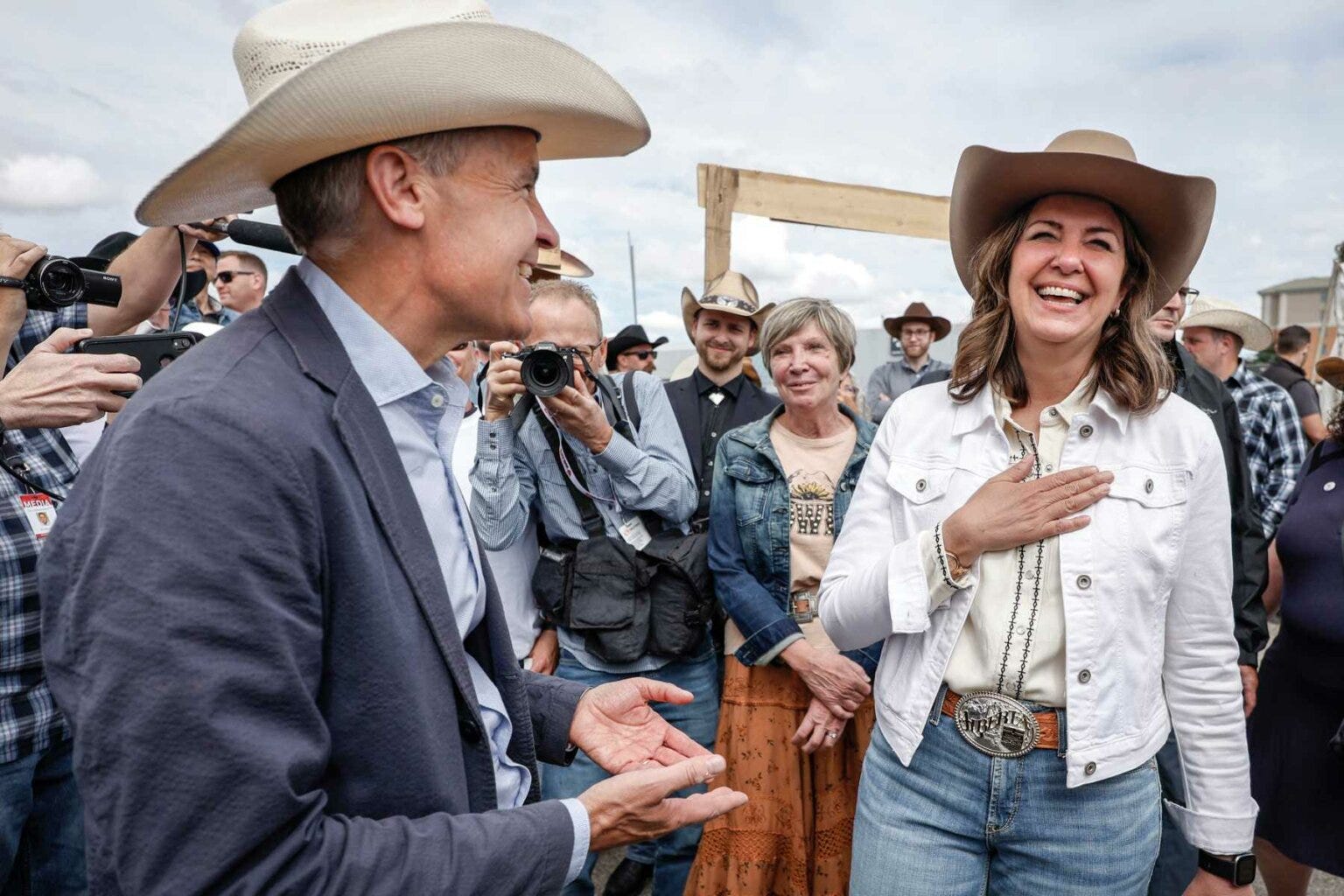
Mark Carney with Danielle Smith at the Stampede breakfast in Calgary, Alberta, July 5, 2025. (Jeff McIntosh / Canadian Press)
This story was originally published on thewalrus.ca
By Carmine Starnino and Stewart Prest
On November 27, Prime Minister Mark Carney’s government and Alberta premier Danielle Smith did something many thought politically impossible: they agreed to a new oil pipeline cutting to the British Columbia coast, designed to move bitumen to foreign markets.
Their memorandum of understanding (or MOU, a non-binding blueprint for where both governments want to go) lays out the high-stakes deal: Ottawa signals a willingness to ease up on key climate rules and even revisit the BC tanker moratorium. In return, Alberta promises tougher carbon pricing for heavy industry and a major expansion in carbon capture projects—emerging technology meant to trap emissions from oil sands operations and bury them underground—alongside a privately financed pipeline with Indigenous co-ownership.
BC wasn’t brought into the room, and it shows. The province is furious, warning that the MOU weakens coastal protections, heightens spill risk, and resurrects a fight many thought was finally behind us. Several First Nations and environmental groups have already come out swinging.
To get past the talking points, I spoke with Stewart Prest, a political scientist at the University of British Columbia, about what’s actually inside the agreement—and what it might unleash.
You can’t share stories from thewalrus.ca on Facebook or Instagram because of Meta’s response to the Online News Act, but you can share this Substack article there
What’s the national interest argument here? Why is Carney doing this now?
I think he sees a need to bridge the gap between Canada, its mainstream political movements, and the more populist right-of-centre political movements, which are very much centred on Alberta and the energy sector. That’s not the only issue that they care about, but it’s clearly one of the primary drivers: grievances around Alberta’s ability to access foreign markets with its energy production. I think Carney sees this as a kind of grand bargain, an opportunity to bring together these two sides, which are so divided. It is really the primary line of polarization, the fault line within Canadian politics right now.
What’s the national interest risk here? Why is this a bad idea?
There are real risks with this strategy. Should it fail, it will provide fresh grievance to that populist group and become just another
...This excerpt is provided for preview purposes. Full article content is available on the original publication.