Three Forms of the End of the World
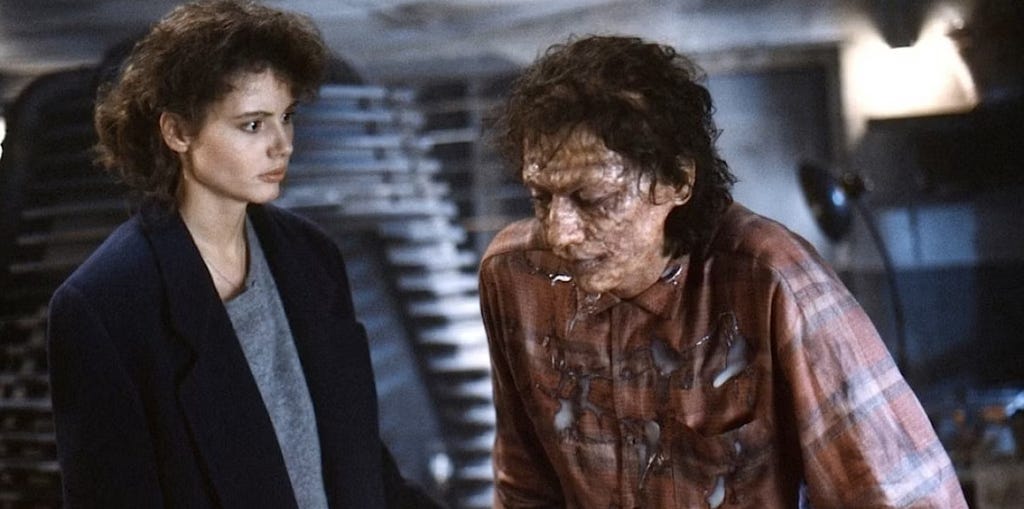
David Cronenberg’s The Fly ( 1986) is a breathtaking and radical piece of subversive political analysis. Yet as popular as the film is, few people have noticed the important difference between this film and the original 1957 short story by George Langelaan. Despite the genius of Cronenberg’s adaptation, Langelaan’s original asks a very different question: how can we understand catastrophe, how can we recognise an absolute end, when it has already occurred? If something like disaster is around the corner, how may we confront the possibility that it has already taken place, that we are playing a perpetual game of catch-up with the reality of our own situation?
From nuclear disaster, the dissolution of a global order by Trump’s tariffs, or the threat of an unthinkable ecological catastrophe, the idea of the ‘end of times’ is especially popular today. We are rightly concerned with the possibility of the end of the world, but this makes it all the more pressing to ask what we truly mean by the term ‘end’. Here, I argue that there are three, entirely irreconcilable, ideologies of the end, all of which carry a weight in any possible political solution.
1: The Desire for the End
The basic idea of The Fly (the story and the film adaptations), is the perfect rendition of apocalyptic speculations. Something terrible is happening or has happened. A grotesque mutation or a dizzying catastrophe of scientific innovation, where in a Ballardesque spectacle the cultural experimentations of man brutally merges him on the cellular level with an unnatural reconstruction of the natural world (a fly, in this case). The first form of the end is the one we see in Cronenberg’s adaptation. This the pragmatist’s ideal version of the end: although initially shocking - possibly even exhilarating - it is eventually calculable, comprehensible, and entertainingly inevitable, it constructs a new mode of desiring.
Seth Brundle’s gradual mutation is a certain march towards an unrecoverable catastrophe. Although initially believing that he has simply been ‘rejuvenated’ by the teleportation, looking into the dematerialisation logs reveals that a fly had got into the transmitter. It is soon certain that a terrible catastrophe is imminent, yet this knowledge does not lead to any preventative measures, but only renders its imminent arrival all the more certain. This compulsive, automated march towards the end is the same process we see in Ballard’s The Drowned World: chief
...This excerpt is provided for preview purposes. Full article content is available on the original publication.