More is Less with Wind and Solar

With all the talk about needing to dramatically increase power supplies to meet the growing demand from data centers, as well as for anticipated electric vehicle adoption and other electrification efforts, it’s time to highlight one glaring reality of filling that demand with wind and solar—the reality of diminishing returns.
As in: the more intermittent capacity you add, the less capacity value you get from it. When it comes to wind and solar, more is less.
How it Works
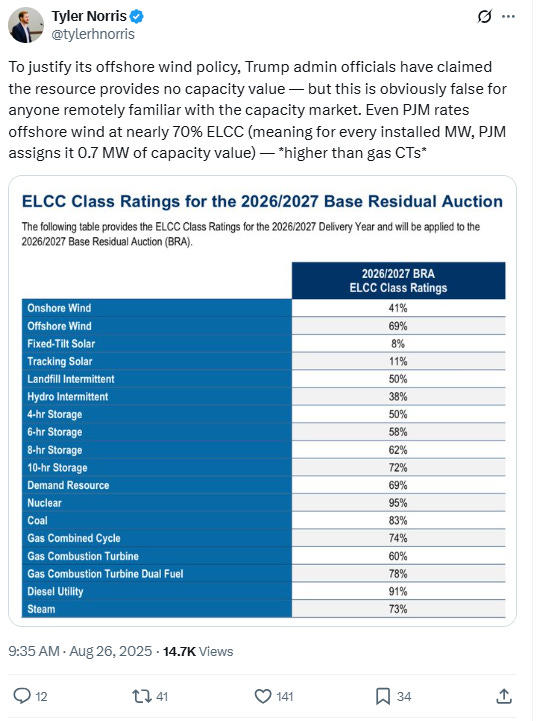
Electric grids and utilities across the country assign reliability ratings to wind and solar resources—called capacity values—and these values diminish to almost zero as the system adds more wind and solar.
This reality is lost on—or intentionally obfuscated by—many wind and solar advocates who like to brag about current high capacity values for wind and solar without mentioning the fact that these values plummet as you add more wind and solar to the grid.
Before we go into how most major power grids in the country show this diminishing effect, here’s a primer on what capacity values are and how they’re calculated.
What Are Capacity Values?
The term “capacity value” is defined by the National Renewable Energy Laboratory (NREL) as “the contribution of a power plant to reliably meeting demand. Capacity value is the contribution that a plant makes toward the planning reserve margin…”
Basically, capacity values are percentages of total installed capacity for each energy source that electric grids believe they can reliably count on to meet demand. It reflects the idea that while every energy source has a maximum capacity that it can reach under ideal conditions, not every energy source can reliably perform at these ratings at any given time and when needed.
Grid operators use different methodologies to calculate capacity values, with most choosing some variation of the Effective Load Carrying Capability (ELCC), while the Midcontinent Independent System Operator (MISO) opts for the Direct Loss of Load (DLOL).
However, even though ELCC and DLOL methodologies can vary from region to region with no set-in-stone method to the madness, the basic concepts are fairly similar.
Methodologies
Capacity value methodologies are typically run using probabilistic hourly models that target a maximum Loss of Load Expectation (LOLE) of .1, which means that the system expects to have a shortfall of capacity .1 days per year or 1 day per 10 years.
From here, there are two ways of going about
...This excerpt is provided for preview purposes. Full article content is available on the original publication.