America has to feel fair
Deep Dives
Explore related topics with these Wikipedia articles, rewritten for enjoyable reading:
-
Civil Rights Act of 1964
18 min read
The article's central legal framework rests on this landmark legislation. Understanding its original scope, the political battle to pass it, and how courts have interpreted its protections over six decades provides essential context for the discrimination debate discussed.
-
Griggs v. Duke Power Co.
14 min read
This 1971 Supreme Court case established the 'disparate impact' doctrine in employment discrimination law, fundamentally shaping how discrimination is proven and contested. It explains why statistical evidence like that cited in the article matters legally.

According to the Civil Rights Act of 1964, it’s illegal to discriminate against anyone based on race or sex. That includes discrimination against White men. If your company or your nonprofit or your university or your government agency tries to avoid choosing White men for a job position, you have violated American civil rights law. Every year, including under Democratic administrations, the U.S. government brings cases against employers for discriminating against non-Hispanic White people, and it often wins these cases (Example 1, Example 2, Example 3).
But having a law against racial discrimination doesn’t automatically get rid of it. Those cases are hard to win, they take a lot of time and money to prosecute, and a lot of plaintiffs probably don’t even know they can sue. It’s not clear how many Americans even understand that the Civil Rights Act protects White men in the first place.
As an analogy, the U.S. government has been prosecuting anti-Black discrimination pretty vigorously for decades, but at least as of 2015, some still existed. A meta-analysis of field experiments by Quillian et al. (2017) found that employers in the early 2010s were still around 50% more willing to contact a White-seeming applicant for a job than a Black-seeming one:
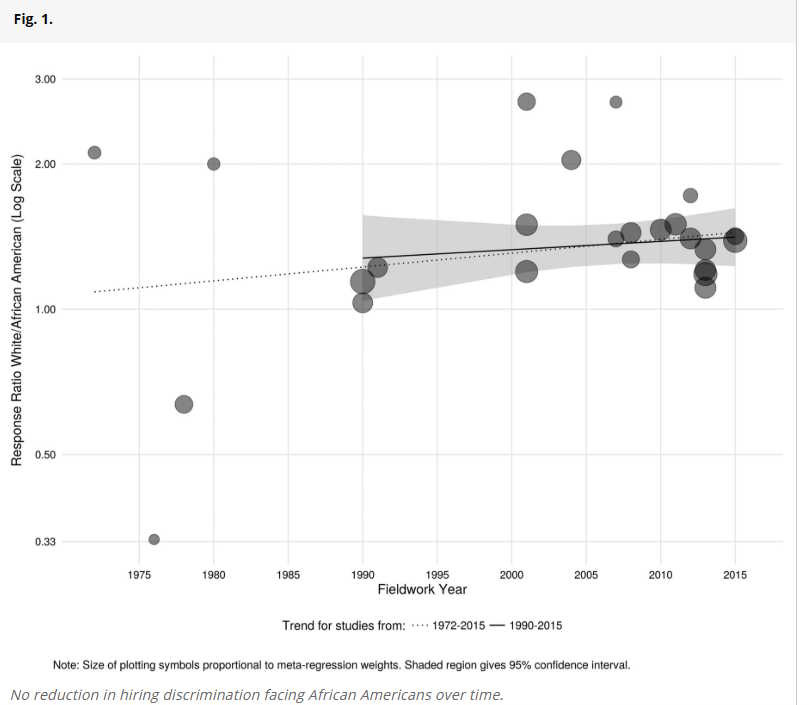
(As a side note, the authors did find that discrimination against seemingly Hispanic candidates had fallen since the 1970s, and may have vanished entirely by 2015.)
So the law is not all-powerful. If a bunch of organizations in American society decide to discriminate based on race, the government has limited ability to stop them.
In a recent article titled “The Lost Generation”, Jacob Savage makes a convincing case that discrimination against White men rose significantly in America starting in the mid-2010s, and especially after 2020, especially in universities and the entertainment industry. Some excerpts:
...The doors seemed to close everywhere and all at once. In 2011, the year I moved to Los Angeles, white men were 48 percent of lower-level TV writers; by 2024, they accounted for just 11.9 percent…White men fell from 39 percent of tenure-track positions in the humanities at Harvard in 2014 to 18 percent in 2023…
In the aftermath of George Floyd’s death…The New York Times solemnly promised “sweeping” reforms—on top of the sweeping reforms it had already promised. The
This excerpt is provided for preview purposes. Full article content is available on the original publication.