Ukraine and Military Training
Deep Dives
Explore related topics with these Wikipedia articles, rewritten for enjoyable reading:
-
NATO Enhanced Forward Presence
13 min read
The article discusses NATO's role in training Ukrainian forces and adopting NATO standards. Understanding NATO's forward presence strategy in Eastern Europe provides essential context for why Western military doctrine matters in Ukraine's defense.
-
Mission-type tactics
13 min read
The article mentions Ukraine's shift toward 'decentralised command and initiative at lower ranks' - this is the core principle of mission-type tactics (Auftragstaktik), contrasting with the Soviet centralized command methods Ukraine is moving away from.
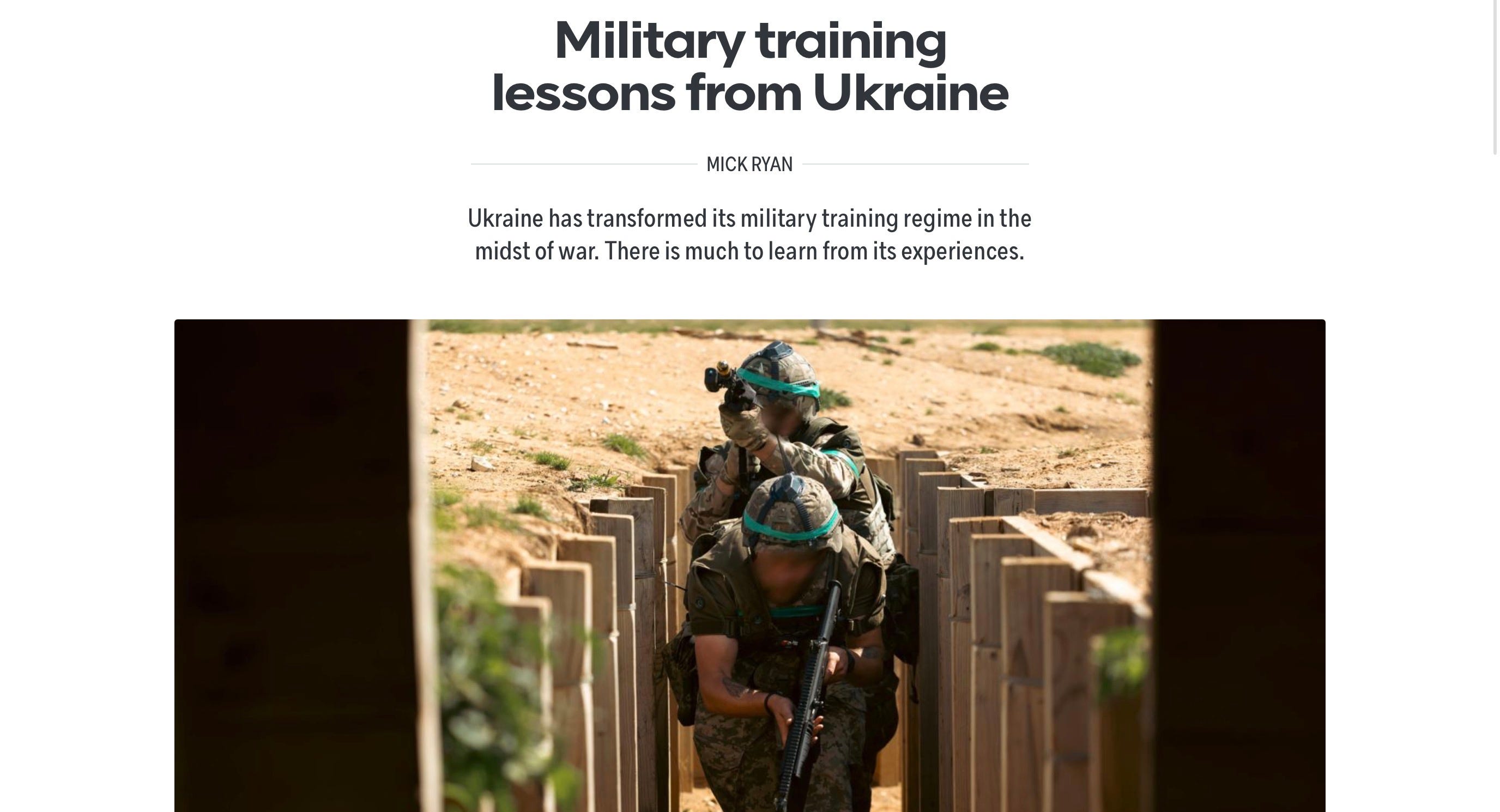
The frame of reference for Western instructors is often Iraq and Afghanistan, which does not provide the foundational behaviours required for combat in eastern Ukraine. Ukrainian training staff.
In my just-completed trip to Ukraine, I examined how the conflict has continued to evolve and how Ukraine’s ‘way of war’ has also changed over time. Command and control, force structure, strategy, tactics and adaptation were all topics I examined.
But one other subject was also important. It is a topic that I have returned to on each of my visits to Ukraine: military training. Training, and a training system that is responsive to battlefield learning and adaptation, is crucial to building effective and resilient military personnel and teams. To that end, I have just published a short article with the Lowy Institute on this vital subject.
The study of how Ukrainian forces have adapted, learned, and transformed their training regimes is a vital but under-examined element of this war, and war more generally. Ukraine’s military training system is foundational to its military capability. Studying it offers not only a window into Ukraine’s overall military capacity but also valuable lessons for Western nations that may need to expand their forces in the coming years.
Challenges
Since Russia’s full-scale invasion in February 2022, Ukraine has faced multiple challenges to its training approach.
First, it has had to manage time constraints. The Russian military, vastly larger than Ukraine’s, drove the need for rapid expansion of the pre-war force. Limited time meant many important trade-offs had to be made in the quality of training. For a long period, basic recruit training was restricted to about one month, which often did not produce the resilient and capable soldiers required on the front line without additional training in their units.
Second, Ukraine has had to balance the key cultures that drive its military affairs: legacy Soviet systems and practices (especially intolerance of reporting failure, and centralised command methods); newer NATO methods and doctrines; and Ukraine’s own culture, both military and national. These often exist in tension and influence every element of Ukrainian military affairs, including its training systems.
Third, it has had to endure, to the present day, Russian attacks on its training institutions. These attacks are designed to kill soldiers in training and the experts that train them. The attacks are designed to have a psychological impact too, particularly in dissuading Ukrainians from joining their military.
Finally,
...This excerpt is provided for preview purposes. Full article content is available on the original publication.