"Seasons Clear, and Awe" - Chapter 1
Deep Dives
Explore related topics with these Wikipedia articles, rewritten for enjoyable reading:
-
Hart Crane
13 min read
The novel's title and epigraph come directly from Hart Crane's poetry (specifically 'Voyages'). Understanding this modernist American poet's tragic life and his ambitious epic 'The Bridge' provides essential context for the novel's themes of artistic ambition, American identity, and the tension between working-class origins and creative aspiration.
-
Bethlehem Steel
14 min read
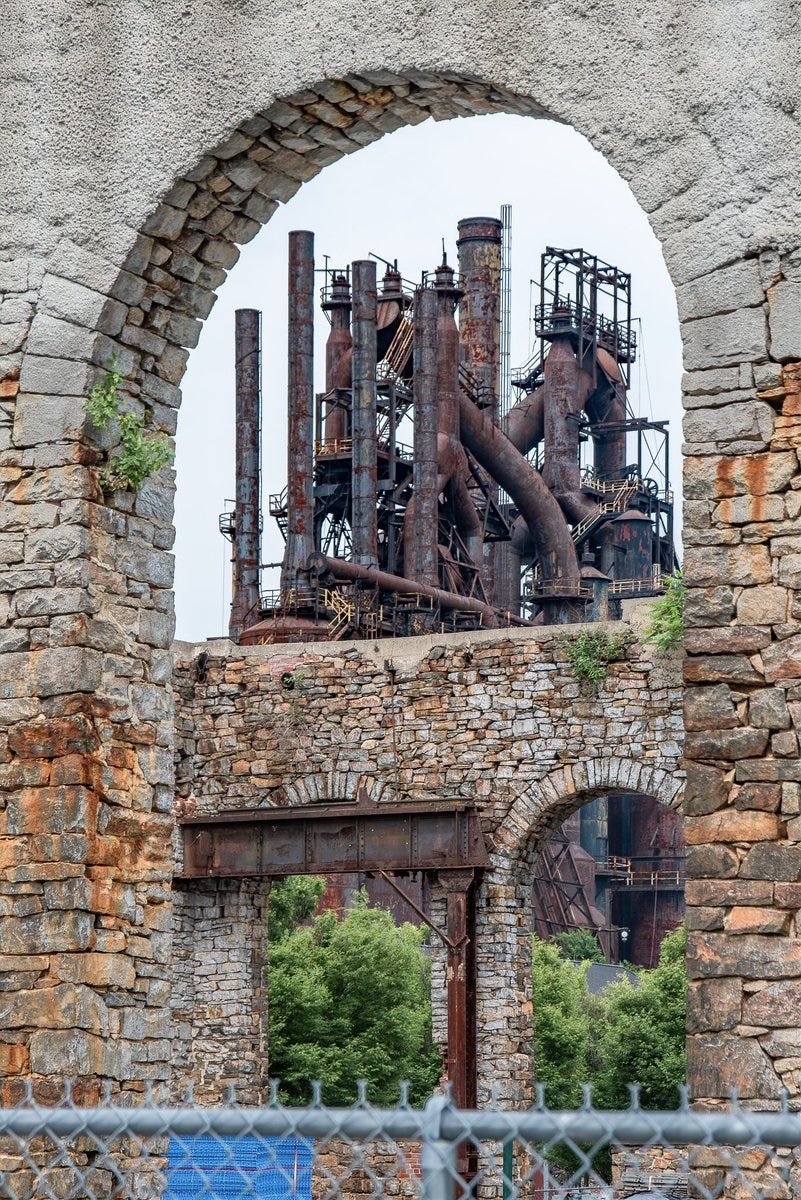
The novel is set in Bethlehem, Pennsylvania and explicitly addresses 'post-industrial, late 20th century America.' Bethlehem Steel was once the second-largest steel producer in America and its decline devastated the Lehigh Valley region where this family lives, directly shaping the economic and cultural landscape the characters inhabit.
-
Psychoanalysis
17 min read
Adele's history with psychoanalysis in Philadelphia is explicitly mentioned and shapes her character—her tendency toward 'psychological dissection' and her frustration when her husband won't explore his past. Understanding Freudian psychoanalysis illuminates her worldview and the generational divide between analytical self-examination and working-class pragmatism central to the novel.
Today begins PILCROW’s Inaugural Serialized Novel Contest. Over the next three weeks, we’ll serialize the first few chapters of our three Finalist’s unpublished novels, and then subscribers (both free and paid) will vote on a Winner to be fully serialized here on the Substack. (Finalists are awarded $500; the Winner $1,000.)
Our Finalists for this round:
Seasons Clear, and Awe by Matthew Gasda
Mites by Gregory Freedman
Notes on the State of Virginia by Peter Pnin
We’re excited to have all of you as a part of this endeavor to forge a new path for fiction on Substack. If you believe in what we’re doing, please consider offering a paid subscription.
“Seasons Clear, and Awe” chronicles three decades in the life of the Gazda family, whose children inherit not wealth but something more dangerous: their parents’ unlived ambitions and their mother’s gift for psychological dissection. As Stephen and Elizabeth grow from precocious children into neurotic artists in their thirties, Matthew Gasda reveals how post-industrial, late 20th century America created a generation too intelligent for ordinary happiness, too self-aware for decisive action: suspended between the working-class pragmatism of their fathers and the creative and spiritual aspirations of their mothers, capable of everything except building lives.
Matthew Gasda is the founder of the Brooklyn Center for Theater Research and the author of many books, including the recent novel The Sleepers and Writer’s Diary.
⚬─────────✧─────────⚬
Bind us in time, O Seasons clear, and awe.
O minstrel galleons of Carib fire,
Bequeath us to no earthly shore until
Is answered in the vortex of our grave
The seal’s wide spindrift gaze toward paradise.
— Hart Crane
These beauteous forms,
Through a long absence, have not been to me
As is a landscape to a blind man’s eye
— Wordsworth
⚬─────────✧─────────⚬
—1992—
They had bought the house from the estate of a woman named Emily Ebberly, who had died in her 80’s, childless. The kitchen was in bad shape, the tiling coming up, and the floorboards needed sanding and lacquering. But the potential was there and they were, for the time being, happy.
Adele had taken her husband’s name, unlike her best friend Mariana, who had opted to hyphenate, and Adele took a secret pleasure in not making such a fuss out of family life: it all came so naturally to her, or so she imagined. Michael, already
...This excerpt is provided for preview purposes. Full article content is available on the original publication.