FY26 NDAA: FORGED for SPEED
Deep Dives
Explore related topics with these Wikipedia articles, rewritten for enjoyable reading:
-
Goldwater–Nichols Act
14 min read
The article references this as a 'once-in-a-generation' reform moment for defense acquisition. The 1986 Goldwater-Nichols Act was the last major restructuring of the Department of Defense, establishing joint commands and the current acquisition hierarchy. Understanding this legislation provides essential context for why the FY26 NDAA changes are being compared to it and what structural precedents exist.
-
Earned value management
13 min read
The article specifically mentions exempting nontraditional contractors from EVMS (Earned Value Management System) requirements. This project management technique has been a cornerstone of defense acquisition oversight since the 1960s. Understanding why it exists and its burden helps readers grasp the significance of these exemptions for new entrants.
The FY26 NDAA started a year ago with the introduction of the FORGED Act by SASC Chairman Sen Wicker followed by the HASC’s SPEED Act by Reps Rogers and Smith. Both bills provided approaches to streamline acquisition, inject private capital into the procurement process, scale new entrants, bolster supply chains and more rapidly field hedge capabilities.
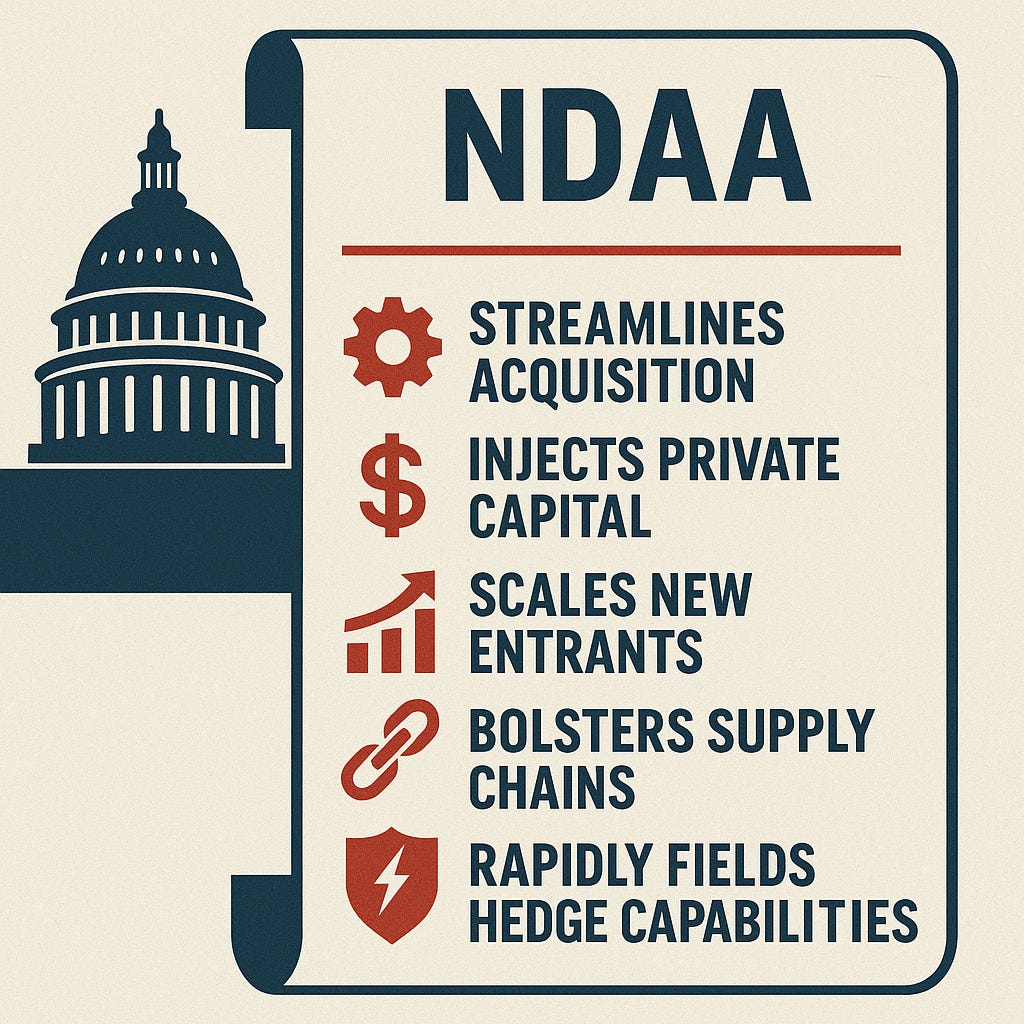
This legislation has been paired with a half a dozen executive orders focused on acquisition reforms, an Acquisition Transformation Strategy and additional SECWAR direction. To have the Senate, House, White House, and the Pentagon aligned on bold reforms to drive speed, agility, and a revitalized acquisition system and industrial base is a once-in-a-generation event. Now is the time to EXECUTE!
The NDAA passed the House by 312-112 on Dec 10 and is expected to pass the Senate with bipartisan support shortly.
The NDAA covered a wide-range of topics across the 3,096 pages of legislative text and 636-page Joint Explanatory Statement. We try to get to the heart of the changes here and pithily identify what changes acquisition professionals and industry partners should care the most about.
SHOUT OUT: We do want to give the PSMs in the SASC and HASC who worked tirelessly to make this happen. We know they likely took many angry phone calls, had to explain their reasoning a million times, had to adjust provisions over and over, and had to make compromise deals to get this to the finish line.
Outline
Quick Assessment
Our Top 10 Provisions in the FY26 NDAA
Best of the Rest in the FY26 NDAA
Acquisition | Contracting | Personnel | Testing | Programs | Logistics | Defense Industrial Base | Software and AI | Funding | Directed Limitations
What Got Lost from House and Senate Bills
Quick Assessment
While the PAEs are now established and get new authorities, this should be viewed as the first step in what will hopefully be a continued transfer of power to accountable and knowledgeable professionals who can work collaboratively with operational users and deliver capability fast. Without improved budget authority and congressional support for killing underperforming programs we worry that PAEs will not be as effective as they could be - and critics will use that to diminish the role. Need appropriator support for PAEs to deliver on the promise. We were disappointed to see the Major Capability Activity Area provision not make the final
This excerpt is provided for preview purposes. Full article content is available on the original publication.