Perhaps People Are Cynical About Success in the Creative Arts for a Reason
Deep Dives
Explore related topics with these Wikipedia articles, rewritten for enjoyable reading:
-
Astroturfing
12 min read
The author explicitly uses 'Astroturf' to describe the coordinated media campaign. Understanding the history and mechanics of astroturfing—fake grassroots campaigns in politics, marketing, and media—provides essential context for the author's argument about manufactured literary buzz versus organic success.
-
Manufacturing Consent
12 min read
Chomsky and Herman's propaganda model directly addresses how media coverage is shaped by institutional forces rather than pure merit—the core thesis of this article. The book's analysis of how powerful interests coordinate media narratives parallels the author's observations about coordinated book publicity.
-
Matthew effect
2 min read
The sociological concept that 'the rich get richer'—those with existing advantages accumulate more advantages—directly explains the dynamic the author describes: well-connected authors receive disproportionate coverage regardless of merit, while equally talented outsiders struggle for attention.
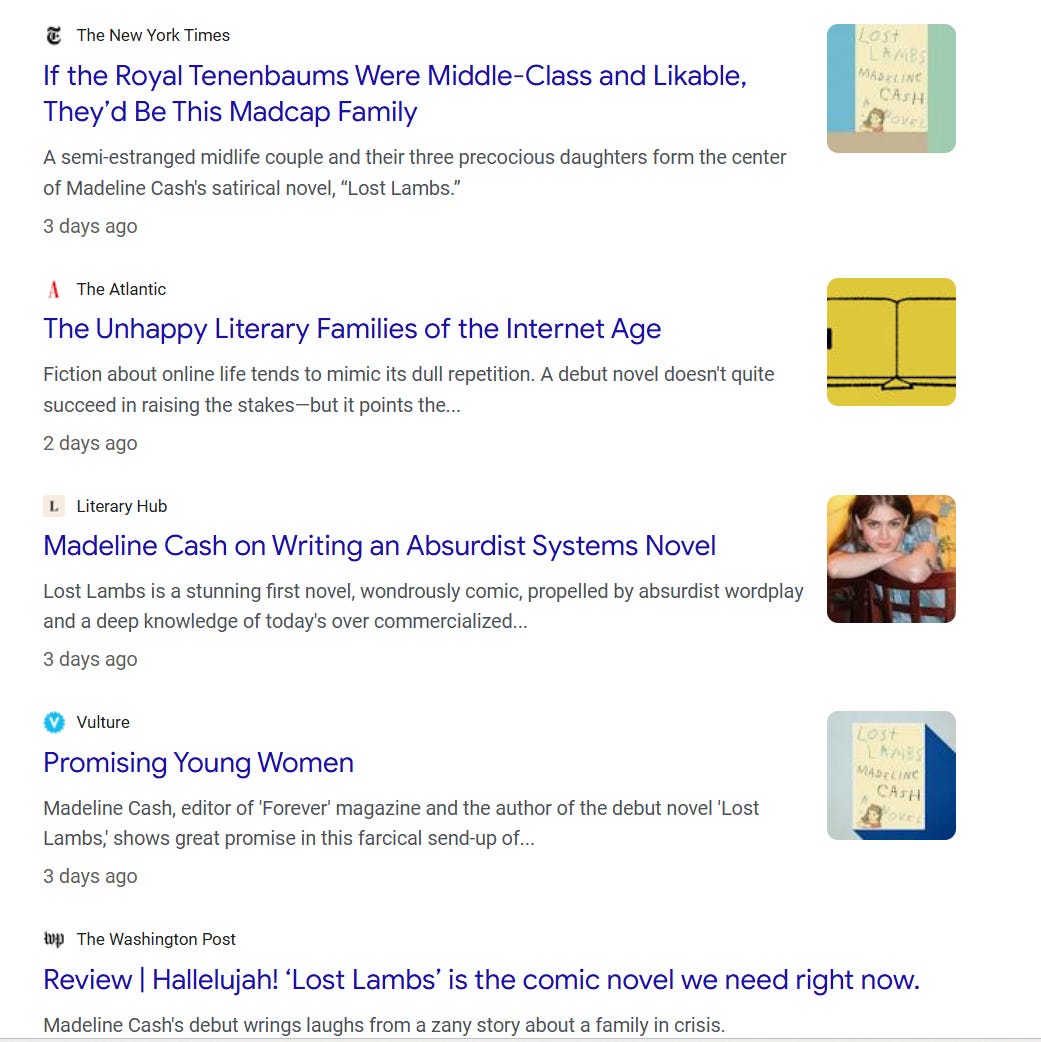
I am not unaware of the fact that this is a completely thankless, pointless thing to write, a piece which will do nothing for me and will not even effectively promote the perspective I’m sharing here. The backlash is too obvious. In the very unlikely event that this post escapes my modest readership and into the broader conversation, it will inevitably redound to the benefit of Ms. Cash here, not harm her. I am setting myself up for the easiest critique in the world, claims of being a jealous white man who can’t stand to see a girlboss winning etc etc. Writing this post is stupid, I am doing it against my own better judgment, I’m dumb.
But, look: the massive rollout for Madeline Cash’s Lost Lambs is a very good example of a coordinated media campaign that has been, to some degree and in some way, orchestrated from above. I don’t know the exact mechanism, but I can tell you for a fact that this level of immediate, simultaneous media penetration does not happen with literary fiction without people in positions of power making it happen. What you see above is positive coverage, running to fawning, in four of the ten-ish most important remaining legacy media publications in the world (Vulture, if you’re unaware, is a vertical of New York magazine) and the single most important and influential indie lit publication that’s still alive and kicking. The next Google result down, which I couldn’t fit in the screengrab, was from Vogue. (Do you want to take a guess at how much Vogue has covered literary fiction in the last decade?) Coverage of novels in legacy media, in general, is almost dead. This kind of coverage attends the publication of novels by maybe ten, maybe fifteen?, of the most celebrated writers of fiction in the world… and now the debut of Madeline Cash. And, for the record, the verbiage used in a lot of this coverage seems, well, implausibly similar. No, this is not a coincidence. This doesn’t just happen. An all-out blitz of this type, for a novel, is not an organic event. Somebody knows somebody. Her publisher is throwing their back behind this book to a massive degree, she’s hired a particularly powerful marketing firm, she’s the daughter of a billionaire, the right people owe her favors, some combination of those, whatever, idk. This coverage is
...This excerpt is provided for preview purposes. Full article content is available on the original publication.