India Accused This Canadian of a Terror Attack in Ottawa. Did the Incident Even Happen?
Deep Dives
Explore related topics with these Wikipedia articles, rewritten for enjoyable reading:
-
Khalistan movement
15 min read
The article centers on accusations tied to Khalistani separatism and protests for an independent Sikh homeland. Understanding the historical origins, key events like Operation Blue Star, and the ongoing political dimensions of this movement provides essential context for why India labels certain activists as terrorists.
-
Lawrence Bishnoi
11 min read
The article mentions Canadian authorities identified the Bishnoi gang in connection with crimes against Sikhs in Canada. This organized crime figure has been linked to transnational extortion and assassination plots, providing crucial context for understanding how criminal networks allegedly operate across borders in these cases.
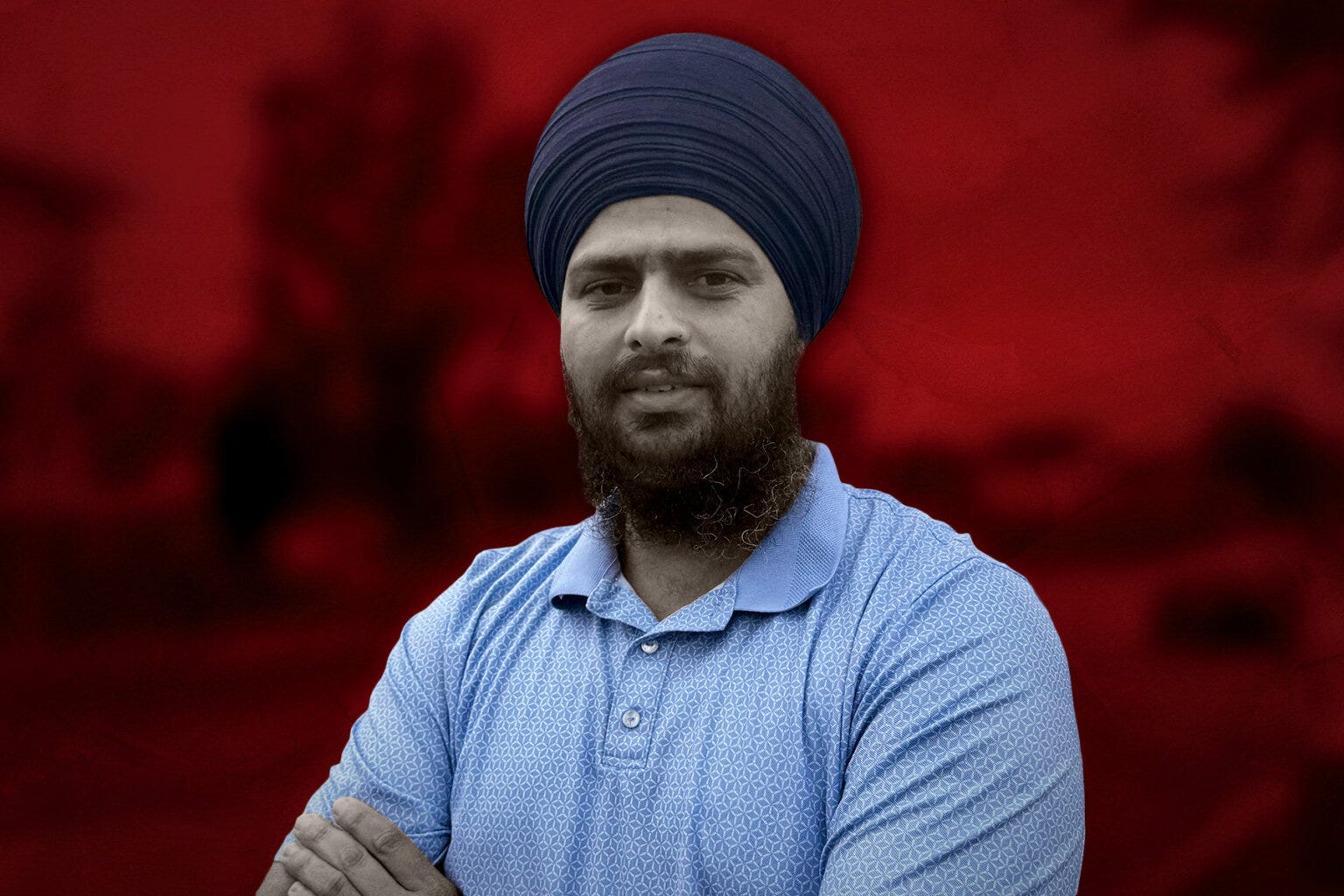
Amarjot Singh (Photo by Katharine Lake Berz / design: Emery Forbes)
This story was originally published on thewalrus.ca
The phone rang early that morning. Amarjot Singh, half asleep in his Montreal apartment, fumbled for his cell. On the line was a relative, calling from India, his voice urgent: Amarjot’s name was in the papers. India’s National Investigation Agency was after him.
Amarjot was being branded a terrorist. That day in June 2023, the Indian government accused him of leading a mob of protesters who allegedly threw two grenades into the country’s high commission in Ottawa during a Sikh protest three months earlier.
Amarjot was shocked. And worried. In March that year, the then thirty-year-old Canadian permanent resident (he is now a Canadian citizen) had attended a rally protesting the Indian government’s crackdown on civil liberties in Punjab. But Amarjot says it was a peaceful event. He hadn’t thrown anything. He wasn’t a political leader. He was a truck driver, a man of faith, and a father to a baby girl. He had attended the protest largely out of family loyalty, because his wife’s brother is a Sikh activist in India and some of the protesters were there to support him. How did attending a protest turn him into a man wanted for terrorism?
As Amarjot tried to understand how his name had become linked to a terror attack he hadn’t heard of, something far more chilling filled the headlines: a few days before, Hardeep Singh Nijjar, a prominent Sikh leader in Surrey, British Columbia, had been gunned down by masked men outside the gurdwara where he served as president. Many in Canada’s Sikh community believed the killing had all the markings of a political assassination—one ordered by the Indian state. That belief took hold quickly, sparked by Nijjar’s outspoken activism against what he saw as India’s human rights abuses and his involvement in the campaign for an independent Sikh homeland, Khalistan. It deepened after reports that he had been warned by the Canadian Security Intelligence Service about threats to his life linked to the Indian government. The Indian government had also labelled Nijjar a terrorist and offered a bounty of 1 million rupees, or roughly $16,000, for his capture.
Amarjot, suddenly branded a terrorist himself, worried he would be next. Haunted by this possibility, he assumed India had targeted him not for anything he’d done but
...This excerpt is provided for preview purposes. Full article content is available on the original publication.