Beware The Flood Of Trump Sentencing Disinformation
I just turned 54 and I’ve grown used to things hurting — lots of things hurting — first thing in the morning. However, I am unaccustomed to awakening only to be kicked right in the junk by the Washington Post before my morning coffee.
I refer to an appallingly bad Washington Post column about the hypothetical sentence Donald Trump faces based on his (to date) three pending criminal cases. When I awoke on Friday, about two dozen gleeful people had sent it to me in some sort of cruel exercise of modern bearbaiting.
The Washington Post column is inexcusable. Here’s why.
How Federal Sentencing Actually Works
In our recent Very Special Episode of Serious Trouble about how to be an informed and critical consumer of legal news, Josh Barro and I spent a long time discussing one of the most important things the media gets badly wrong: it reports the statutory maximum sentences defendants face as if those numbers had anything to do with the actual sentences the defendants face. They almost never do. Adding up all the statutory maximum sentences for all the counts charged in an indictment is an exercise in clickbait disinformation. I’ve been ranting about this for more than a decade but we are still here.
Here’s how federal sentencing works. The United States Probation Office, with the input of the parties, proposes a recommended sentence calculated using the United States Sentencing Guidelines. The Guidelines are extremely complex; calculating a sentence under them can be comparable to filling out a business’ tax return. Using the Guidelines yields two key numbers: a Criminal History Category (a number 1 through 6 representing the seriousness of the defendant’s criminal record) and an Offense Level (a number 1 through 43 representing the seriousness of the crimes of conviction). The parties can then object to the Probation Office’s calculations and make arguments to the court about whether and how the Probation Office got it wrong. Once the judge determines the Criminal History Category and Offense Level, he or she applies them to the Sentencing Table to generate a sentencing range in months:
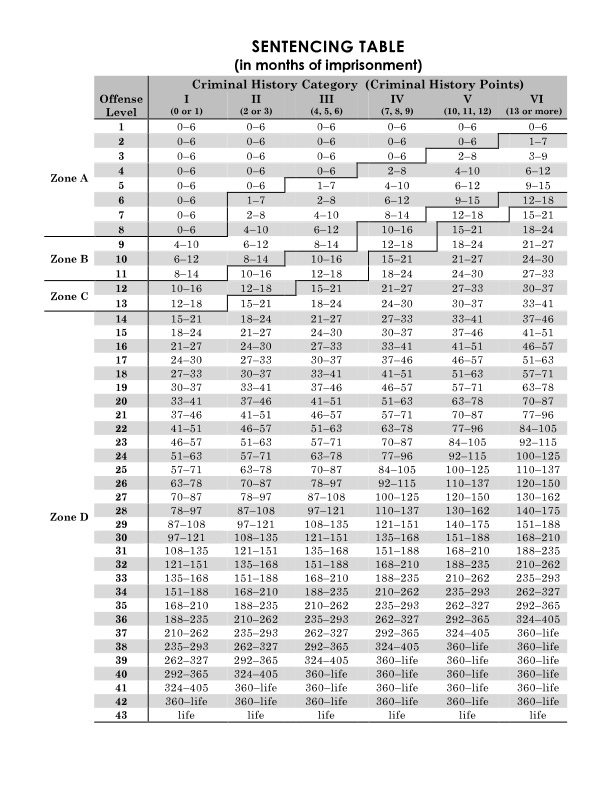
In the old days, the resulting sentencing range was mandatory and bound the court; in 2005 the Supreme Court ruled that the Guidelines could only be treated as a recommendation, not a mandate. So now federal judges treat the Guidelines sentence as a recommendation — a
...This excerpt is provided for preview purposes. Full article content is available on the original publication.