Socialists in City Hall? A New Look at Sewer Socialism in Wisconsin
Deep Dives
Explore related topics with these Wikipedia articles, rewritten for enjoyable reading:
-
Victor L. Berger
1 min read
The article centers on Berger as the founder of Milwaukee socialism, but readers may not know he was the first Socialist elected to US Congress, was denied his seat twice during WWI, or his complex relationship with Eugene Debs
-
Daniel De Leon
17 min read
The article contrasts Berger's pragmatic approach with De Leon's 'doctrinaire rigidity' but doesn't explain De Leon's influential Marxist theories or why his Socialist Labor Party strategy failed where Berger's succeeded
In 1910, Milwaukee’s socialists swept into office and they proceeded to run the city for most of the next fifty years. Though ruling elites initially predicted chaos and disaster, even Time magazine by 1936 felt obliged to run a cover story titled “Marxist Mayor” on the city’s success, noting that under socialist rule “Milwaukee has become perhaps the best-governed city in the US.”
This experience is rich in lessons for Zohran Mamdani and contemporary Left activists looking to lean on City Hall to build a working-class alternative to Democratic neoliberalism and Donald Trump’s authoritarianism. But the history of Milwaukee’s so-called sewer socialists is much more than a story simply about local Left governance. The rise and effectiveness of the town’s socialist governments largely depended on a radical political organization rooted in Milwaukee’s trade unions and working class.
Nowhere in the US were socialists stronger than in Milwaukee. And Wisconsin was the state with the most elected socialist officials as well as the highest number of socialist legislators (see Figure 1). It was also the only state in America where socialists consistently led the entire union movement — indeed, it was primarily their roots in organized labor that made their electoral and policy success possible, including the passage of 295 socialist-authored bills statewide between 1919 and 1931.
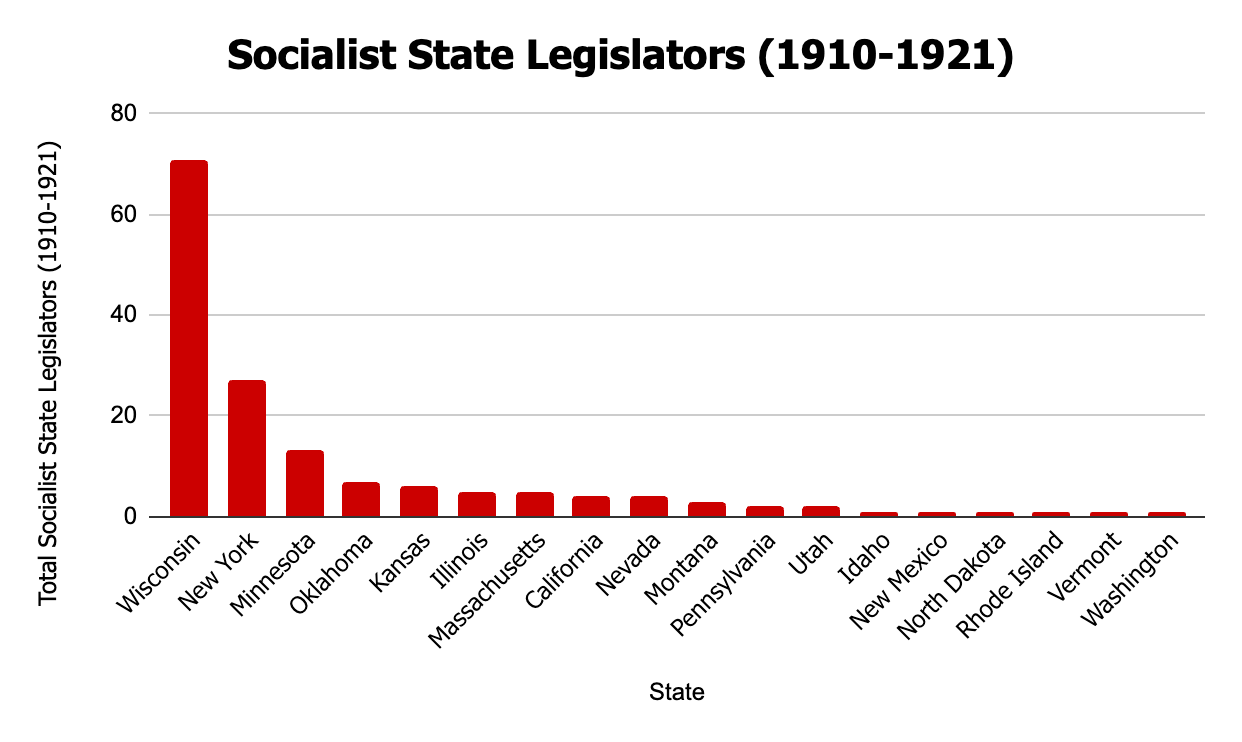
Contrary to what much of the literature on sewer socialism has suggested, the party’s growth did not come at the cost of dropping radical politics. That they didn’t get closer to overthrowing capitalism was due to circumstances outside of their control, including relatively conservative public opinion. And the fact that they did achieve so much was because they flexibly concretized socialist politics for America’s uniquely challenging context.
The Rise of Sewer Socialism
Sewer socialism’s rise was far from automatic or rapid. Though Milwaukee’s largely German working class was perhaps somewhat more open to socialist ideas than some other ethnicities, a quantitative study of pre-war US immigrant voting found that Germans were negatively correlated with socialist votes nationwide.
Figure 2 captures the party’s slow-but-steady rise over many decades. Here’s how the party’s founder, Victor Berger, described this dynamic in a speech following their big 1910 mayoral election victory:
...“It took forty years to get a Socialist Mayor and administration in Milwaukee since first a band of comrades joined together. … It
This excerpt is provided for preview purposes. Full article content is available on the original publication.